
Solitaire
How to play Mahjong Solitaire
Mahjong Solitaire is a matching game for one, played with the tiles of a mahjong set: take them off the table two at a time, in matching pairs, until none are left. It shares the tiles with Mahjong and nothing else of the game.
- Players
- 1
- Equipment
- A mahjong set: 72, 108 or all 144 tiles, by layout
- Goal
- Take every tile off the table in matching pairs
- Length
- One deal
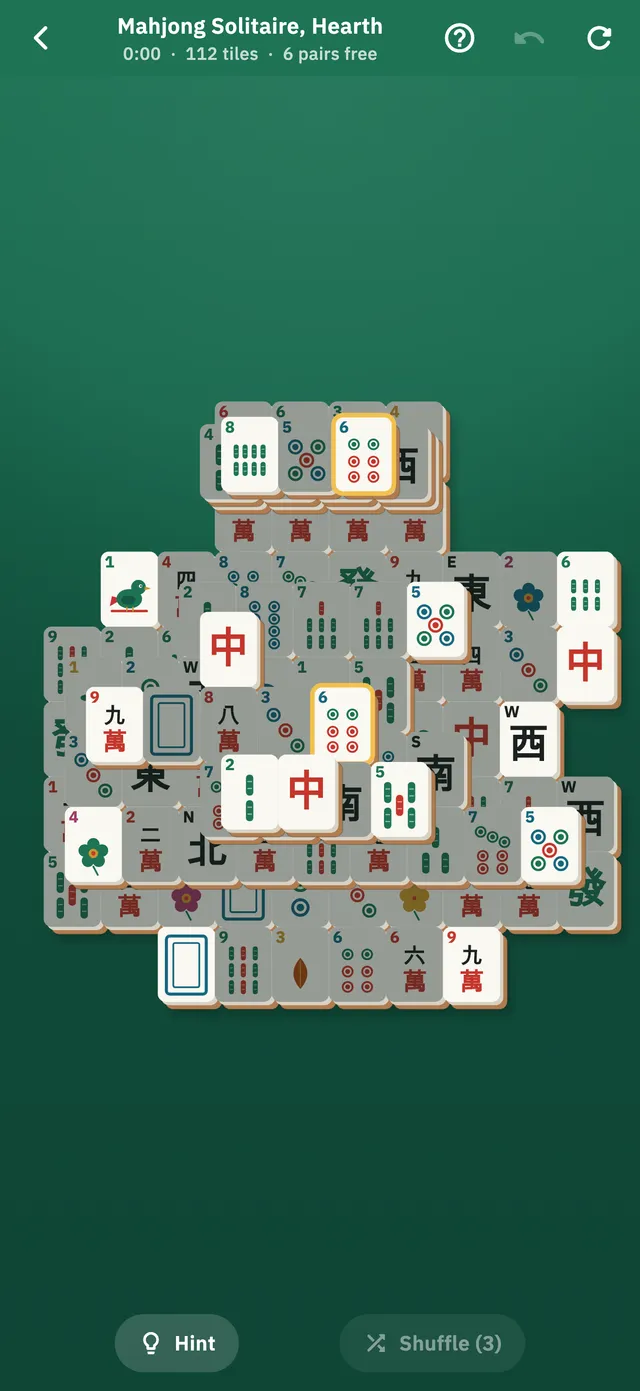
Play Mahjong Solitaire on your phone or tablet
We’re two brothers, and we made Fireside Classic Games to play Mahjong Solitaire by the rules on this page, along with 26 more classic games.


Play three games of Mahjong Solitaire free before you decide. After that, a monthly or yearly subscription unlocks every game, with the first month free for new subscribers, or a one-time purchase unlocks them for good. Klondike, Hearts, Checkers and Number Place are free for good.
- No ads, ever
- Works offline, with no connection needed
- No account to make
- Large, clear tiles that are easy to read
- Four layouts of our own, from 72 tiles to all 144, and every deal can be cleared
- Set the shuffles, turn undo off, or stop shading the tiles that are not free
On this page
The goal
Mahjong Solitaire is a game for one player. The tiles of a mahjong set are stacked in a layout several layers deep, and the goal is to take them all off the table, two at a time, in matching pairs.
It shares the tiles with Mahjong and nothing else: there are no hands to build, no discards and no other players.
The tiles
A full mahjong set has 144 tiles:
- three suits, dots, bamboo and characters, each numbered one to nine, with four of every tile;
- the four winds (east, south, west and north) and the three dragons (red, green and white), four of each;
- four flowers and four seasons, all different.
The two smaller layouts use part of the set.
Free tiles
You can only take a tile that is free. A tile is free when nothing lies on top of it, not even a corner of another tile, and its left side or its right side is clear. Only left and right count: the tiles above and below it in the picture are not its sides.
Pairs
Two free tiles make a pair when they are the same tile: two red dragons, two threes of bamboo. The flowers and seasons are looser: any two flowers make a pair, and so do any two seasons.
Tap a free tile, then its partner, and both come off the table.
Good to know
When three or four of the same tile are free, it can matter which two you take. Before you take a pair, look at what each tile is holding down.
The four layouts
Fireside’s layouts are our own, shaped to fit a phone held either way up. You choose one under Set Difficulty, and each keeps its own record.
| Layout | Tiles | How it is built |
|---|---|---|
| Garden | 72 | Two layers, nearly all of them in reach; 56 tiles on the bottom layer |
| Lantern | 108 | Three layers; 62 tiles on the bottom layer |
| Pagoda | 144 | The full set, stacked four high; 72 tiles on the bottom layer |
| Hearth | 144 | The full set, five high around a chimney that buries a great deal; 64 tiles on the bottom layer |
Every deal can be cleared
Fireside builds each deal backward from an empty table, one pair at a time, so a way through to the last tile always exists. When a game ends with tiles left, a choice along the way closed it off, usually taking two of a kind while the other two were still buried, when it mattered which two.
With undo, you can take pairs back as far as you like to find that choice.
When no pair is left
If no free pair is left, the standard rule lets you shuffle the tiles still on the table, three times a game. A shuffle deals them out again among the same places, with a way through whenever the shape of what is left allows one. After the third shuffle, no pair left ends the game.
A shuffle cannot be taken back, and it clears the list of pairs you could undo. Fireside’s Shuffle button shows how many shuffles you have left.
How a game ends
You win when the table is clear. A game is lost when no pair is left and no shuffle remains, and starting a new deal partway through one counts as a loss too.
There are no points. The bar at the top shows a clock, the tiles left and how many pairs are free, and a win shows your time, the layout and the deal number, with a button to play the same deal again.
The house rules people argue about
People play Mahjong Solitaire more or less forgivingly: with or without shuffles, with or without taking a pair back, and with the free tiles pointed out or not. Fireside lets you set all three on the House Rules sheet, once Default is off, and choose the layout under Set Difficulty.
-
Which layout do you play?
The layout is the difficulty: more tiles and taller stacks bury more of them.
- Garden Where Fireside starts 72 tiles on two layers, nearly all of them in reach.
- Lantern 108 tiles on three layers.
- Pagoda The full set of 144, stacked four high.
- Hearth All 144, five high around a chimney that buries a great deal.
In Fireside: Set Difficulty, which asks “Which layout?”
-
What happens when no pair is left?
Shuffles decide whether a game can be lost by running out of pairs, or only by giving it up.
- Three shuffles Fireside’s standard Deal the tiles left out again, three times a game. After the third, no pair left ends it.
- Shuffle every time A shuffle whenever you are stuck, as often as it happens: a deal is only lost by giving it up.
- No shuffles The strict, old rule: no pair left is the end of the game.
In Fireside: House Rules, with Default turned off.
-
Can you take a pair back?
Undo lets you go back and find the choice that closed a game off. Without it, every pair is final, as it would be with real tiles.
- Undo allowed Fireside’s standard Put pairs back as far as you like, to find the choice that closed a game off.
- No undo A pair taken stays taken, as it would on a real table.
In Fireside: House Rules, with Default turned off.
-
Are tiles that are not free yet shaded?
Shading makes the free tiles stand out. Without it, telling which tiles are free is part of the game.
- Shaded Fireside’s standard Tiles that cannot be taken yet are dimmed, so the free ones stand out.
- Not shaded Every tile looks the same, and telling which are free is up to you. Tap a tile that is not free and Fireside says why.
In Fireside: House Rules, with Default turned off.
Fireside deals every game at its standard rules, the ones this page teaches, until you change them. To play your own way, open Mahjong Solitaire in the app, tap House Rules, turn off Default and choose. Your table stays as you set it, on your device, and the rules, the lesson and the practice game all follow it.
Learn it in Fireside
Under How to Play, Mahjong Solitaire has its rules sheet, a deal to watch and a deal to practice, and all three follow your table: the layout, the shuffles, undo and shading.
Watch a Deal clears one real deal a pair at a time, with each pair ringed and the reason it was the right one.
Practice Deal gives you a real deal with a coach on the help button that names the pair it would take and says why, and nothing counts toward your record.
Quick answers
Which tiles match in Mahjong Solitaire?
Two identical tiles, such as two red dragons or two threes of bamboo. The bonus tiles are looser: any two flowers make a pair, and so do any two seasons.
What makes a tile free in Mahjong Solitaire?
Nothing lies on top of it, not even a corner of a tile, and its left side or its right side is clear. The tiles above and below it in the picture do not count as its sides.
Can every game of Mahjong Solitaire be won?
In Fireside, yes: every deal is built backward from an empty table, so a way to clear it always exists. A game that ends with tiles left was closed off by a choice along the way.
What happens when there are no matches left?
In Fireside’s standard game you may shuffle the tiles left on the table, three times a game. House rules allow a shuffle every time you are stuck, or none at all.
Is Mahjong Solitaire the same game as Mahjong?
No. It uses the same tiles, but it is a matching game for one. Mahjong itself is a game for four players who build hands from the tiles, and Fireside has that too, played by Hong Kong rules.