
Board and tile games
How to play Hong Kong Mahjong
Hong Kong Mahjong is the four-player tile game as it is played at home across southern China and Hong Kong: draw and discard until your tiles make four sets and a pair, worth enough faan to be allowed to win. It is not American Mah Jongg, the game played from a card of hands that changes every year.
- Players
- 4, every player for themselves
- Equipment
- A 144-tile set with flowers and seasons
- Goal
- Four sets and a pair, worth at least 3 faan
- Length
- The east round, or a full game of four rounds
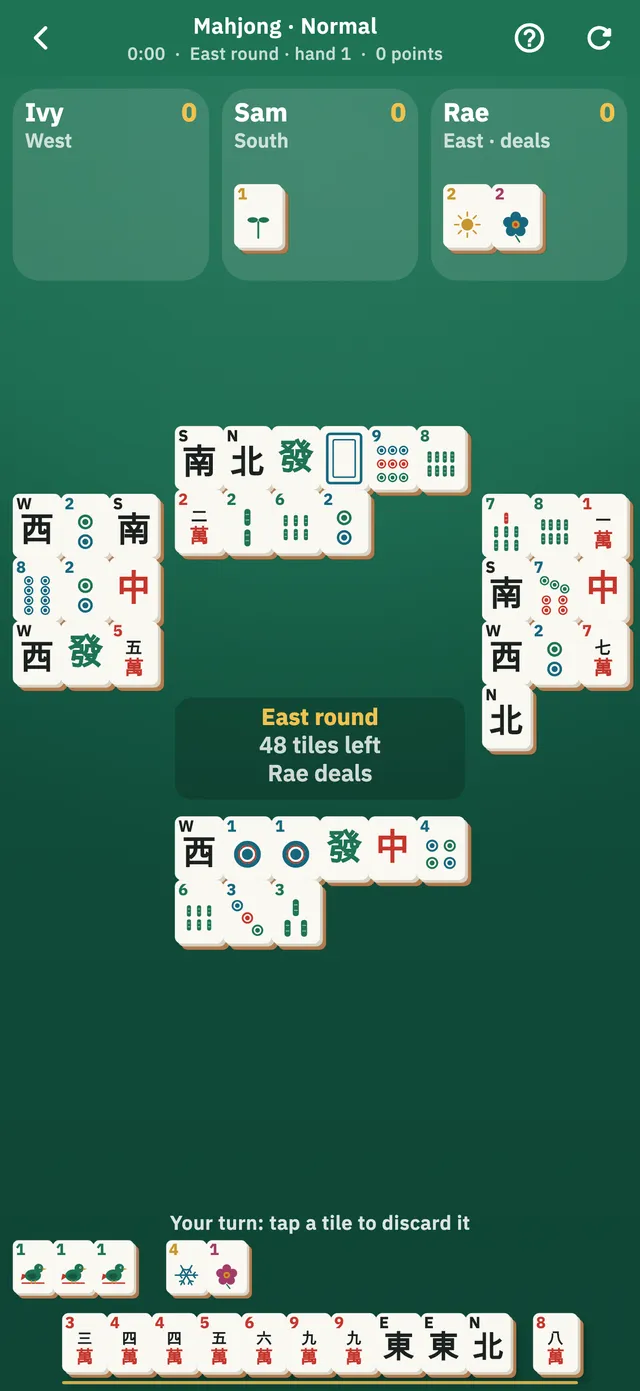
Play Hong Kong Mahjong on your phone or tablet
We’re two brothers, and we made Fireside Classic Games to play Hong Kong Mahjong by the rules on this page, along with 26 more classic games.


Play three games of Hong Kong Mahjong free, at Easy, Normal or Hard, before you decide. After that, a monthly or yearly subscription unlocks every game at every level, Expert included, with the first month free for new subscribers, or a one-time purchase unlocks them for good. Klondike, Hearts, Checkers and Number Place are free for good.
- No ads, ever
- Works offline, with no connection needed
- No account to make
- Large, clear tiles that are easy to read
- Four levels of computer opponent, from Easy to Expert, each described before you start
- Set the faan a hand needs, who pays for a discard, whether seven pairs wins and who deals after a hand nobody wins
On this page
The tiles
A Hong Kong set has 144 tiles:
| Tiles | What they are | How many |
|---|---|---|
| Dots, bamboo, characters | Three suits, each numbered 1 to 9, four of every tile | 108 |
| Winds | East, South, West and North, four of each | 16 |
| Dragons | Red, green and white, four of each | 12 |
| Flowers and seasons | Bonus tiles numbered 1 to 4, one of each | 8 |
The winds and dragons are the honors. The ones and nines of the three suits are the terminals.
Good to know
Fireside prints a number or letter in the corner of every tile, and a tap on anybody’s sets or discards shows them full size.
The goal
Be the first to turn your hand into four sets and a pair. A set is one of these:
- A chow: three in a row in one suit, such as the 4, 5 and 6 of bamboo. Honors cannot make chows.
- A pung: three of a kind.
- A kong: four of a kind.
The pair is two of a kind. The hand must also count enough faan, the points a hand earns for its patterns. At Fireside’s standard table, a hand needs at least 3.
The wall and the deal
The tiles are shuffled face down into the wall. Every tile is drawn from its front, except replacement tiles, which come from the back.
The dealer sits East, and the other players are South, West and North in the order of play. Everybody takes 13 tiles, and then the dealer draws a 14th and makes the first discard.
A flower or season dealt to you is set aside face up and replaced from the back of the wall.
A turn
Play goes to the right. On your turn, draw a tile from the wall, then discard one face up in front of you.
If the tile you draw completes a winning hand, declare the win instead: that is a self-drawn win.
Claiming a discard
A discard may be claimed before the next player draws:
- Anybody may claim it to win.
- Anybody holding two more of it may claim it for a pung, or holding three more, for a kong.
- Only the next player in turn may claim it for a chow.
A win beats a pung or a kong, and a pung beats a chow. If two players could win on the same tile, the first in turn after the discarder takes it.
The claimed tile and the tiles that go with it are laid out face up as a set. Play carries on from whoever claimed it: they discard, and the turn passes on from them.
Kongs
Four of a kind is a kong, and it counts as one set. Claim one from a discard, declare one from your own hand after you draw, or add the fourth tile to a pung you laid out earlier. Each time, draw a replacement tile from the back of the wall before you discard.
A tile added to a pung can be taken by any player it wins for. That is robbing the kong.
Flowers and seasons
A flower or season is set aside face up the moment you draw it, and you draw a replacement from the back of the wall. Bonus tiles are never part of a set.
The flower and the season that carry your seat’s number, 1 for East, 2 for South, 3 for West and 4 for North, each count 1 faan if you win.
Winning
Four sets and a pair wins. So does thirteen orphans: one each of the six terminals, the four winds and the three dragons, with a second of any one of them. Seven pairs does not win at Fireside’s standard table.
A hand must also count at least 3 faan to be allowed to win. Short of that it is not a winning hand at all, and you play on.
If the wall runs out before anybody wins, nobody wins the hand and nobody pays.
Faan
Faan are what a hand counts. A hand adds up every faan it earns, to a limit of 10, and each faan roughly doubles what the hand is paid.
| Hand | Faan |
|---|---|
| Thirteen orphans, all honors, all terminals, all kongs, nine gates, or four winds | Limit (10) |
| Heavenly hand: the dealer wins on the deal | Limit (10) |
| Earthly hand: another player wins on the dealer’s first discard | Limit (10) |
| Big three dragons: a pung or kong of each dragon | 8 |
| Pure one suit: one suit and no honors | 7 |
| Small three dragons: two dragon pungs and a dragon pair | 5 |
| Mixed one suit: one suit with honors | 3 |
| All pungs: no chows | 3 |
| A pung of dragons | 1 each |
| A pung of your seat’s wind, or of the round’s wind | 1 each |
| All chows | 1 |
| Concealed hand: no set made from a claimed discard | 1 |
| Self-drawn win | 1 |
| Winning on the wall’s last tile or the discard after it, on a replacement tile, or by robbing a kong | 1 each |
| Your own flower or season | 1 each |
| No bonus tiles at all | 1 |
| All four flowers, or all four seasons | 2 more |
Four winds means pungs of all four winds, or of three with a pair of the fourth. Nine gates is 1, 1, 1, 2, 3, 4, 5, 6, 7, 8, 9, 9, 9 of one suit, all in your hand, plus any other tile of that suit. All terminals is a hand of nothing but ones and nines.
Good to know
Big and small three dragons already include their dragon pungs, so those do not count again. Fireside scores every hand the way that counts the most.
Paying
A hand is paid in points, by its faan:
| Faan | Points |
|---|---|
| 0 | 1 |
| 1 | 2 |
| 2 | 4 |
| 3 | 8 |
| 4 | 16 |
| 5 | 24 |
| 6 | 32 |
| 7 | 48 |
| 8 | 64 |
| 9 | 96 |
| 10 (the limit) | 128 |
A self-drawn win is paid that much by each of the other three players. A win on a discard is paid double by the player who discarded the tile, and nobody else pays; robbing a kong is paid the same way, by the player who added the tile.
So a 3-faan hand won on a discard collects 16 from the discarder, and the same hand self-drawn collects 8 from each of the other three, 24 in all.
Deals and rounds
The dealer keeps the deal after winning, and after a hand nobody wins. Otherwise the deal passes to the right, and that player becomes East.
Fireside’s standard game is the east round, which ends once every player has dealt and lost the deal: four hands at the least. A full game plays four rounds, east, south, west and north, and the round’s wind changes each time the deal goes all the way around.
Whoever has the most points at the end wins the game.
Good to know
So that a dealer on a long run cannot keep a game going forever, Fireside ends the east round after 12 hands at most, and a full game after 48.
The house rules people argue about
Hong Kong tables agree on the tiles and the sets, and argue about the rest: how many faan a hand needs, who pays for a discard, whether seven pairs wins. Fireside plays the usual Hong Kong rules, and lets your table change each of these.
-
How long is a game?
One round is a sitting in which everybody deals; four rounds bring each wind around as the round’s wind.
- The east round Where Fireside starts Everybody deals, and keeps the deal until they lose it. Four hands at the least.
- A full game All four rounds, east, south, west and north, the way a table plays an evening.
In Fireside: Set Difficulty, under The game
-
How many faan must a hand count to win?
A minimum makes players build hands worth something, instead of racing to any four sets and a pair.
- Three Fireside’s standard A hand must count 3 faan to be allowed to win. The usual Hong Kong minimum.
- One One faan is enough: a quicker, looser game.
- Any hand Four sets and a pair wins, however little it counts.
In Fireside: House Rules, with Default turned off.
-
Who pays for a win on a discard?
Making the discarder pay alone punishes a careless discard; sharing the bill softens it.
- The discarder pays Fireside’s standard Whoever let the tile go pays double, and nobody else pays.
- Everybody pays The discarder pays double and the other two pay once each.
In Fireside: House Rules, with Default turned off.
-
Does seven pairs win?
Many tables allow it and many do not, and a hand full of pairs depends on the answer.
- Not a winning hand Fireside’s standard Four sets and a pair, or thirteen orphans, and nothing else.
- Wins, for four faan Seven different pairs win too, as many tables allow, with nothing laid out. Four of a kind counts as one pair, not two.
In Fireside: House Rules, with Default turned off.
-
When nobody wins a hand, who deals next?
Keeping the deal lets a dealer’s run go on; passing it keeps the game moving around the table.
- The dealer deals again Fireside’s standard A hand nobody wins does not cost the dealer the deal.
- The deal passes on The deal moves to the right, as if the dealer had lost.
In Fireside: House Rules, with Default turned off.
Fireside deals every game at its standard rules, the ones this page teaches, until you change them. To play your own way, open Hong Kong Mahjong in the app, tap House Rules, turn off Default and choose. Your table stays as you set it, on your device, and the rules, the lesson and the practice game all follow it.
Learn it in Fireside
How to Play holds the rules sheet, with the faan and the payments as your table’s house rules set them; the lesson and the practice game follow the same rules.
Watch a Hand shows one real hand from your seat, with the reason for every discard and every claim; there is nothing to play.
Practice Hand is a real game with a coach on the help button that says what it would discard or claim and why. Nothing is counted.
Quick answers
How many tiles are in a Hong Kong mahjong set?
144: three suits of dots, bamboo and characters numbered 1 to 9, with four of each tile; four winds and three dragons, four of each; and eight bonus tiles, four flowers and four seasons.
How many tiles does each player get in mahjong?
13. On your turn you draw a 14th and then discard, and a winning hand is four sets and a pair: 14 tiles, plus one more for each kong.
What is faan in mahjong?
Faan are what a Hong Kong hand counts: points for its patterns, such as a pung of dragons or a hand all in one suit. Each faan roughly doubles what the hand is paid, up to a limit of 10, and at Fireside’s standard table a hand needs 3 faan to win.
Can you claim a discard for a chow from anyone?
No. Anybody may claim a discard to win, or for a pung or a kong, but only the next player in turn may claim it for a chow.
What happens if nobody wins a hand of mahjong?
When the wall runs out with no winner, nobody pays. In Fireside’s standard game the dealer then deals again; a house rule passes the deal on instead.