
Card games
How to play Pinochle
Pinochle is a bidding game played with a 48-card pack that holds every card twice. You bid for the right to name trumps, score the combinations in your hand, then play for the points in the tricks.
- Players
- 4, in two partnerships, or 3 each for themselves
- Equipment
- A 48-card pinochle pack: 9 through ace, every card twice
- Goal
- Make your bid in meld and tricks, and reach 1500 first
- Length
- To 1500 points (usually 10 to 15 hands), or to 1000
Play Pinochle on your phone or tablet
We’re two brothers, and we made Fireside Classic Games to play Pinochle by the rules on this page, along with 26 more classic games.


Play three games of Pinochle free, at Easy, Normal or Hard, before you decide. After that, a monthly or yearly subscription unlocks every game at every level, Expert included, with the first month free for new subscribers, or a one-time purchase unlocks them for good. Klondike, Hearts, Checkers and Number Place are free for good.
- No ads, ever
- Works offline, with no connection needed
- No account to make
- Large, clear cards that are easy to read
- Four levels of computer opponent, from Easy to Expert, each described before you start
- Play with a partner or three-handed, to 1500 or 1000, and pick the lowest bid and whether the kitty is shown
On this page
The goal
Pinochle is usually played four-handed, two against two, with partners sitting across from each other. In Fireside you and Sam play Ivy and Rae. Each hand starts with an auction: the side that bids highest names the trump suit (the suit that beats all the others), then has to score at least its bid. Points come from meld, the scoring combinations in a player’s hand, and from the cards won in tricks, one card from each player in turn.
The first side to reach 1500 points wins. Fireside also plays three-handed Pinochle, every player for themselves; it is explained at the end.
The pack
A pinochle pack has 48 cards: the ace, ten, king, queen, jack and nine of each suit, two of each. The ten is the surprise. It ranks second, above the king, so every suit runs ace, ten, king, queen, jack, nine.
The deal
The dealer deals all 48 cards, 12 to each player, with nothing left over. The deal moves one seat to the left after every hand.
Bidding
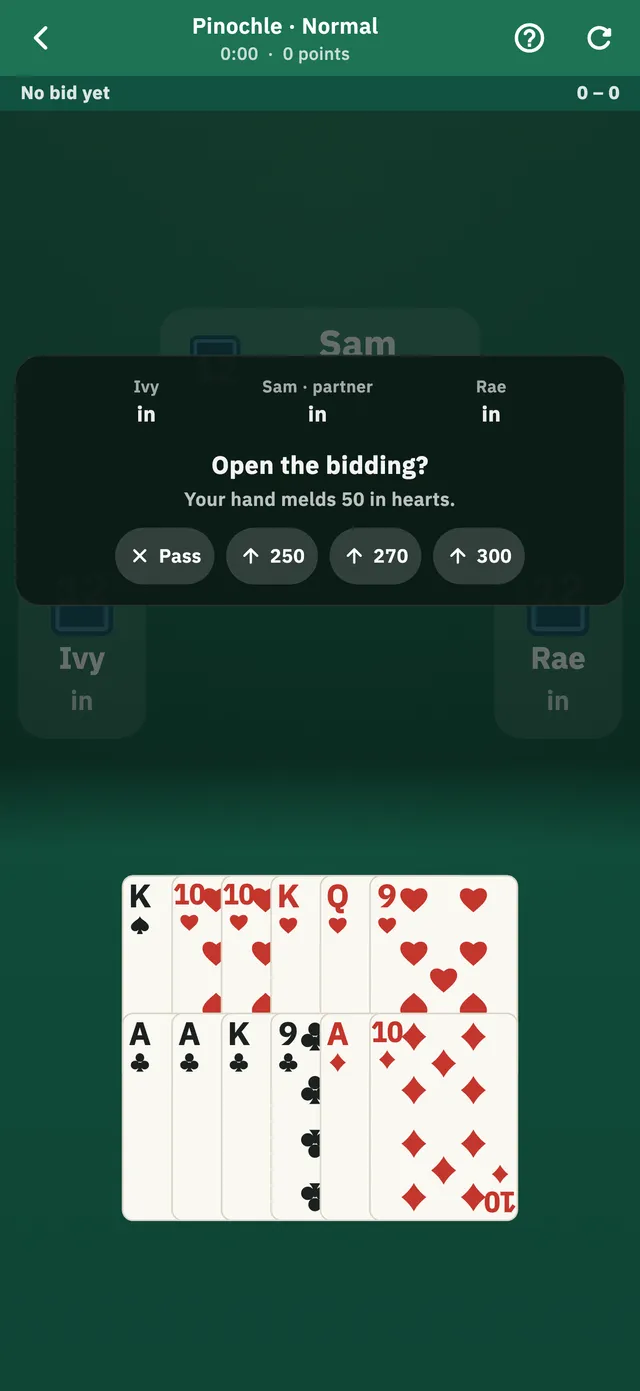
The player to the dealer’s left speaks first, and the auction goes around the table. On your turn you bid or pass. The first bid is at least 250, and every bid after it must be higher, in steps of 10; you may jump. Once you pass, you are out of the auction for good.
The last player still in when the others have passed wins the contract: their bid is what their side must now make. That player names trumps. If nobody bids at all, the dealer is stuck with the contract at 250 and names trumps.
The tricks hold 250 points in all, so even the opening bid counts on some meld. Your partner’s meld counts toward your contract too.
Meld
Once trumps are named, every player scores the meld in their hand: the combinations in the table below. Every side scores its meld, not just the side holding the contract, and partners add theirs together. Fireside counts it for you and shows each side’s total before the first card is played.
| Meld | Cards | Points | Held twice |
|---|---|---|---|
| Run | Ace, ten, king, queen and jack of trumps | 150 | 1500 |
| Royal marriage | King and queen of trumps | 40 | 80 |
| Marriage | King and queen of any other suit | 20 | 40 |
| Dix | Nine of trumps | 10 | 20 |
| Pinochle | Queen of spades and jack of diamonds | 40 | 300 |
| Aces around | One ace of each suit | 100 | 1000 |
| Kings around | One king of each suit | 80 | 800 |
| Queens around | One queen of each suit | 60 | 600 |
| Jacks around | One jack of each suit | 40 | 400 |
Held twice means holding both copies of every card in the meld. A double run, a double pinochle and double arounds are worth far more than twice the single meld; two marriages in one suit are simply two marriages.
One card can count in melds of different kinds, but only once within a kind. The kinds are the trump melds (run, marriages and dix), the pinochle, and the arounds. So the queen of spades can sit in a marriage, the pinochle and queens around all at once.
Good to know
The king and queen inside a run are part of the run. A royal marriage on top of a run needs a second king and queen of trumps, and scores 150 plus 40.
Throwing the hand in
With the meld on the table and before the first card is played, the side holding the contract may give the hand up instead of playing it out. That side is set: the bid comes off its score, exactly as if it had played and failed. The other side scores its meld and no trick points at all.
Throwing in makes sense when the contract cannot be made. Playing it out anyway hands the other side the trick points on top of the set.
Good to know
In Fireside, Throw it in sits beside Play whenever your side holds the contract, and it lights up once even every trick point still to come could not make the bid.
Playing the tricks
The player who won the contract leads the first trick. Each player in turn plays one card, and the four cards together are a trick. What you may play is strictly set:
- If you hold the suit led, you must play it, and you must beat the card that is winning the trick if you can. (If somebody has already trumped, any card of the suit led will do.)
- If you have none of the suit led, you must play a trump, and beat the highest trump in the trick if you can.
- Only when you hold neither the suit led nor a trump may you play any card.
The highest trump wins the trick. If no trump was played, the highest card of the suit led wins. When two identical cards tie for best, the one played first wins, and the winner of each trick leads the next.
Trick points
| Card | Points |
|---|---|
| Ace | 11 |
| Ten | 10 |
| King | 4 |
| Queen | 3 |
| Jack | 2 |
| Nine | 0 |
That makes 240 points in the pack. Taking the last trick earns 10 more, so every hand has 250 trick points to win.
Scoring a hand
When the last trick is taken, each side adds its meld to its trick points.
- The side holding the contract scores its meld and trick points in full if together they reach the bid. If they fall short, the side is set: it scores nothing for the hand, and the whole bid comes off its score.
- The other side scores its meld and trick points, whatever happens to the contract.
- A side that takes no trick at all loses its meld. If that is the side holding the contract, it is set.
Say you and Sam win the contract at 300 with 120 in meld between you, so you need 180 trick points. Take 190 and you score 310; take 170 and you are set, losing 300. Either way, Ivy and Rae score their own meld plus the trick points they took. Scores can go below zero.
How the game ends
The first side to reach 1500 points wins the match. If both sides get there on the same hand, the side that held the contract wins.
Three-handed Pinochle
Three can play with no partners, each scoring for themselves. Everything above holds, with these changes:
- The deal. Each player gets 15 cards, and the last three go face down in the middle as the kitty.
- The kitty. When the auction ends, the kitty is turned face up for everyone to see. Whoever holds the contract, a stuck dealer included, takes it into their hand and then names trumps.
- The bury. The bidder then puts any three cards back face down. They are out of the play, but their trick points count for the bidder at the end of the hand. Meld is read only after the bury, so a buried card cannot meld.
- Scoring. The bidder needs meld and trick points, the bury included, to reach the bid. Each of the other two scores their own meld and trick points, and a player who takes no trick loses their meld. If the bidder throws the hand in, each of the others scores just their meld.
- Winning. The first player to 1500 wins. If more than one gets there on the same hand, the bidder wins if they are one of them; if not, the higher score wins.
Good to know
Burying is how you empty a suit. With none of it left in your hand, you can trump that suit the first time it is led.
The house rules people argue about
Pinochle tables differ on how low the bidding may start and, when three play, whether everyone sees the kitty. Fireside lets each table choose, along with the table itself: partners or three-handed, and how long a match runs. Turn Default off on the House Rules sheet to change them.
-
Partners or three-handed, and how long a match?
The size of the table changes the game: four-handed you bid with a partner’s meld behind you, three-handed you play alone with a kitty to win. The match length decides how much one bad hand costs.
- Partners, to 1500 Fireside’s standard You and Sam against Ivy and Rae. The standard match, usually 10 to 15 hands.
- Partners, to 1000 Shorter, and being set once is much harder to come back from.
- Three-handed, to 1500 No partner. Fifteen cards each, three in the kitty for whoever holds the contract, and every hand for itself.
- Three-handed, to 1000 The same game over a shorter match. One bad contract can decide it.
In Fireside: House Rules, with Default turned off.
-
What is the lowest bid?
Every hand has a contract either way, because the dealer is stuck when nobody bids. The floor decides how hard that contract is to make.
- Two hundred and fifty Fireside’s standard The usual floor. With 250 points in the tricks, any bid at all counts on some meld.
- Two hundred A stuck dealer has a real chance of making it, and a hand with modest meld can bid on purpose instead of passing and hoping.
In Fireside: House Rules, with Default turned off.
-
When three play, is the kitty shown to everyone?
Seeing the kitty tells the other two players where three cards went, which is most of what makes the three-handed game a counting game. Fireside asks this only at a three-handed table.
- Turned face up Fireside’s standard Shown to the table before the bidder takes it, so everyone knows those three cards.
- Face down Only the bidder ever sees it, and keeps the whole advantage of it.
In Fireside: House Rules, with Default turned off.
Fireside deals every game at its standard rules, the ones this page teaches, until you change them. To play your own way, open Pinochle in the app, tap House Rules, turn off Default and choose. Your table stays as you set it, on your device, and the rules, the lesson and the practice game all follow it.
Learn it in Fireside
How to Play opens with the rules sheet, written for the table you have set: it gives your lowest bid and your target, and at a three-handed table it explains the kitty and the bury.
Watch a Hand plays one real deal a step at a time, with the reason for every card, and asks nothing of you.
Practice Hand lets you play a real hand with everybody’s cards readable, while the coach on the help button says what each card you can play would do. Nothing is counted, and all three follow the house rules in force.
Quick answers
How many cards do you deal in Pinochle?
Four-handed, all 48 cards go out, 12 to each player, with nothing left over. Three-handed, each player gets 15 and the last three form the kitty for whoever holds the contract.
What is a pinochle worth?
The queen of spades with the jack of diamonds is a pinochle, worth 40 in meld. Holding both of each, a double pinochle, is worth 300.
What is the minimum bid in Pinochle?
In Fireside’s standard game the bidding opens at 250 and rises in tens; a house rule lowers the floor to 200. If nobody bids, the dealer is stuck with the contract at the floor.
How many points are in a pinochle deck?
The cards carry 240 trick points: aces 11, tens 10, kings 4, queens 3, jacks 2 and nines nothing. The last trick earns 10 more, so each hand has 250 trick points to win, before any meld.
What happens if you don’t make your bid in Pinochle?
Your side is set: neither your meld nor your trick points count, and the whole bid comes off your score. The other side still scores its own meld and trick points.