
Card games
How to play Spades
Spades is the trick-taking game where spades are always trump: say how many tricks you will take, then take at least that many, and not many more. This is the whole game as Fireside plays it, with a partner or on your own.
- Players
- 4, in two partnerships, or each alone
- Equipment
- One standard 52-card deck
- Goal
- Make your bid without piling up extra tricks
- Length
- First to 500 points, about 10 hands
Play Spades on your phone or tablet
We’re two brothers, and we made Fireside Classic Games to play Spades by the rules on this page, along with 26 more classic games.


Play three games of Spades free, at Easy, Normal or Hard, before you decide. After that, a monthly or yearly subscription unlocks every game at every level, Expert included, with the first month free for new subscribers, or a one-time purchase unlocks them for good. Klondike, Hearts, Checkers and Number Place are free for good.
- No ads, ever
- Works offline, with no connection needed
- No account to make
- Large, clear cards that are easy to read
- Four levels of computer player, from Easy to Expert, each described before you start
- Pick partners or solo, 500 or 250, what bags cost and whether blind nil is allowed
On this page
The goal
Spades is a game for four players. In the standard game you play in two partnerships, with partners sitting across the table from each other: in Fireside, you and Sam against Ivy and Rae.
Every hand is played in tricks. A trick is one card from each player, played in turn, and whoever wins it collects the four cards and leads the next trick. Spades are always trump: any spade beats any card of another suit.
Before the play, everyone bids the number of tricks they expect to take. Your side scores well for making its bid and loses points for missing it, and in the standard game too many extra tricks cost you as well. The first side to 500 points wins.
The deal
Spades uses one standard 52-card deck, with aces high. The dealer deals out the whole deck, so each player holds 13 cards, and the deal passes to the left after every hand.
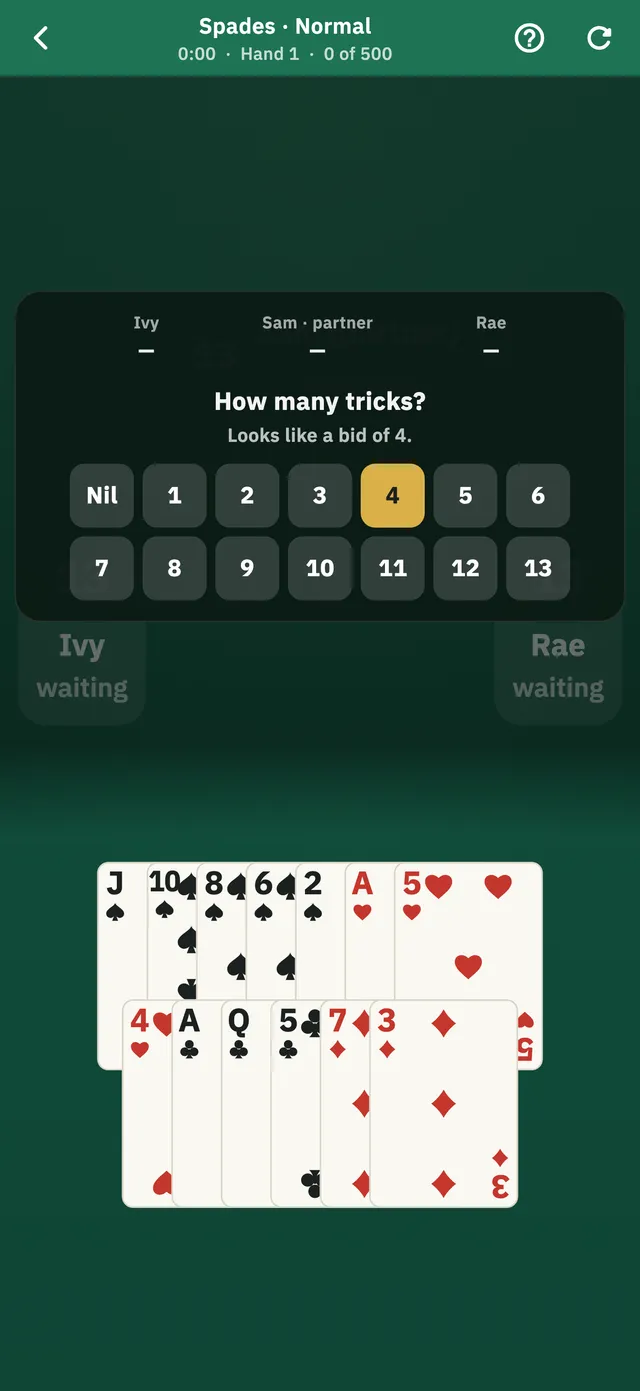
In Fireside, Rae deals the first hand, so you bid first and lead first.
Bidding
Starting with the player on the dealer’s left and going around once, each player bids the number of tricks they expect to win: any number from 1 to 13, or nil. Everybody bids exactly once.
In the partnership game, your bid and your partner’s add together into one contract for your side. Bid 4 and 3, and the two of you must take 7 tricks between you, however they are split. In the solo game, your bid is yours alone.
Good to know
In Fireside the board suggests a bid, but the number is yours.
Nil
A bid of nil is a promise to take no tricks at all. Take none and you score 100; take even one and you lose 100.
Your partner’s bid stands on its own as your side’s contract, and your partner should be covering you: taking the tricks you are trying to duck. In the solo game there is nobody to cover you, which makes nil a much braver bid.
Blind nil, bid before you look at your cards, is a house rule, off as standard (see House rules).
The play
- The player on the dealer’s left leads to the first trick.
- Play goes around to the left. You must play a card of the suit led if you have one; if you have none, you may play any card, a spade included.
- The highest spade in a trick wins it. With no spade in it, the highest card of the suit led wins.
- The winner of each trick leads the next, until all 13 tricks have been played.
Good to know
The rule people forget: nobody may lead a spade until a spade has been played on a trick led in another suit, unless spades are all they hold.
Scoring
At the end of the hand, each side counts its tricks against its contract.
| Result | Points |
|---|---|
| Contract made | 10 for each trick bid, plus 1 for each trick over |
| Contract missed | Minus 10 for each trick bid |
| Nil made | 100 |
| Nil failed | Minus 100 |
| Every tenth bag | Minus 100 |
Every trick over your contract is worth 1 point and is also a bag. Bags add up from hand to hand for the whole match, and each time your side’s total reaches another 10 (at 10, 20, 30 and so on), you lose 100 points. That is why bidding low and hoping is not the easy answer it looks.
If a nil fails, the tricks the nil bidder took still count for the side: toward the partner’s contract, and as bags beyond it. A player or side whose only bid was nil counts every trick it takes as a bag.
For example, you bid 4 and Sam bids 3, a contract of 7. Take 9 tricks and your side scores 72 and two bags; take 6 and you lose 70.
How the game ends
The match ends after any hand in which somebody reaches 500 points, as long as one side has the highest score on its own, and that side wins. If the top scores are tied, another hand is played.
In the solo game, each of the four players keeps their own score and their own bags, and the same rule decides the winner.
The house rules people argue about
Spades has no official rule book, so tables differ on whether to play with partners, how far a match runs, what overtricks cost and whether a losing side may bid blind. Fireside lets you choose each of them.
-
Partners or solo, and how far?
The standard game is two partnerships racing to 500. Solo turns it into four players for themselves, and a lower target makes a shorter match.
- Partners, to 500 Fireside’s standard You and Sam against Ivy and Rae. The standard match, and about 10 hands.
- Partners, to 250 The same game in four or five hands. Nil is worth more, because there is less time to earn 100 back the slow way.
- Solo, to 500 Every player for themselves, and nobody to cover your nil. Four scores climb to the same 500, so it runs nearer 18 hands.
- Solo, to 250 Cutthroat over eight hands or so: the shorter solo match, and the one to pick first.
In Fireside: House Rules, under The match, with Default turned off.
-
Do overtricks cost you?
Without a penalty, a side can bid low on every hand and coast home on overtricks.
- Every tenth costs one hundred Fireside’s standard Every overtrick is a point and a bag, and every tenth bag your side collects costs 100 points.
- A point each, and no penalty A gentler, looser game in which an overtrick never costs anything. A great many people play this way.
In Fireside: House Rules, with Default turned off.
-
May a losing side bid nil without looking?
Blind nil is a comeback: a big gamble that exists only for somebody who is losing.
- Not offered Fireside’s standard Nil is bid with your cards in front of you, like every other bid.
- One hundred behind and you may go blind A player whose side is 100 or more behind the leader may bid nil before looking at their cards, for 200 either way. In the solo game it is any player 100 or more behind. The cards really do stay face down until you decide.
In Fireside: House Rules, with Default turned off.
Fireside deals every game at its standard rules, the ones this page teaches, until you change them. To play your own way, open Spades in the app, tap House Rules, turn off Default and choose. Your table stays as you set it, on your device, and the rules, the lesson and the practice game all follow it.
Learn it in Fireside
How to Play holds the rules sheet, written for the table you have set: partners or solo, the target, and your rules for bags and blind nil. Watch a Hand plays one real deal a step at a time, with the reason for every card and nothing for you to play.
Practice Hand lets you play a real hand with everybody’s cards readable, while the coach on the help button says what each card you can play would do; nothing is counted.
Quick answers
How many points do you need to win at Spades?
In the standard game, 500. The match ends after a hand in which somebody reaches it with the highest score on their own; Fireside also offers matches to 250.
What are bags in Spades?
A bag is a trick taken beyond your contract. Each one is worth a point, but every tenth bag your side collects costs 100, unless your table has turned that penalty off.
What happens if you bid nil and take a trick?
Your nil fails, and your side loses 100. The tricks you took still count toward your partner’s contract, and as bags beyond it.
Can you lead spades on the first trick?
Only if spades are all you hold. Nobody may lead a spade until a spade has been played on a trick led in another suit.
How does blind nil work in Spades?
In Fireside it is a house rule, off as standard. When it is on, a player whose side is 100 or more behind may bid nil before looking at their cards: 200 if it works, minus 200 if it fails.