
Card games
How to play Bridge
Bridge is the partnership card game where an auction decides how many tricks one side promises to take, and then that side has to take them. This is the whole game as Fireside plays it, from the first bid to the final score.
- Players
- 4, in two partnerships
- Equipment
- One standard 52-card deck
- Goal
- Bid a contract and make it, or defeat theirs
- Length
- Four deals in Chicago, the standard match
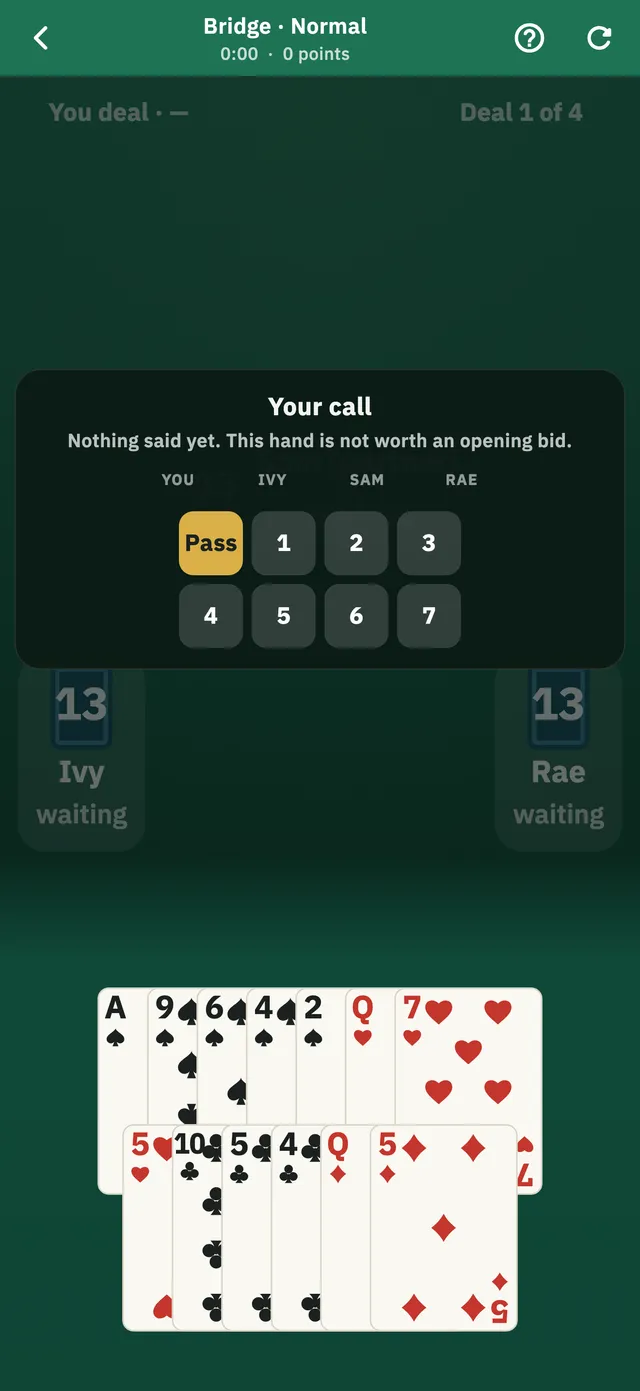
Play Bridge on your phone or tablet
We’re two brothers, and we made Fireside Classic Games to play Bridge by the rules on this page, along with 26 more classic games.


Play three games of Bridge free, at Easy, Normal or Hard, before you decide. After that, a monthly or yearly subscription unlocks every game at every level, Expert included, with the first month free for new subscribers, or a one-time purchase unlocks them for good. Klondike, Hearts, Checkers and Number Place are free for good.
- No ads, ever
- Works offline, with no connection needed
- No account to make
- Large, clear cards that are easy to read
- Four levels of computer partner and opponents, from Easy to Expert, each described before you start
- Pick Chicago, rubber or duplicate, Standard American or Acol, the conventions and whether honors count
On this page
The goal
Bridge is played by four people in two partnerships, with partners sitting across the table from each other. In Fireside you sit with your partner, Sam, against Ivy and Rae.
Every deal is played in tricks. A trick is one card from each player, played in turn around the table, and whoever wins it collects the four cards. There are 13 tricks in every deal.
First comes the auction, in which both sides bid for the right to name trumps: a suit whose every card beats any card of the other three suits. The side that bids highest wins the contract, a promise to take a number of tricks with that suit as trumps, or with no trumps at all. Then the cards are played, and the score depends on whether the contract was made.
A bid of 1 promises 7 tricks, a bid of 4 promises 10, and so on: the number of tricks is always 6 more than the bid.
The deal
Bridge uses one standard 52-card deck, with aces high. The dealer deals out the whole deck, so each player holds 13 cards, and the deal passes to the left after every deal.
In Fireside you deal first, except in duplicate (see How the match ends). The dealer also makes the first call of the auction.
The auction
Starting with the dealer and going around to the left, each player makes one call at a time. A call is one of four things:
- A bid: a number from 1 to 7 and a suit or notrump, such as “two hearts” or “three notrump.” Every bid must be higher than the last bid anyone made.
- Pass: nothing to say this turn. You may still bid on a later turn.
- Double: made on the other side’s bid, while it is still the last bid and nobody has doubled it. It raises what that contract scores, whether it is made or not.
- Redouble: made after the other side has doubled your side’s bid. It raises the stakes again.
A bid is higher if it has a bigger number, or the same number in a higher-ranking suit. Clubs rank lowest, then diamonds, then hearts, then spades, and notrump ranks above them all, so two notrump beats two spades and three clubs beats both. Hearts and spades are called the majors, and clubs and diamonds the minors.
Once somebody has bid, three passes in a row end the auction. The last bid becomes the contract, doubled or redoubled if it was. If all four players pass without a bid, the deal is passed out: nobody plays it, nobody scores, and the next deal begins.
The side that made the last bid plays the contract. Of the two partners, the declarer is whichever one named the contract’s suit, or notrump, first; the other becomes the dummy. The other two players are the defenders.
Good to know
In Fireside you tap a number in the bidding box, then a suit or notrump. The box may light a suggested call, but the call is yours, and the line under the box says in plain words what the last call showed.
What a bid tells your partner
Almost no bid in an auction is a plan to play in the suit it names. A bid is a sentence about your hand, and your partner is listening: how strong it is, and which suits are long.
Strength is counted in points: 4 for an ace, 3 for a king, 2 for a queen and 1 for a jack, so there are 40 in the deck. About 12 points is enough to open the bidding, and about 25 between you and your partner is roughly what it takes to make a game, the contract that earns the big bonus (see Scoring).
Partners agree in advance what their bids mean, and that agreement is their bidding system. Fireside’s robots play Standard American as standard: an opening bid in hearts or spades promises at least five cards in that suit, and an opening bid of one notrump shows 15 to 17 points. Sam plays it, and so do Ivy and Rae.
Some bids, called conventions, mean something other than the suit they name. At the standard table, two clubs in answer to one notrump asks partner for four cards in hearts or spades and says nothing about clubs, and four notrump with a suit agreed asks how many aces partner holds. The standard set is Stayman, Blackwood, the strong two clubs, weak twos and takeout doubles.
Good to know
You don’t have to memorize any of it to start. Fireside says in plain words what every call showed, the opponents’ calls included, and you can tap Bidding during the play to read the whole auction back.
The play
- The defender on declarer’s left makes the opening lead: any card to the first trick.
- Then the dummy lays their whole hand face up on the table and takes no further part. Declarer plays both hands, choosing dummy’s card whenever it is dummy’s turn.
- Play goes around to the left. You must play a card of the suit led if you have one; if you have none, you may play any card, a trump included.
- The highest trump in a trick wins it. With no trump in it, the highest card of the suit led wins. In a notrump contract there are no trumps, so the highest card of the suit led always wins.
- The winner of each trick leads to the next, until all 13 have been played. Tricks are counted by side, so a trick won by dummy is declarer’s trick.
The opening lead is made before anybody has seen dummy, which is why it is always partly a guess. When you are declarer in Fireside, dummy is the row of cards above the table, and you tap one when it is dummy’s turn.
Good to know
When Sam is declarer, you are the dummy. Fireside lets you watch Sam play it, which is how you learn to play a hand, or skip ahead to the result (see House rules).
Scoring
If declarer’s side takes at least the tricks it promised, it scores trick points for each trick it bid beyond the first 6, plus any bonuses. If it falls short, the contract has gone down, and the defenders score for every trick it fell short, called an undertrick.
| Contract | Points |
|---|---|
| Clubs or diamonds | 20 a trick |
| Hearts or spades | 30 a trick |
| Notrump | 40 for the first, 30 for each after |
A contract worth 100 trick points or more is a game, and anything less is a part score. That is why three notrump (100), four hearts or four spades (120) and five clubs or five diamonds (100) are the contracts everybody aims at. Doubling counts the trick points twice over and redoubling four times, so even two hearts doubled (120) is a game.
A bid of six, for 12 tricks, is a small slam, and a bid of seven, for all 13, is a grand slam. Tricks taken beyond the contract are overtricks.
| Bonus | Not vulnerable | Vulnerable |
|---|---|---|
| Game, in Chicago and duplicate | 300 | 500 |
| Part score, in Chicago and duplicate | 50 | 50 |
| Part score on the fourth deal of a Chicago | 100 | 100 |
| Small slam | 500 | 750 |
| Grand slam | 1,000 | 1,500 |
| Making a doubled contract | 50 | 50 |
| Making a redoubled contract | 100 | 100 |
| Contract | Not vulnerable | Vulnerable |
|---|---|---|
| Undoubled | Its trick value (20 or 30) | Its trick value (20 or 30) |
| Doubled | 100 | 200 |
| Redoubled | 200 | 400 |
| Tricks short | Undoubled, not vulnerable | Undoubled, vulnerable | Doubled, not vulnerable | Doubled, vulnerable |
|---|---|---|---|---|
| 1 | 50 | 100 | 100 | 200 |
| 2 | 100 | 200 | 300 | 500 |
| 3 | 150 | 300 | 500 | 800 |
| 4 | 200 | 400 | 800 | 1,100 |
| Each one more | 50 | 100 | 300 | 300 |
Redoubled, the defenders score twice the doubled figures. Honors score only at a table that counts them (see House rules).
Vulnerability
A vulnerable side is paid more for its games and slams and charged more when it goes down, as the tables above show. It is the single fact that most changes how a hand should be bid, and Fireside shows it above the table on every deal.
Who is vulnerable depends on the match:
- Chicago: nobody on the first deal, the dealer’s side alone on the second and third, and both sides on the fourth.
- Rubber: a side becomes vulnerable once it has won a game, and stays that way.
- Duplicate: the tournament cycle, the same for every board number. Over Fireside’s eight boards it runs nobody, your side, their side, both, your side, their side, both, nobody.
How the match ends
Chicago, Fireside’s standard match, is four deals. Every deal is scored on its own as soon as it is played, with the game or part-score bonus paid at once and nothing carried forward. A passed-out deal still counts as one of the four. After the fourth deal, the side with more points wins, and equal totals are a draw.
Rubber is the traditional home game. Trick points go below the line; everything else, from overtricks and slams to undertricks and honors, goes above the line. A side that reaches 100 below the line, in one deal or over several, wins a game, and both sides’ part scores are wiped out for the next one. No bonus is paid for a game on the spot.
The first side to win two games wins the rubber and a bonus: 700 if the other side won none, 500 if they won one. Then everything is added up, above and below the line, and the side with more points wins the match.
Duplicate is eight boards: deals each scored on its own, with the game or part-score bonus paid at once, on the tournament vulnerability cycle. Sam deals the first board, and the deal moves left from there. At a club, duplicate compares your score with other tables playing the same cards; there are no other tables in an offline game, so Fireside adds up the eight boards and the higher total wins.
The house rules people argue about
Bridge has one set of laws, but tables still choose how to keep the score, which bidding system and conventions to play, and whether honors count. Fireside lets you choose each of them, and Sam, Ivy and Rae play whatever you choose.
-
How long is a match, and how is it scored?
The same contract scores differently in each: when a game bonus is paid, whether a part score carries forward, and what makes a side vulnerable.
- Chicago Fireside’s standard Four deals, scored as you go, with the vulnerability fixed in advance.
- Rubber The traditional game. One hundred below the line wins a game and two games win the rubber, however long that takes.
- Duplicate Eight boards on the tournament vulnerability cycle, each scored on its own. There are no other tables to compare with in an offline game.
In Fireside: House Rules, under The match, with Default turned off.
-
Which bidding system does the table play?
A bid means whatever the partnership has agreed it means, so the system decides what your partner understands by every bid you make.
- Standard American Fireside’s standard Five-card majors and a 15 to 17 point notrump: an opening in hearts or spades promises at least five of them. What most American players and most bridge software mean by “standard.”
- Acol Four-card majors and a 12 to 14 point notrump: an opening in hearts or spades may have just four of them. The British club standard.
In Fireside: House Rules, with Default turned off.
-
Which conventions are in play?
Each convention is a bid with an agreed meaning other than the suit it names. More of them make a stronger partnership, and more to remember.
- Standard Fireside’s standard Stayman, Blackwood, the strong two clubs, weak twos and takeout doubles. What a convention card actually says.
- Full The same plus transfers, Gerber, negative doubles and a forcing notrump. A transfer asks partner to bid the suit above the one you named, so that the strong hand plays it. Stronger, and more to remember.
- Natural only Every bid means the suit it names. Nothing to learn, and not how anybody actually plays, but a fair way to meet the auction for the first time.
In Fireside: House Rules, with Default turned off.
-
Do honors score?
Honors are pure luck: nobody bid for them and nobody played for them. They are traditional at rubber, and many tables leave them out.
- Not counted Fireside’s standard Every point is one somebody bid or played for.
- Counted 100 for four of the top five trumps (ace, king, queen, jack and 10) in one hand, 150 for all five, or 150 for all four aces in one hand at notrump. They go to whoever held them, defenders included, whether the contract is made or not.
In Fireside: House Rules, with Default turned off.
-
What happens while your partner plays the hand?
When Sam is declarer, you are the dummy and have nothing to do. Some players like to watch every card; others would rather see the result and deal again.
- Watch it Fireside’s standard You are the dummy and have nothing to do, which is how you learn to play a hand.
- Get on with it Runs the hand through quickly and shows you the result.
In Fireside: House Rules, with Default turned off.
Fireside deals every game at its standard rules, the ones this page teaches, until you change them. To play your own way, open Bridge in the app, tap House Rules, turn off Default and choose. Your table stays as you set it, on your device, and the rules, the lesson and the practice game all follow it.
Learn it in Fireside
How to Play holds the rules sheet, written for the table you have set: your match, your bidding system and your conventions. Watch a Hand plays one real deal a step at a time, with the reason for every card and nothing for you to play.
Practice Hand lets you play a real hand with everybody’s cards readable, while the coach on the help button says what it would bid and why, and what each card would do; nothing is counted. At the table itself, every call is explained in plain words, and tapping Bidding during the play reads the whole auction back.
Quick answers
How many cards does each player get in bridge?
Thirteen. The whole 52-card deck is dealt out, so all four players hold 13 cards and every deal has 13 tricks.
How many points do you need to open the bidding in bridge?
Count 4 for an ace, 3 for a king, 2 for a queen and 1 for a jack. About 12 points is enough to open, and about 25 between you and your partner is roughly what a game takes.
Who leads first in bridge?
The defender on declarer’s left makes the opening lead. Only after that card is played does the dummy lay their hand face up.
How many points is a game in bridge?
100 trick points: three notrump, four hearts or spades, or five clubs or diamonds will do it in one deal. In Chicago and duplicate a game earns a bonus of 300, or 500 vulnerable; at rubber, 100 below the line wins a game, even over several deals.
What is the difference between rubber and Chicago bridge?
A rubber runs until one side wins two games, with part scores adding up toward each game. Chicago is four deals with the vulnerability fixed in advance, each deal scored on its own. Fireside plays Chicago as standard and offers rubber and duplicate under House Rules.