
Card games
How to play Cribbage
Cribbage is a race around a pegboard for two players, and every hand scores twice: once as the cards are played, and again when they are counted. Learn the crib, the play and the count below, and you can sit down at any board.
- Players
- 2: you and one opponent
- Equipment
- A standard 52-card deck and a cribbage board
- Deal
- 6 cards each, 2 of them thrown to the crib
- Goal
- Be the first to peg 121 points
- Length
- To 121, twice around the board, or to 61
Play Cribbage on your phone or tablet
We’re two brothers, and we made Fireside Classic Games to play Cribbage by the rules on this page, along with 26 more classic games.


Play three games of Cribbage free, at Easy, Normal or Hard, before you decide. After that, a monthly or yearly subscription unlocks every game at every level, Expert included, with the first month free for new subscribers, or a one-time purchase unlocks them for good. Klondike, Hearts, Checkers and Number Place are free for good.
- No ads, ever
- Works offline, with no connection needed
- No account to make
- Large, clear cards that are easy to read
- One computer opponent at four levels, from Easy to Expert, each described before you start
- Pick the length of the game, what a crib flush needs and whether skunks count double
On this page
The goal
Cribbage is a game for two. Points are scored the moment they are made, by moving pegs along a cribbage board, which is why scoring is called pegging. The first player to reach 121, twice around the board, wins as soon as they get there, even in the middle of a hand.
Every hand scores in two ways: in the play, as the cards are laid one at a time, and in the show, when each hand is counted.
What the cards count
| Card | Counts |
|---|---|
| Ace | 1 |
| 2 to 10 | Its own number |
| Jack, queen, king | 10 |
For runs, the cards keep their order: ace, 2, 3 and so on up to 10, jack, queen, king. The ace is always low.
The deal and the crib
Deal 6 cards to each player. Each player then chooses 2 cards and throws them face down into the crib, an extra hand of 4 cards that belongs to the dealer and is counted at the end of the hand. You keep the other 4.
The deal alternates, so the crib does too. When the crib is yours, throw it cards that will score; when it is your opponent’s, give away as little as you can. In Fireside, your opponent, Sam, deals the first hand, so you play first and count first.
The cut
When both players have thrown, turn the next card of the deck face up. This card is the cut (some players call it the starter). It belongs to both hands and to the crib, so every count is made of five cards: four of your own and the cut.
If the cut is a jack, the dealer pegs 2 at once, for his heels.
The play: one running count
The player who did not deal goes first. Take turns laying one card face up in front of you, and say the running total of every card laid so far. The total starts at zero and may never go past 31.
You score for what your card makes. A run is three or more cards of consecutive ranks, in any suits.
| Your card makes | Points |
|---|---|
| A total of exactly 15 | 2 |
| A total of exactly 31 | 2 |
| A pair with the card just laid | 2 |
| Three of a kind in a row | 6 |
| Four of a kind in a row | 12 |
| A run of three or more | 1 a card |
| The last card of a count, under 31 | 1 |
Pairs count only when the cards are laid one straight after another. A run need not be laid in order (a 5, then a 3, then a 4 is a run of three), but no other card may come between. Going past 15 scores nothing; the total simply carries on toward 31.
Go, and the last card
If you cannot lay a card without taking the total past 31, you say go. Your opponent then keeps laying cards alone for as long as they can stay at 31 or under, scoring anything they make.
When neither player can lay, the count is over, and whoever laid the last card pegs 1 for it. The exception is a total of exactly 31: that already paid 2 and pays nothing more. Fifteen never ends a count: a count ends only at 31, or when neither player can lay.
The total then goes back to zero, and the player who did not lay the last card starts the next count, if they have a card left. Carry on until both players have laid all 4 cards. The very last card of the play always scores: 1, or 2 if it makes 31.
Here is one count, played through:
- You lay a 5. The total is 5, and nothing scores.
- Sam lays a 10. The total is 15, so Sam pegs 2.
- You lay a 9. The total is 24. Nothing: passing 15 is worth nothing.
- Sam lays a 6. The total is 30. Still nothing.
- Neither of you holds an ace, so neither can lay. Sam laid last and pegs 1. The total goes back to zero, and you start the next count.
Good to know
Fireside says go for you when none of your cards will fit, and pegs every point of the play the moment it is made.
The show: counting the hands
After the play, each player picks up their 4 cards again. The hands are counted in a fixed order: the non-dealer’s hand first, then the dealer’s hand, then the crib, which the dealer scores. Every count uses that hand’s cards plus the cut.
The order is a rule, not a courtesy. The game ends the moment somebody reaches 121, so a non-dealer who gets there during their own count has won before the dealer counts at all.
| Combination | Points |
|---|---|
| Fifteen: any cards that add up to 15 | 2 each |
| Pair | 2 |
| Three of a kind | 6 |
| Four of a kind | 12 |
| Run of three or more | 1 a card |
| Flush: the 4 cards in a hand all one suit | 4 |
| Flush: those 4 and the cut all one suit | 5 |
| Flush in the crib: its 4 cards and the cut all one suit | 5 |
| His nob: the jack of the cut’s suit, in the hand or crib counted | 1 |
Good to know
In Fireside’s standard game, four of a suit in the crib scores nothing: a crib flush needs the cut to match as well, all five cards. It is the scoring mistake beginners make most often.
Fifteens: any cards, any number of them
A fifteen is any group of the five cards that adds up to 15, whether it takes two cards, three, four or all five. Every different group scores 2, and a card counts in every group it fits, not just the first.
Hold a jack, a king, a 4 and an ace, and you have two fifteens, jack-4-ace and king-4-ace, for 4 points. The 4 and the ace are used in both.
The best hand in the game is three 5s and a jack, with the fourth 5, the one of the jack’s suit, as the cut: 29 points. That is eight fifteens for 16, four of a kind for 12 and his nob for 1.
Pairs and runs
Every pair of matching ranks scores 2. Three of a kind holds three different pairs, so it is 6; four of a kind holds six pairs, so it is 12.
A run scores 1 for each card in it. The ace is low and a run cannot turn the corner: queen, king, ace is not a run.
When a rank in a run is doubled, the run counts once for each way of making it. A 4, two 5s and a 6 make two runs of three, 6 points, and the pair of 5s and any fifteens count on top.
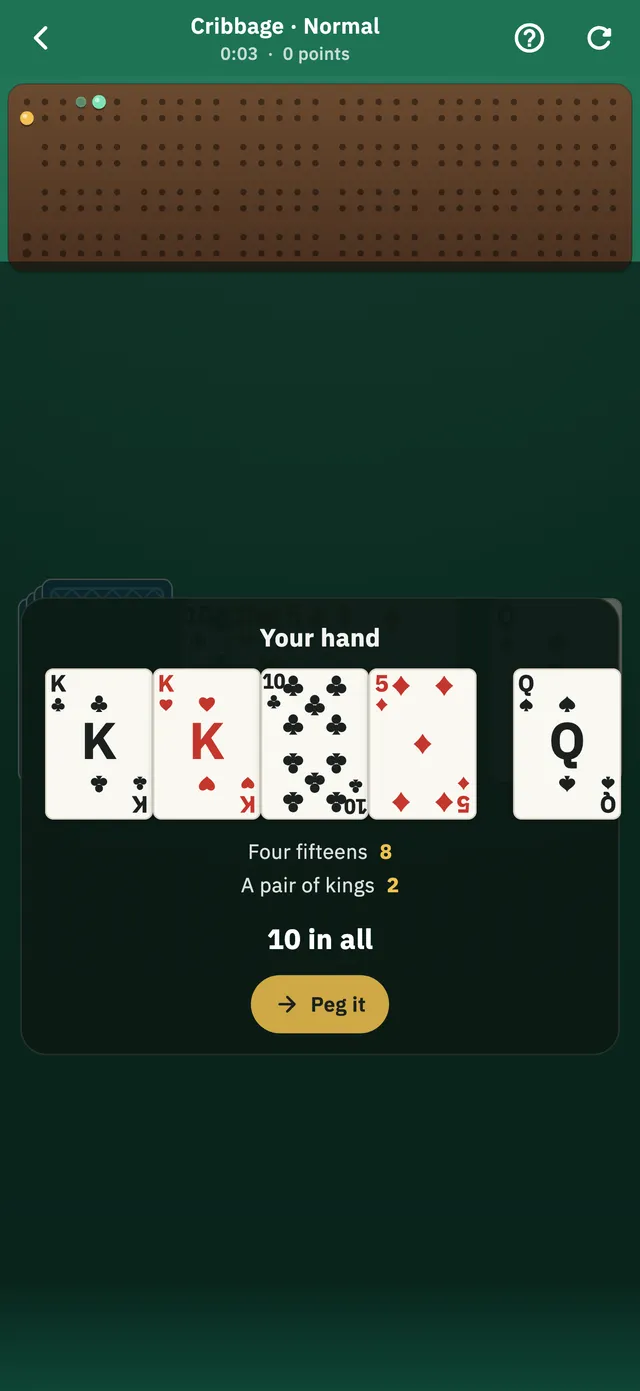
For example, a king, a king, a 10 and a 5, with a queen cut: the 5 makes 15 with each of the other four cards, four fifteens for 8, and the kings are a pair for 2. That is 10 in all.
How the game ends
The first player to reach 121 wins at once, whether that happens in the play, in a count or on his heels, and nothing after that moment is scored. Fireside also plays a shorter game to 61, once around the board.
Skunks are not counted in the standard game. At a table that counts them, a loser who has not reached 91 (31 in the game to 61) has been skunked, and the game counts double.
Good to know
Fireside counts every hand and the crib for you, and shows the working line by line before you peg it, so no point is ever missed.
The house rules people argue about
Cribbage tables still split on a few questions: how long a game runs, whether four of a suit pays in the crib, and whether a lopsided game counts double. Fireside plays the standard game while Default is on; turn Default off on the House Rules sheet and your table can choose each one.
-
How long is a game?
Twice around the board is the standard game. Once around is half the distance, so a single big crib can decide it.
- To 121 Fireside’s standard Twice around the board. The game everybody means.
- To 61 Once around. Half the distance, and one crib can decide it.
In Fireside: House Rules, with Default turned off.
-
Does four of a suit count in the crib?
The strict rule says a crib flush must be all five cards, cut included. A great many tables pay four anyway, and that changes the throw: a dealer who knows four will pay puts two of a suit into their own crib far more readily.
- All five, as the rules say Fireside’s standard Four of a suit in the crib counts nothing at all. With the cut the same suit, all five pay 5.
- Four counts four Four of a suit in the crib pays 4, as it would in a hand, and 5 if the cut matches.
In Fireside: House Rules, with Default turned off.
-
Does a big win count double?
Counting skunks gives a player who can no longer win something to play for: getting past the skunk line in time.
- A win is a win Fireside’s standard The margin is not recorded.
- Thirty-one short counts double Tournament scoring: a loser who has not reached 91 (31 in the game to 61) has been skunked, and the game counts double.
In Fireside: House Rules, with Default turned off.
Fireside deals every game at its standard rules, the ones this page teaches, until you change them. To play your own way, open Cribbage in the app, tap House Rules, turn off Default and choose. Your table stays as you set it, on your device, and the rules, the lesson and the practice game all follow it.
Learn it in Fireside
How to Play holds the rules sheet, a lesson and a practice game, and all three follow the house rules your table has set.
Watch a Hand plays one real deal a step at a time, with the reason for every card: about twenty taps, and nothing to play.
Practice Hand is a real game with both hands face up and a coach on the help button. Nothing is made easier; it is just no longer hidden.
Quick answers
How many cards do you deal in cribbage?
Six to each player in the two-player game. Each player throws 2 into the dealer’s crib and keeps 4, and one more card is turned face up as the cut.
What is the highest possible cribbage hand?
29: three 5s and a jack, with the fourth 5, the one of the jack’s suit, as the cut. It scores eight fifteens, four of a kind and his nob.
Does a four-card flush count in the crib?
Not in Fireside’s standard game: a crib flush needs all five cards, cut included, to be one suit. A table that sets the house rule Four counts four pays 4 for it.
Do you get a point for the last card if you make 31?
No. Reaching exactly 31 pays 2 and ends the count, and there is no extra point for the last card on top of it.
What is a skunk in cribbage?
Losing without reaching 91, at a table that counts skunks; the game then counts double. Fireside’s standard game does not count them, and a table can turn them on as a house rule.