
Card games
How to play Gin Rummy
Gin Rummy is rummy for two: draw a card, throw a card, and fit your ten cards into sets and runs until you can knock. Every hand is a race to be ready first.
- Players
- 2: you and one opponent
- Equipment
- A standard 52-card deck
- Deal
- 10 cards each
- Goal
- Be the first to reach 100 points
- Length
- To 100 points, or to 50
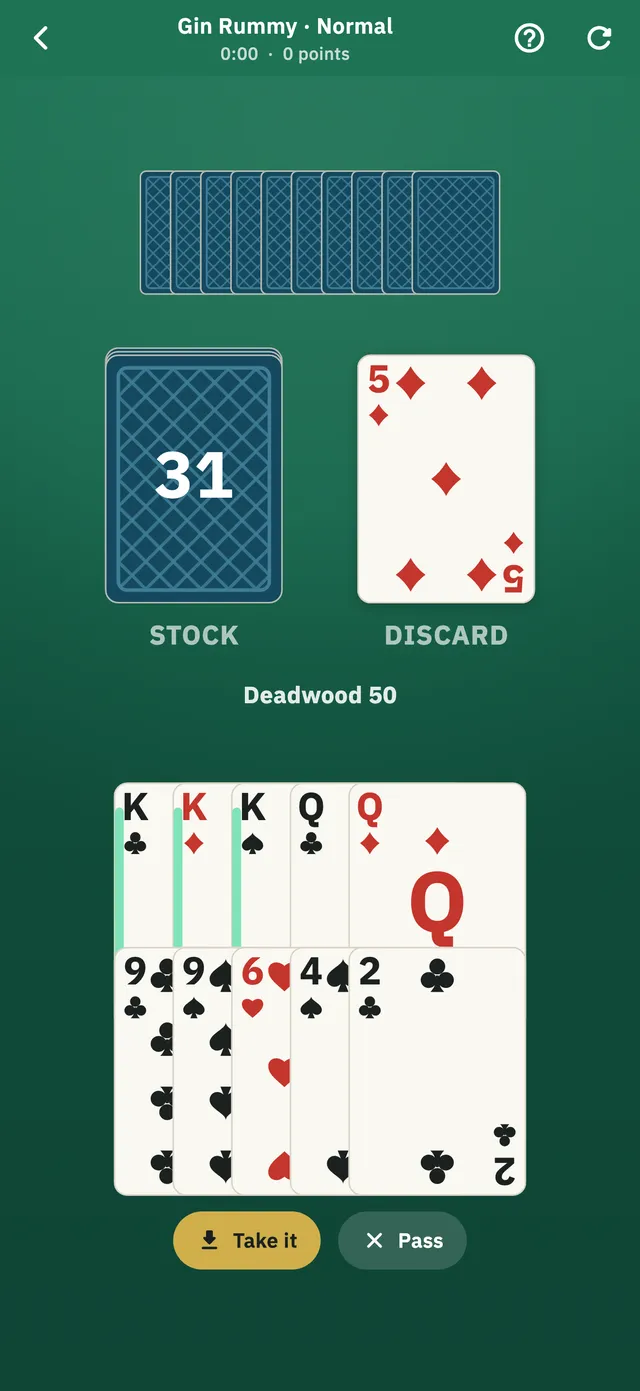
Play Gin Rummy on your phone or tablet
We’re two brothers, and we made Fireside Classic Games to play Gin Rummy by the rules on this page, along with 26 more classic games.


Play three games of Gin Rummy free, at Easy, Normal or Hard, before you decide. After that, a monthly or yearly subscription unlocks every game at every level, Expert included, with the first month free for new subscribers, or a one-time purchase unlocks them for good. Klondike, Hearts, Checkers and Number Place are free for good.
- No ads, ever
- Works offline, with no connection needed
- No account to make
- Large, clear cards that are easy to read
- One computer opponent at four levels, from Easy to Expert, each described before you start
- Play to 100 or to 50, and try Oklahoma, where the card turned up sets the knock
On this page
The goal
Two players each hold 10 cards and try to arrange them into melds: sets and runs. Any card that is not in a meld is deadwood, and deadwood counts against you.
When your deadwood is low enough, you may knock to end the hand, and the hand is scored on the deadwood each of you has left. The first player to reach 100 points wins the match.
Melds and deadwood
- A set is three or four cards of the same rank, such as three 7s.
- A run is three or more cards in sequence in one suit, such as the 4, 5 and 6 of hearts. The ace is low, and a run cannot turn the corner from king to ace.
A card can be in only one meld at a time. Everything else is deadwood, counted at these values:
| Card | Counts |
|---|---|
| Ace | 1 |
| 2 to 10 | Its own number |
| Jack, queen, king | 10 |
Good to know
Fireside marks your melds with a colored stripe down the edge of each card and keeps your deadwood total on screen, so you never have to work either one out yourself.
The deal
Deal 10 cards to each player, starting with the non-dealer. Turn the next card face up to start the discard pile, and put the rest of the deck face down beside it as the stock.
After each hand somebody wins, the deal passes to the other player. In Fireside, your opponent, Sam, deals the first hand.
The first turn
The card turned up is offered to the non-dealer first, who may take it or pass. If they pass, the dealer may take it or pass.
Whoever takes it adds it to their hand and throws a card onto the discard pile, and play goes on from there. If both pass, the non-dealer must take the top card of the stock to begin.
A turn
On every turn after that, take one card, either the top card of the stock or the top card of the discard pile, then throw one card from your hand face up onto the discard pile.
Taking the face-up card tells your opponent something about what you are collecting; taking from the stock tells them nothing. That is why the obvious card is not always the right one.
Knocking and gin
Once the 10 cards you keep after your throw carry 10 or less in deadwood, you may knock: you make your throw, and the hand ends. In Fireside, tap Knock, then tap the card to throw.
If every card you keep is in a meld, that is gin, and it pays a bonus.
You never have to knock, and you do not need gin to knock. Waiting for gin is how hands are lost: your opponent only has to knock first.
Scoring a hand
When you knock, both hands go face up, and your opponent may lay off: add cards from their deadwood to your melds, such as the fourth card of your set or a card that carries your run on at either end. Laid-off cards stop counting as deadwood. Nothing may be laid off against gin.
Then the hand is scored:
| How the hand ends | Who scores | Points |
|---|---|---|
| Knock, with less deadwood than the other hand | The knocker | The difference |
| Undercut: the other hand has the same deadwood or less | The other player | The difference plus 25 |
| Gin: no deadwood at all | The knocker | 25 plus the other hand’s deadwood |
For example, you knock with 6 deadwood. Your opponent holds 15, lays off a 4 and is left with 11, so you score 5. Had they been left with 6 or less, they would have undercut you.
Good to know
Fireside lays off for the player who did not knock, choosing the cards that leave the least deadwood.
Running out of cards
The last two cards of the stock are never drawn. If a player takes the card that leaves two and then throws without knocking, the hand ends: nobody scores, and the same player deals again.
Winning the match
Each hand’s score is added up as you go, and the first player to reach 100 wins the match. Then the bonuses go on:
- Game bonus: 100 to the winner.
- Box bonus: 25 to each player for every hand they won.
- Shutout: if the loser never scored at all, the winner’s whole total is doubled.
Say you reach 104 having won 5 hands, and Sam has 61 from 3 hands. You finish with 104 + 100 + 125 = 329, and Sam with 61 + 75 = 136.
Fireside also plays a shorter match to 50, with the same bonuses at the end.
The house rules people argue about
Gin is played a little differently in almost every house. Fireside plays the standard game while Default is on; turn Default off on the House Rules sheet and your table can choose the length of the match and the old Oklahoma way of knocking.
-
How long is a match?
A match to 100 is the standard game. To 50 is half the distance, so two or three good hands can settle it.
- To 100 Fireside’s standard The standard game, with the box and game bonuses at the end.
- To 50 Half the distance, with the same bonuses at the end.
In Fireside: House Rules, with Default turned off.
-
Does the card turned up set the knock?
Playing Oklahoma gives every hand its own limit, so some hands have to be nearly gin before anyone can knock, and some count double.
- Knock at ten, as usual Fireside’s standard The limit is 10 every hand, whatever is turned up.
- Oklahoma The card turned up at the deal sets how much deadwood a knock may carry: its own value, with 10s and face cards at 10. A 3 means a knock has to be nearly gin; an ace means a knock may carry a single ace and nothing more. If that card is a spade, the hand’s points count double.
In Fireside: House Rules, with Default turned off.
Fireside deals every game at its standard rules, the ones this page teaches, until you change them. To play your own way, open Gin Rummy in the app, tap House Rules, turn off Default and choose. Your table stays as you set it, on your device, and the rules, the lesson and the practice game all follow it.
Learn it in Fireside
How to Play holds the rules sheet, a lesson and a practice game, and all three follow the house rules your table has set.
Watch a Hand plays one real deal a step at a time, with the reason for every card, and nothing to play.
Practice Hand is a real hand with a coach on the help button that turns both hands face up and says what to watch for. Nothing is counted.
Quick answers
How many cards do you deal in Gin Rummy?
Ten to each player. The next card is turned face up to start the discard pile, and the rest of the deck is the stock.
When can you knock in Gin Rummy?
When the 10 cards you keep after your throw carry 10 or less in deadwood. With Fireside’s Oklahoma house rule, the card turned up at the deal sets the limit instead.
How much is gin worth?
25 points plus all of your opponent’s deadwood, and they cannot lay off any of it. Like any hand won, it also earns a 25-point box bonus at the end of the match.
What is an undercut in Gin Rummy?
When the player who did not knock ends up with the same deadwood as the knocker, or less. They score the difference plus 25, and the knocker scores nothing.
What are box bonuses in Gin Rummy?
At the end of the match, each player gets 25 for every hand they won, and the winner gets 100 more. If the loser never scored at all, the winner’s whole total is doubled.