
Solitaire
How to play FreeCell
FreeCell deals every card face up, so nothing is hidden and almost every deal can be won. It is a game of thinking ahead, with four spare cells to help you take the columns apart.
- Players
- 1
- Equipment
- One standard 52-card deck
- Goal
- All 52 cards on the four foundations, ace to king by suit
- Free cells
- Four, or two or one to make it harder
- Length
- One deal
Play FreeCell on your phone or tablet
We’re two brothers, and we made Fireside Classic Games to play FreeCell by the rules on this page, along with 26 more classic games.


Play three games of FreeCell free before you decide. After that, a monthly or yearly subscription unlocks every game, with the first month free for new subscribers, or a one-time purchase unlocks them for good. Klondike, Hearts, Checkers and Number Place are free for good.
- No ads, ever
- Works offline, with no connection needed
- No account to make
- Large, clear cards that are easy to read
- Four, two or one free cells
On this page
The goal
FreeCell is a game for one player with an ordinary 52-card deck. The goal is to move every card onto the four foundations: one pile for each suit, built up from the ace to the king.
Every card is dealt face up, so you can see the whole game from the first move. With four free cells nearly every deal can be solved, and a lost game is one you misplayed rather than one you were dealt.
The deal
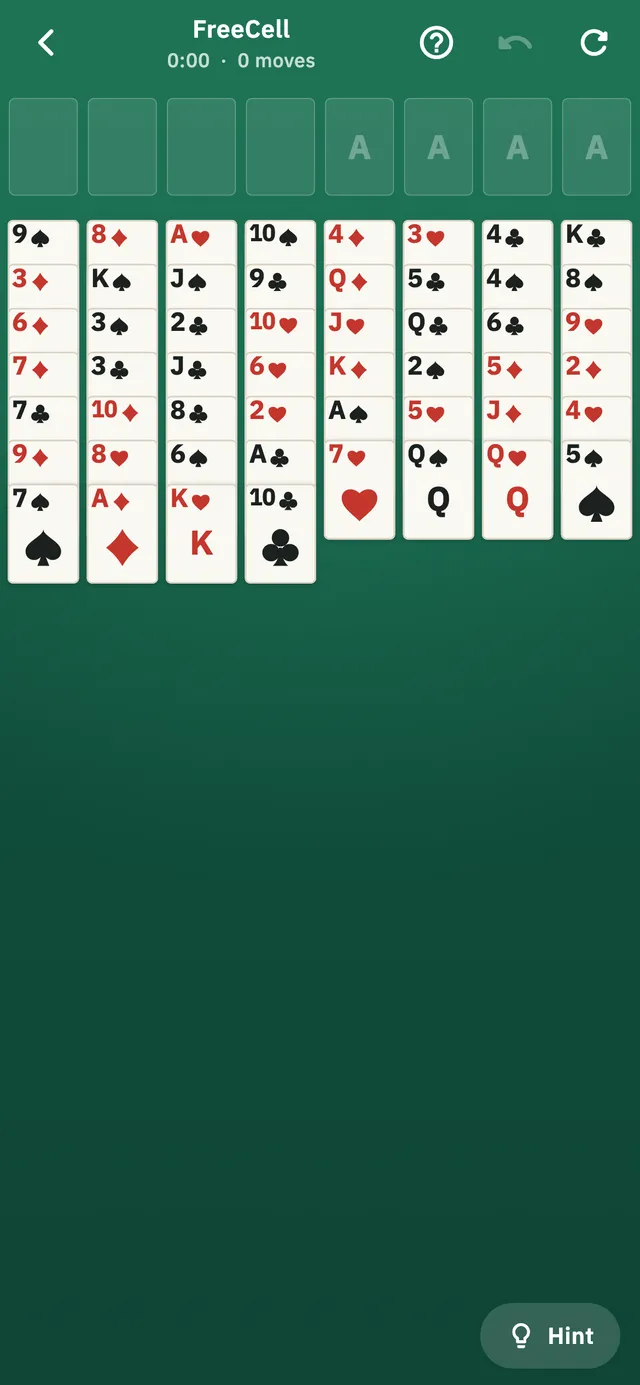
Deal all 52 cards face up into eight columns, overlapping so that every card shows. The first four columns get seven cards each and the last four get six. There is no stock.
Above the columns go four empty free cells on the left and four empty spaces for the foundations on the right.
Moving cards
You move one card at a time. The top card of a column, the one nothing covers, can go to any of three places:
- onto the top card of another column that is one rank higher and the other color: a red six onto a black seven;
- into an empty free cell;
- onto its foundation, when it is next in line: an ace to an empty foundation, then the two of that suit, and so on up to the king.
A card in a free cell can come back out onto a column, or go to its foundation, whenever it fits. Fireside also lets the top card of a foundation come back down, should you need it.
Good to know
In Fireside, a tapped card goes to its foundation first, then onto another column, and into a free cell only as a last resort, since a free cell is nearly always the weakest place to park a card. Drag it if you want it somewhere else.
The free cells
Each free cell holds a single card, and any card can go into an empty one. The cells are what let you take a column apart to reach a card buried in it. They are also how most games are lost: fill them all with cards that have nowhere to go and you are stuck.
Empty columns
Any card can go into an empty column, and so can a run, within the limit below. An empty column holds a whole run where a free cell holds one card, so it is worth even more than a cell.
Moving a run at once
Cards stacked down a column in order, each one rank lower and the other color, make a run. Moving a run is shorthand for a string of single moves through the free cells and empty columns, so you may move it in one go only when there is room to have done it a card at a time.
The number of cards you can move is one more than your empty free cells, doubled for every empty column. When you move a run into an empty column, that column does not count.
| Empty free cells | No empty column | One empty column | Two empty columns |
|---|---|---|---|
| 4 | 5 | 10 | 20 |
| 3 | 4 | 8 | 16 |
| 2 | 3 | 6 | 12 |
| 1 | 2 | 4 | 8 |
| 0 | 1 | 2 | 4 |
Fireside works this out for you and refuses any move that could not have been made one card at a time.
How a game ends
You win when all 52 cards are on the foundations. Once every column runs downward, with no card sitting on a lower one, the rest is a formality, and Fireside offers a Finish button that plays the cards home for you.
Fireside does not score FreeCell in points. The bar at the top shows a clock and a count of your moves, and a win shows your time, your moves and the deal number, with a button to replay the same deal.
Ways to play
FreeCell’s rules hardly change from table to table. What players change is how hard it is, and the dial is the number of free cells. Fireside offers three, under Set Difficulty.
-
How many free cells do you play with?
Every cell you take away makes it harder to take a column apart. With four, almost every deal can be won; with one, very few can.
- Four cells Where Fireside starts The game everybody means. Almost every deal can be won.
- Two cells Harder by a long way, and a good many deals cannot be won at all.
- One cell Very few deals go out. For somebody who has run out of four-cell games to lose.
In Fireside: Set Difficulty, which asks “How many spare cells?”
Fireside remembers your choice on your device, and the rules, the lesson and the practice game all follow it.
Learn it in Fireside
Under How to Play, FreeCell has its rules sheet, a deal to watch and a deal to practice, each set for the number of free cells you have chosen.
Watch a Deal plays one real deal a move at a time, with the board redrawn after each move and the reason it was the right one.
Practice Deal gives you a real deal with a coach on the help button that names the move it would make and says why, and nothing counts toward your record.
Quick answers
Can every game of FreeCell be won?
Nearly every deal with four free cells can be won, because every card is face up from the start. With two cells a good many deals cannot be won, and with one cell very few can.
How many cards can you move at once in FreeCell?
One more than your empty free cells, doubled for each empty column: five cards with four empty cells, ten with four empty cells and an empty column. A column you are moving into does not count.
What can go in an empty column in FreeCell?
Any card, or a run of cards, as long as there is room to have moved the run one card at a time.
How are the cards dealt in FreeCell?
All 52 go face up into eight columns: seven cards in each of the first four and six in each of the last four. The free cells and foundations start empty, and there is no stock.