
Solitaire
How to play Klondike Solitaire
Klondike is the classic solitaire: seven columns to sort, four foundations to fill, and a stock to draw from when you are stuck. All it takes is one deck of cards, and this page takes you from the deal to the last card.
- Players
- 1
- Equipment
- One standard 52-card deck
- Goal
- All 52 cards on the four foundations, ace to king by suit
- Draw
- One card at a time, or three
- Length
- One deal
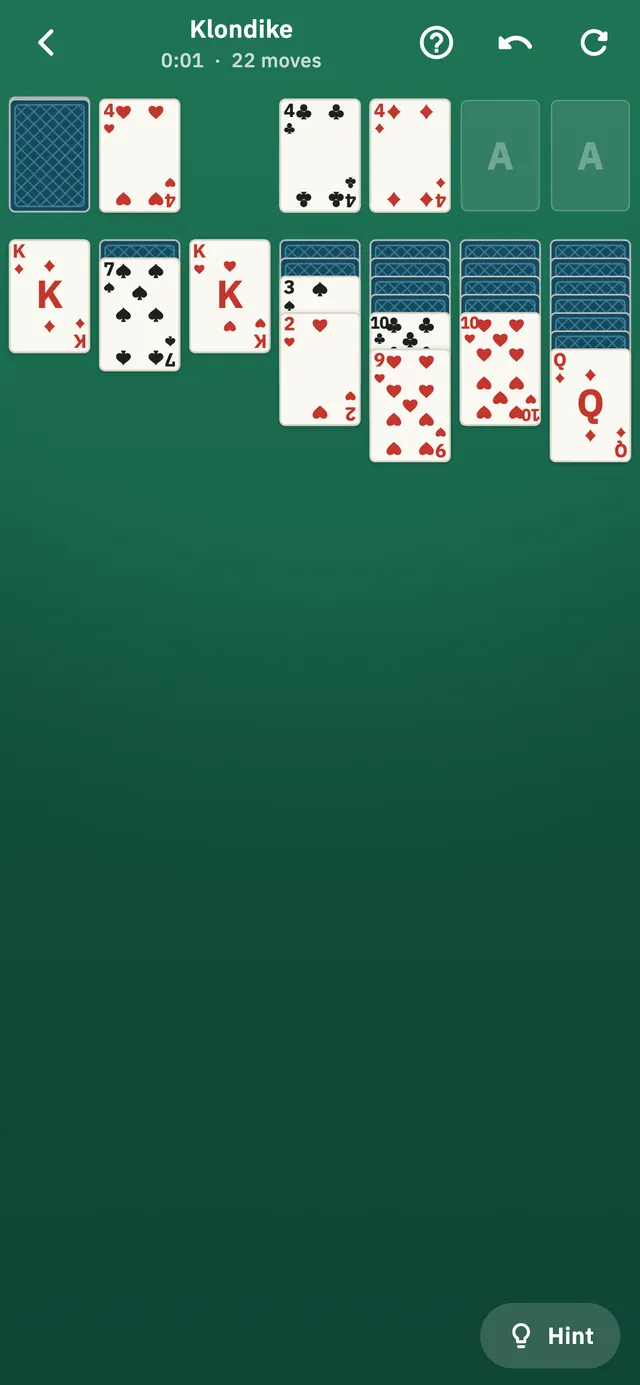
Play Klondike on your phone or tablet
We’re two brothers, and we made Fireside Classic Games to play Klondike by the rules on this page, along with 26 more classic games.


Klondike is free to play for good, at every difficulty, and so are Hearts, Checkers and Number Place. Every other game plays free three times before you decide.
- No ads, ever
- Works offline, with no connection needed
- No account to make
- Large, clear cards that are easy to read
- Draw one or draw three
- Pick how many times you may go through the stock
On this page
The goal
Klondike is a game for one player with an ordinary 52-card deck. The goal is to move every card onto the four foundations: one pile for each suit, built upward from the ace to the king. Fill all four and you have won.
The deal
Shuffle and lay out seven columns from left to right. The first column gets one card, the second two, and so on up to seven cards in the last, 28 cards in all. Only the top card of each column, the one nothing covers, is face up; the rest lie face down beneath it.
The 24 cards left over go face down at the top left. This is the stock, the pile you draw from when you are stuck. Leave room at the top right for the four foundations, which start empty.
Moving cards
In the columns, a card can go on one that is one rank higher and the other color: a red six on a black seven, a black jack on a red queen. The ranks run from the ace, which is low, through ten, jack and queen to the king.
Cards stacked in that order make a run, and you can move a run as a unit, starting from any face-up card in it. When you move the last face-up card off a column, the face-down card beneath it turns over. Turning those cards over is how you make progress.
Any top card that is next in line for its foundation can go there: an ace to an empty foundation, then the two of the same suit on it, and so on up to the king.
Good to know
In Fireside, tap a card to send it where it fits, its foundation first, or drag it where you want it. A card on a foundation can also come back down onto a column when you need it to hold a lower card.
Empty columns
Only a king can go into an empty column, either on its own or at the head of a run. An empty column with no king to put in it is just a hole, so it is worth planning for rather than rushing into.
The stock and the waste
When you run out of moves, tap the stock to turn cards face up onto a pile beside it, the waste. The top card of the waste is always in play: it can go onto a column or up to its foundation.
How many cards you turn at a time is the biggest choice in Klondike:
- Draw one: one card at a time. Every card in the stock can be reached, which is why most draw-one deals can be won.
- Draw three: three cards at a time, and only the top one of the three can be played. Play it and the card under it is free. The rest stay out of reach until the order shifts on a later pass, which makes this the traditional game and much the harder one.
When the stock is empty, tap it to turn the waste back over and go through again. In the standard game you may go through as many times as you like. A house rule limits you to three passes, or to one. Once your last pass is used the stock stops turning, but the top card of the waste stays in play.
Winning, and when a deal runs out
You win when all 52 cards are on the foundations. Once every card is face up and the stock and waste are empty, the rest is a formality, and Fireside offers a Finish button that plays the cards home for you.
Not every deal can be won. A deal has run out when no move can turn a card over or bring a new card into play, and then the only thing to do is deal again. In Fireside, the Hint button tells you when that has happened.
Fireside does not score Klondike in points. The bar at the top shows a clock and a count of your moves, and a win shows your time, your moves and the deal number, with a button to replay the same deal.
The house rules people argue about
Tables have always disagreed about Klondike in two places: how many cards you turn from the stock, and how many times you may go through it. Fireside lets you choose both: the draw under Set Difficulty, and the passes on the House Rules sheet once you turn Default off.
-
How many cards do you turn at a time?
Turning one card makes every card in the stock reachable. Turning three puts two cards in every three out of reach, which is the traditional game and much the harder one.
- Draw one Where Fireside starts Turn a single card. Most deals can be won.
- Draw three Turn three at a time and play only the top one. The traditional, harder deal.
In Fireside: Set Difficulty, which asks “How many cards to turn?”
-
How many times can you go through the stock?
The limit decides how many deals can be won. With no limit most of them can; with a single pass most of them cannot.
- As many as you like Fireside’s standard How nearly everybody plays on a screen, and the reason most deals can be won.
- Three The traditional table game. The third time through the stock, every card matters.
- One Straight through and no going back. Most deals simply cannot be won, which is rather the point.
In Fireside: House Rules, with Default turned off.
Fireside deals every game at its standard rules, the ones this page teaches, until you change them. To play your own way, open Klondike in the app, tap House Rules, turn off Default and choose. Your table stays as you set it, on your device, and the rules, the lesson and the practice game all follow it.
Learn it in Fireside
Under How to Play, Klondike has its rules sheet, a deal to watch and a deal to practice, and all three follow the table you have set: draw one or three, and your passes through the stock.
Watch a Deal plays one real deal a move at a time, with the board redrawn after each move and the reason it was the right one.
Practice Deal gives you a real deal with a coach on the help button that names the move it would make and says why, and nothing counts toward your record.
Quick answers
How many cards do you deal in Klondike Solitaire?
You deal 28 cards in seven columns: one card in the first column, two in the second, and so on up to seven in the last, with only the top card of each face up. The other 24 cards are the stock.
What is the difference between draw one and draw three?
In draw one you turn one card at a time from the stock, so every card can be reached and most deals can be won. In draw three you turn three and can play only the top one, which is the traditional and much harder game.
What can go in an empty column in Klondike?
Only a king, either alone or at the head of a run.
How many times can you go through the deck in Klondike?
In Fireside’s standard game, as many times as you like. House rules let you play the traditional limit of three passes, or just one.
Can you move a card back off a foundation?
In Fireside, yes. The top card of a foundation can come back down onto a column if it is one rank lower than that column’s top card and the other color, which sometimes gives a lower card somewhere to go.