
Solitaire
How to play Spider Solitaire
Spider is the solitaire of patience and planning: two decks’ worth of cards in ten columns, sorted into eight suits from king to ace. Learn it with one suit, then work up to four.
- Players
- 1
- Equipment
- 104 cards, two decks’ worth, in one, two or four suits
- Goal
- Eight full runs, king down to ace, each in one suit
- Length
- One deal
Play Spider on your phone or tablet
We’re two brothers, and we made Fireside Classic Games to play Spider by the rules on this page, along with 26 more classic games.


Play three games of Spider free before you decide. After that, a monthly or yearly subscription unlocks every game, with the first month free for new subscribers, or a one-time purchase unlocks them for good. Klondike, Hearts, Checkers and Number Place are free for good.
- No ads, ever
- Works offline, with no connection needed
- No account to make
- Large, clear cards that are easy to read
- One, two or four suits
- Choose whether a row may be dealt while a column is empty
On this page
The goal
Spider is a game for one player. The goal is to build eight full runs: 13 cards of one suit in order, from the king down to the ace. A full run is lifted off the board the moment it is complete, and when all eight are gone you have won.
The cards
Spider uses 104 cards, two decks’ worth. How many suits they come in is the game’s difficulty:
| Deck | What is in it | How hard |
|---|---|---|
| One suit | Eight sets of spades, ace to king | Most deals go out with a little care |
| Two suits | Four sets of spades and four of hearts | You have to plan a few moves ahead |
| Four suits | Two full decks | Genuinely hard: expect to lose some |
The deal
Deal ten columns. The first four get six cards each and the other six get five, 54 cards in all. Only the top card of each column, the one nothing covers, is face up.
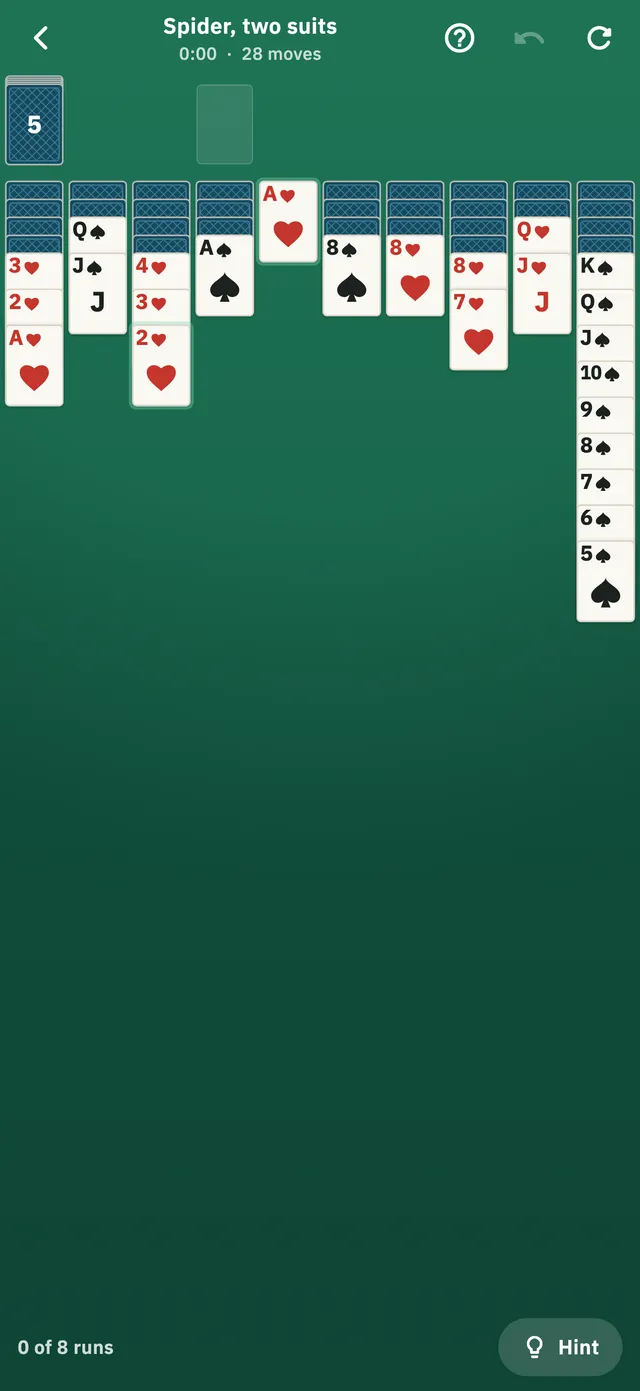
The 50 cards left over are the stock: five more deals of ten cards each. Fireside shows on the stock how many deals are left, and counts your full runs at the bottom of the screen.
Moving cards
A top card can go onto any top card one rank higher, whatever its suit: any nine onto any ten. The king is the highest card and the ace the lowest, so nothing goes on an ace.
Moving several cards at once is stricter. Cards stacked in order from high to low make a run, and you can pick up a run only when every card in it is the same suit. A run built from mixed suits is legal to make, but it cannot travel as one: it has to be taken apart again.
When you move the last face-up card off a column, the face-down card beneath it turns over.
Good to know
That gap between what you may build and what you may move is the whole game. Tap a card or run in Fireside and it goes onto a card of its own suit if it can, since that keeps it movable.
Empty columns
Any card, or any run of one suit, can go into an empty column. Space is the whole currency of Spider: an empty column is where you park cards while you dig out the ones you need.
Dealing a new row
When you have done what you can, tap the stock to deal one card face up onto every column, ten cards at once.
In the standard game the stock will not deal while any column is empty. That single rule is why a Spider player hoards empty columns and fills them only when it is time to deal. A house rule lets you deal whenever you like.
How a deal ends
You win when all eight full runs are off the board. Not every deal can be won, especially with four suits. When no move and no new row can change anything, the deal has run out, and in Fireside the Hint button tells you so.
Fireside does not score Spider in points. The bar at the top shows a clock and a count of your moves, and a win shows your time, your moves and the deal number, with a button to replay the same deal.
The house rules people argue about
Spider players argue about one rule above all: whether you may deal a new row while a column stands empty. Fireside lets each table settle it on the House Rules sheet, with Default turned off, and choose the number of suits under Set Difficulty.
-
How many suits are in the deck?
Fewer suits means more cards of each suit, so runs come together and move far more easily. Four suits is a much harder game.
- One suit Where Fireside starts All spades. Most deals go out with a little care.
- Two suits Spades and hearts. You have to plan a few moves ahead.
- Four suits The full deck, and genuinely hard. Expect to lose some.
In Fireside: Set Difficulty, under “Choose a deck”
-
Can you deal a new row while a column is empty?
An empty column is the most valuable thing on a Spider board, and a deal fills it with a card you did not choose. The strict rule makes you decide when to give one up.
- Not while a column is empty Fireside’s standard The standard rule, and the reason a Spider player hoards empty columns until it is time to deal.
- Whenever you like Deal onto the gaps if you want to. Kinder, and a great many people play this way.
In Fireside: House Rules, with Default turned off.
Fireside deals every game at its standard rules, the ones this page teaches, until you change them. To play your own way, open Spider in the app, tap House Rules, turn off Default and choose. Your table stays as you set it, on your device, and the rules, the lesson and the practice game all follow it.
Learn it in Fireside
Under How to Play, Spider has its rules sheet, a deal to watch and a deal to practice, and all three follow your table: the number of suits and the dealing rule.
Watch a Deal plays one real deal a move at a time, with the board redrawn after each move and the reason it was the right one.
Practice Deal gives you a real deal with a coach on the help button that names the move it would make and says why, and nothing counts toward your record.
Quick answers
How many cards are dealt in Spider Solitaire?
You deal 54 cards in ten columns: six in each of the first four columns and five in each of the other six, with only the top card of each face up. The other 50 cards are the stock, dealt ten at a time.
How many decks of cards does Spider use?
It uses 104 cards, two decks’ worth. With four suits that is two ordinary decks; with one or two suits, the same 104 cards are all spades, or spades and hearts.
Can you deal in Spider when a column is empty?
Not in the standard game: the stock will not deal while any column is empty. Fireside has a house rule that lets you deal whenever you like.
What can go in an empty column in Spider?
Any card, or any run of cards in one suit. Unlike Klondike, it does not have to be a king.
Is one-suit Spider easier than four-suit?
By far. With one suit every run is the same suit, so anything in order can be picked up whole. With four suits, a run in order is usually a run in several suits, and it has to come apart again.