
Puzzles
How to play Minesweeper
Minesweeper is a logic puzzle: a field of covered squares, some of them hiding mines, and numbers that tell you how many mines are near. Read the numbers well and you can clear the field without touching a mine.
- Players
- 1
- Equipment
- A field of covered squares, some hiding mines
- Goal
- Open every square that is not a mine
- Score
- Your time
- Fields
- Four, from 8 by 11 with 12 mines to 16 by 24 with 80
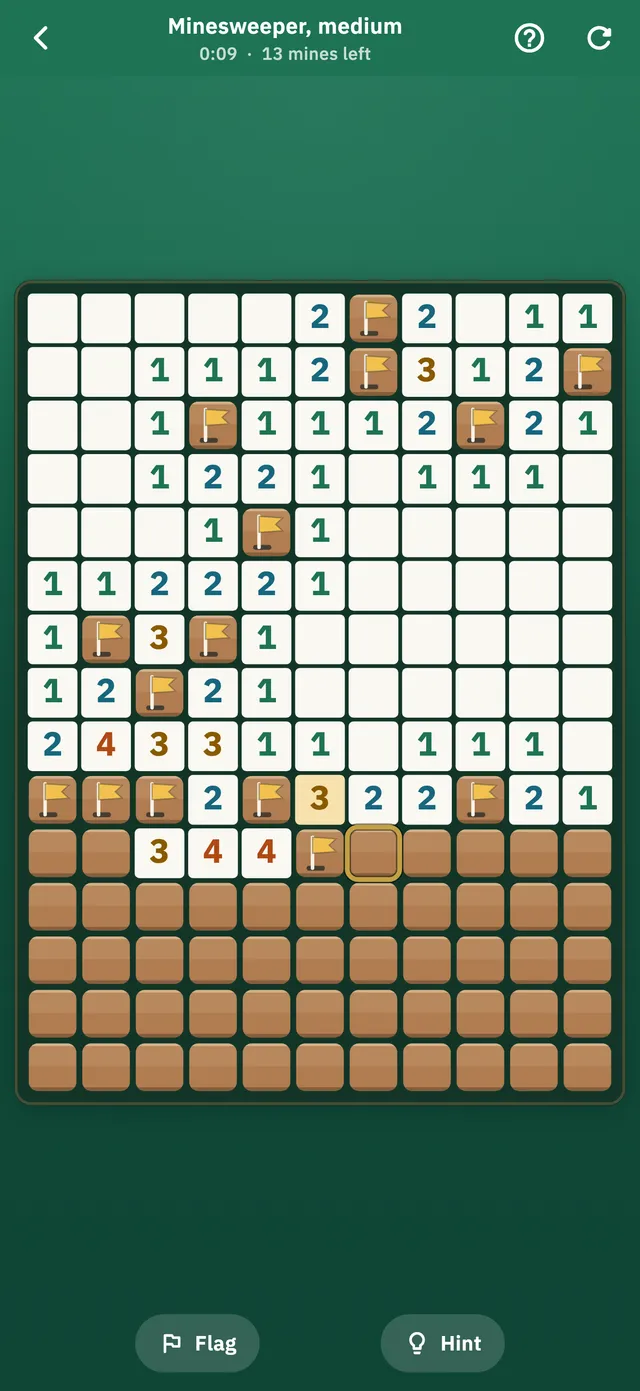
Play Minesweeper on your phone or tablet
We’re two brothers, and we made Fireside Classic Games to play Minesweeper by the rules on this page, along with 26 more classic games.


Play three games of Minesweeper free before you decide. After that, a monthly or yearly subscription unlocks every game, with the first month free for new subscribers, or a one-time purchase unlocks them for good. Klondike, Hearts, Checkers and Number Place are free for good.
- No ads, ever
- Works offline, with no connection needed
- No account to make
- A large, clear grid that is easy to read
- Four fields, from 8 by 11 with 12 mines to 16 by 24 with 80
- Choose what the first tap opens, whether a field may need a guess, question marks, and three lives
On this page
The goal
Minesweeper is a puzzle for one. The field is a grid of covered squares, and some of them hide mines. Open every square that does not hide a mine, without opening one that does, and the field is cleared.
What the numbers mean
Every square you open shows how many mines touch it, counting all eight squares around it: the sides and the corners. A 1 means exactly one mine among those eight; a 3 means three.
A square with no mines around it opens blank, and the field opens everything around it for you. A blank beside another blank keeps going, which is how a single tap can open a whole patch.
Digging and flags
Tap a covered square to dig it, which opens it. When you are sure a square is a mine, press and hold it to plant a flag, and hold again to take the flag off. A flagged square cannot be dug by accident.
The Flag button swaps the two, for a stretch of flagging: a tap plants a flag and holding digs. The count at the top of the screen shows how many mines are left, which is the field’s mines minus your flags.
Clearing around a number
Once a number has all its mines flagged, tap it to dig every other square around it at once. If one of those flags is wrong, the square that really holds the mine opens with the rest, so the shortcut is exactly as safe as your flags.
The first tap
The mines are laid when you make your first tap, and that square is never a mine. In the standard game it is never beside one either, so your first tap always opens a patch to start from. A house rule plays the older way, where the first tap can land beside a mine and show only a number.
Working it out
Most of a field can be proved from the numbers. A 1 with only one covered square beside it means that square is a mine. A number with all its mines flagged means every other square around it is safe.
With the mines scattered at random, the traditional way, a field now and then comes down to two squares that are a true coin toss, and the only thing to do is pick one. Fireside’s hint says so plainly when that happens: it only ever points at a square it can prove.
Good to know
Would you rather never guess? Fireside’s “Never needed” house rule checks every field before you see it, so from the first tap it can be cleared by reasoning alone.
The four fields
Fireside’s fields are taller than they are wide, shaped for a phone held upright. Turn the phone sideways and the field turns on its side to fit, and every square keeps the same neighbors.
| Field | Size | Mines | About |
|---|---|---|---|
| Easy | 8 across, 11 down | 12 | One square in seven |
| Medium | 11 across, 15 down | 28 | One square in six |
| Hard | 14 across, 20 down | 52 | One square in five |
| Expert | 16 across, 24 down | 80 | One square in five |
How a game ends
You win when every square without a mine is open; you do not have to flag the mines. Your time is the score, and each size of field keeps its own record.
In the standard game, dig up a mine and the game is over. Every mine is shown and a wrong flag is crossed out, so you can see what happened. A house rule gives you three lives instead.
The house rules people argue about
Minesweeper players disagree about how much luck belongs in it: whether the first tap is sure to open a patch, whether a field may need a guess, and whether one mine should end the game. Fireside lets each table set those, and question marks too, on the House Rules sheet once Default is off.
-
How big a field do you play?
A bigger field holds more mines, and a bigger share of its squares are mines, so the numbers get crowded.
- Easy Where Fireside starts 8 squares by 11, with 12 mines. A gentle field.
- Medium 11 by 15, with 28 mines.
- Hard 14 by 20, with 52 mines. The numbers get crowded.
- Expert 16 by 24, with 80 mines: one square in five.
In Fireside: Set Difficulty, which asks “How big a field?”
-
What does the first tap open?
A first tap that opens a patch always gives you numbers to work from. One that is merely safe can show a single number, and then the second tap may be a guess.
- Opens a patch Fireside’s standard Never a mine and never beside one, so it always clears a patch to start from. How nearly everybody plays now.
- Just never a mine The older rule. Safe, but it can land beside a mine and show only a number, which can leave the second tap a guess.
In Fireside: House Rules, with Default turned off.
-
Can a field need a guess?
Mines scattered at random sometimes leave squares that no reasoning can tell apart. Checking each field first takes that luck out.
- Now and then Fireside’s standard The mines are scattered at random, the traditional way, so once in a while a field comes down to a coin toss.
- Never needed Every field is checked before you see it: from the first tap, it can be cleared by reasoning alone.
In Fireside: House Rules, with Default turned off.
-
Do you use question marks?
A question mark notes a square you suspect but have not proved, without the commitment of a flag.
- Flags only Fireside’s standard Hold a square to flag it, and hold again to take the flag off.
- Flags and question marks A second hold turns a flag into a question mark, for a square you suspect but have not proved, and a third clears it.
In Fireside: House Rules, with Default turned off.
-
What happens when you dig up a mine?
One mine ending the game is the traditional rule. Lives let you carry on past a mistake.
- Ends the game Fireside’s standard The traditional rule: one mine, and the field wins.
- Costs a life Three lives. A mine you dig up is shown and counted as found, and the third one ends the game.
In Fireside: House Rules, with Default turned off.
Fireside deals every game at its standard rules, the ones this page teaches, until you change them. To play your own way, open Minesweeper in the app, tap House Rules, turn off Default and choose. Your table stays as you set it, on your device, and the rules, the lesson and the practice game all follow it.
Learn it in Fireside
Under How to Play, Minesweeper has its rules sheet, a field to watch and a field to practice, and all three follow your table: the field and every house rule.
Clear a Field works through one real field an argument at a time, with the numbers each one rests on marked.
Practice Field gives you a real field with a coach on the help button that names the square it would dig or flag and proves it, and nothing counts toward your record.
Quick answers
What do the numbers mean in Minesweeper?
A number tells you how many mines touch that square, counting all eight squares around it, corners included. A blank square has no mines around it.
How do you flag a mine in Minesweeper?
In Fireside, press and hold a covered square to plant a flag, and hold again to take it off. The Flag button swaps tap and hold, so that a tap plants a flag.
Is the first click in Minesweeper always safe?
In Fireside the first tap is never a mine. In the standard game it is never beside one either, so it always opens a patch to start from.
Do you ever have to guess in Minesweeper?
With the mines placed at random, the traditional way, a field now and then comes down to a true coin toss. Fireside’s “Never needed” house rule checks every field first, so that it can be cleared by reasoning alone.
How many mines are in each Minesweeper field?
In Fireside, 12 on Easy (8 by 11), 28 on Medium (11 by 15), 52 on Hard (14 by 20) and 80 on Expert (16 by 24).