
Card games
How to play Oh Hell!
Oh Hell! is a trick-taking game where the only thing that counts is guessing right. Bid exactly how many tricks you will take, then take exactly that many: one too many is as bad as one too few.
- Players
- 4, each playing alone: you and three opponents
- Equipment
- A standard 52-card deck
- Goal
- Take exactly the number of tricks you bid
- Hands
- From 1 card up to 7 and back down
- Length
- 13 hands, or 25 in the full match
Play Oh Hell on your phone or tablet
We’re two brothers, and we made Fireside Classic Games to play Oh Hell by the rules on this page, along with 26 more classic games.


Play three games of Oh Hell free, at Easy, Normal or Hard, before you decide. After that, a monthly or yearly subscription unlocks every game at every level, Expert included, with the first month free for new subscribers, or a one-time purchase unlocks them for good. Klondike, Hearts, Checkers and Number Place are free for good.
- No ads, ever
- Works offline, with no connection needed
- No account to make
- Large, clear cards that are easy to read
- Three computer opponents at four levels, from Easy to Expert, each described before you start
- Pick the match length and which way the hands run, the scoring, what a miss costs, the turned ace and the dealer’s hook
On this page
The goal
The game is played by four, each for themselves. A trick is one card from each player, played in turn, and the best card takes all four.
At the start of each hand, every player bids how many tricks they will take. Take exactly that many and you score; take one more or one fewer and you do not. The number of cards changes every hand, and the highest score after the last hand wins.
How the hands run
The first hand is 1 card each. Each hand after that is one card bigger, up to 7, and then one smaller each time, back down to 1. That makes 13 hands in Fireside’s standard match: 1, 2, 3, 4, 5, 6, 7, 6, 5, 4, 3, 2, 1.
The deal passes to the left after every hand. Fireside also plays a full match, out to 13 cards and back, for 25 hands.
Trumps
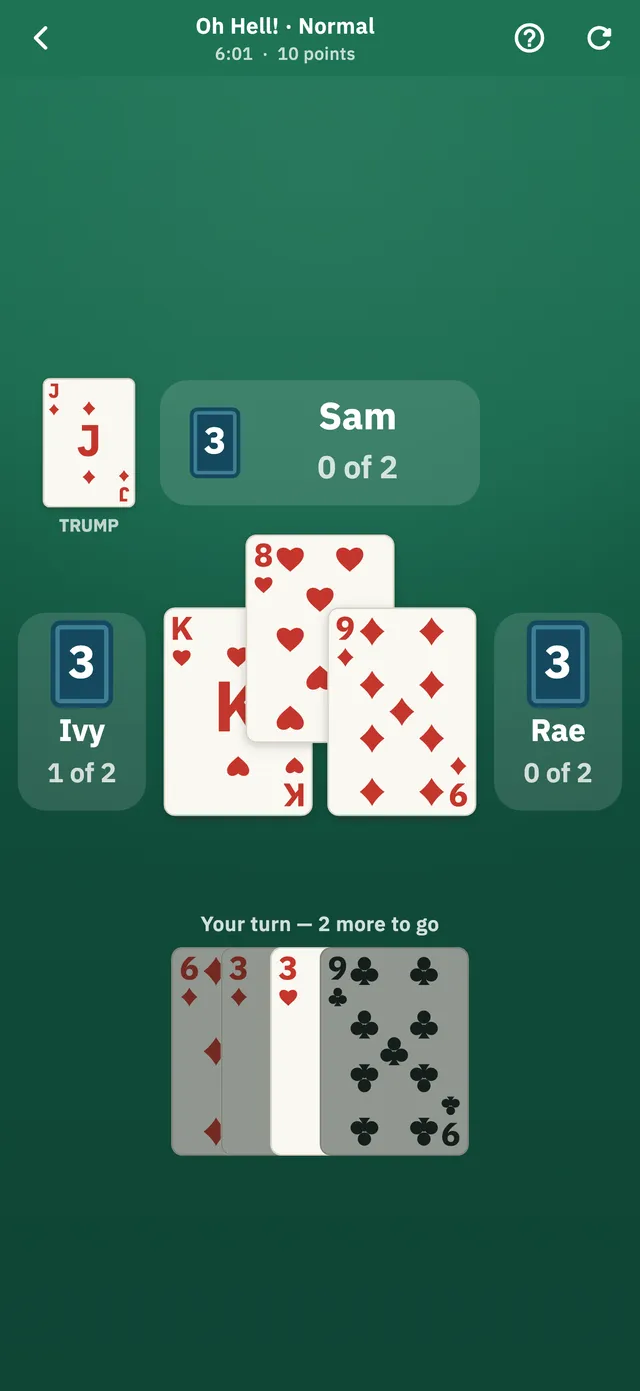
After the deal, turn the next card of the deck face up. Its suit is trump for the hand: any trump beats any card of another suit.
In Fireside’s standard game, a turned ace means the hand is played with no trump at all. In the full match, the 13-card hand uses the whole deck, so there is no card left to turn and no trump either.
Bidding
Bidding starts with the player to the dealer’s left and goes around the table, so the dealer bids last. Each player says how many tricks they will take, from zero up to the number of cards in their hand.
The dealer’s hook: the dealer may not bid the number that would make all the bids add up to the number of tricks in the hand. Somebody at the table has to be wrong.
For example, in a 5-card hand where the first three bids are 2, 0 and 1, the bids so far add up to 3, so the dealer may bid anything but 2.
Good to know
When you deal, Fireside’s bidding pad shows the barred number struck out, and says why.
Playing the tricks
The player to the dealer’s left leads the first trick, and play goes around to the left. You must follow suit, playing a card of the suit led, if you can. If you cannot, play any card you like. Trumps may be led at any time.
Cards rank from the ace, the highest, down to the 2. The highest trump takes the trick; if no trump was played, the highest card of the suit led takes it. The winner of each trick leads the next.
Scoring
Make your bid exactly and you score 10, plus 1 for each trick you took. Miss it, over or under, and you score nothing for that hand.
| Bid | Tricks taken | Score |
|---|---|---|
| 0 | 0 | 10 |
| 2 | 2 | 12 |
| 4 | 4 | 14 |
| 3 | 2 | 0 |
| 1 | 3 | 0 |
A bid of zero counts like any other: take no tricks at all and it scores 10. House rules can change the scoring, with the tricks squared instead of a point each, or points taken off for a miss.
How the game ends
The match ends after the last hand, and the highest total wins. If two or more players tie for the top, the match is a draw.
The house rules people argue about
Almost every family plays this game its own way: how far the hands go, what a made bid is worth, what a miss costs. Fireside plays the standard game while Default is on; turn Default off on the House Rules sheet and your table can choose each of these.
-
How long is a match?
The small hands are almost a guess; the big ones are where a match is decided. The full match has more of them, and makes a long evening.
- Short Fireside’s standard Out to 7 cards and back: 13 hands.
- Full Out to 13 cards and back: 25 hands. The 13-card hand uses the whole deck and has no trump.
In Fireside: House Rules, with Default turned off.
-
Do the hands start small or big?
Starting small lets the table warm up on one-card guesses. Starting big puts the hard hands first, while nobody has a feel for the table yet.
- Up first Fireside’s standard Start with one card and build to the biggest hand, then back down.
- Down first Start with the biggest hand, work down to one, then back up.
In Fireside: House Rules, with Default turned off.
-
What is a made bid worth?
It decides how bold to be. With the tricks squared, a big bid made is worth far more than a small one.
- One a trick Fireside’s standard 10 for making the bid, plus a point for each trick: four tricks bid and made is 14.
- Tricks squared 10 for making the bid, plus the tricks multiplied by themselves: four tricks bid and made is 26. Big bids are worth chasing.
In Fireside: House Rules, with Default turned off.
-
What does a missed bid cost?
With nothing at stake, a hand you cannot make is one you can stop thinking about. With the difference against you, you fight to miss by as little as possible; at a flat ten, a safe bid looks far better than a bold one.
- Nothing at all Fireside’s standard A missed bid simply scores nothing. The gentlest way to play, and the commonest.
- The difference against you A point off for every trick you were out by, over or under: miss by two and it is 2 points off.
- Ten against you Ten off for any miss, whether you were one trick out or four.
In Fireside: House Rules, with Default turned off.
-
What happens when an ace is turned for trump?
It happens about one deal in 13, and with the no-trump rule it turns a hand you had already counted into something else entirely.
- No trumps Fireside’s standard The hand is played without a trump suit.
- Names its suit The ace makes its suit trump like any other card. With that ace face up, the king of trumps is the highest card anyone can hold.
In Fireside: House Rules, with Default turned off.
-
Is the dealer hooked?
The hook makes sure somebody misses every hand. Without it, every player can make their bid at once.
- Hooked Fireside’s standard The bids may not add up to the number of tricks, so the dealer is barred from the one number that would balance them.
- Free Anybody may bid anything. Every player can make their bid, and sometimes they all do.
In Fireside: House Rules, with Default turned off.
Fireside deals every game at its standard rules, the ones this page teaches, until you change them. To play your own way, open Oh Hell! in the app, tap House Rules, turn off Default and choose. Your table stays as you set it, on your device, and the rules, the lesson and the practice game all follow it.
Learn it in Fireside
How to Play holds the rules sheet, a lesson and a practice game, and all three follow the house rules your table has set.
Watch a Hand plays one real deal a step at a time, with the reason for every card, and nothing to play.
Practice Hand is a real hand with everybody’s cards readable, and the coach on the help button says what each card you can play would do. Nothing is counted.
Quick answers
How many cards do you deal in Oh Hell?
It changes every hand. In Fireside’s standard match the first hand is 1 card each, then 2, up to 7, and back down to 1, for 13 hands. The full match goes up to 13 cards and back, for 25 hands.
What is the hook in Oh Hell?
The dealer bids last and may not bid the number that would make the bids add up to the tricks in the hand, so somebody always misses. Fireside plays with the hook as standard, and the house rule Free turns it off.
What do you score for bidding zero in Oh Hell?
Take no tricks and you have made your bid, which scores 10 in Fireside’s standard game. Take even one trick and you have missed.
What happens if an ace is turned up for trump?
In Fireside’s standard game, that hand is played with no trump. A table can set the house rule Names its suit, and the ace then makes its suit trump like any other card.
How do you score Oh Hell?
Make your bid exactly and score 10, plus 1 for each trick; miss it and score nothing. House rules can square the tricks instead, or take points off for a miss.