
Board and tile games
How to play Backgammon
Backgammon is a race between two players, each moving 15 checkers around the board by the roll of the dice, and the first to bring them all home and off the board wins. Below are the rules, the scoring and the doubling cube, as they are played in a match.
- Players
- 2: you and one opponent
- Equipment
- A backgammon board, 15 checkers each, dice and a doubling cube
- Goal
- Be the first to bear off all 15 of your checkers
- Length
- A match to 5 points, to 7, or a single game
Play Backgammon on your phone or tablet
We’re two brothers, and we made Fireside Classic Games to play Backgammon by the rules on this page, along with 26 more classic games.


Play three games of Backgammon free, at Easy, Normal or Hard, before you decide. After that, a monthly or yearly subscription unlocks every game at every level, Expert included, with the first month free for new subscribers, or a one-time purchase unlocks them for good. Klondike, Hearts, Checkers and Number Place are free for good.
- No ads, ever
- Works offline, with no connection needed
- No account to make
- A large, clear board that is easy to read
- Four levels of computer opponent, from Easy to Expert, each described before you start
- Play to 5, to 7 or a single game, with or without the cube, and set the Crawford and Jacoby rules
On this page
The goal
Backgammon is a race for two players. Each has 15 checkers, moved around the board by the roll of two dice: yours travel toward your home board, the six points at your end, and your opponent’s travel the other way, toward theirs.
Once all 15 of your checkers are home, you start taking them off the board, which is called bearing off. The first player to bear off all 15 wins the game. Games are played in a match, and in Fireside’s standard game the first player to 5 points wins it.
The board and the setup
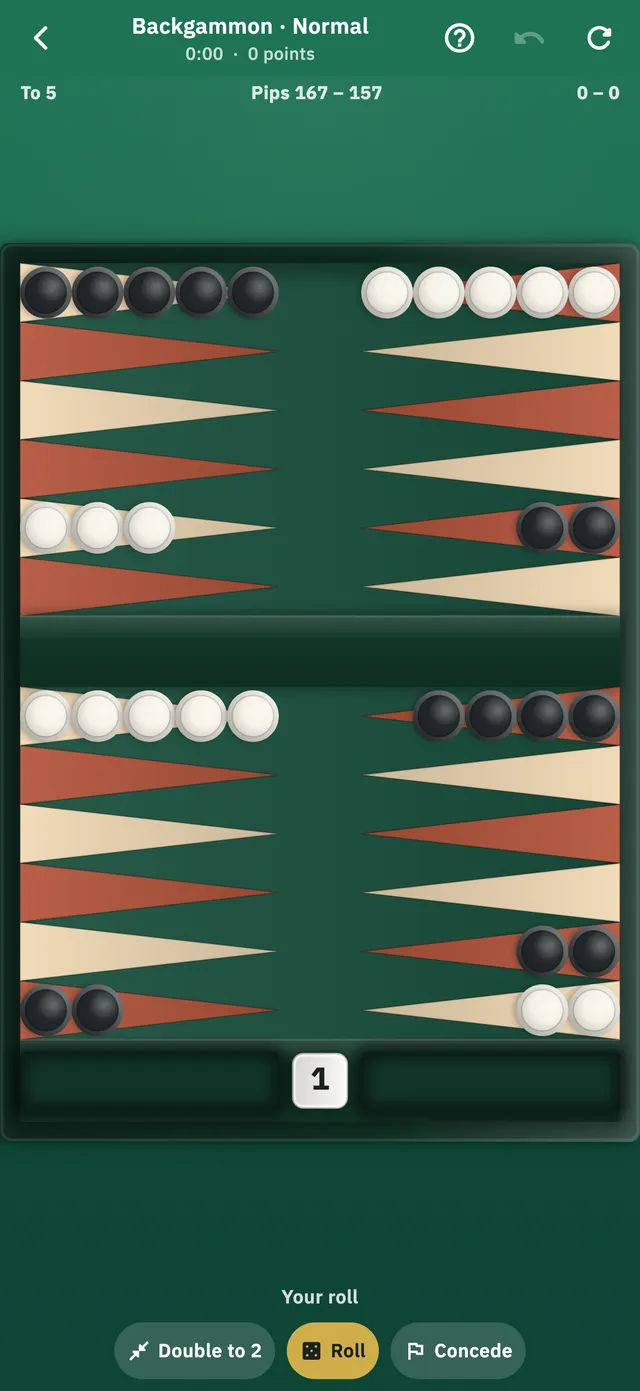
The board has 24 long triangles called points, six in each quarter, with a divider down the middle called the bar. Number the points from 1 to 24 along your own path: your checkers move from your 24-point down to your 1-point, and your home board is points 1 to 6. Your opponent numbers them from the other end.
| Point | Checkers |
|---|---|
| Your 24-point, in your opponent’s home board | 2 |
| Your 13-point, the midpoint | 5 |
| Your 8-point | 3 |
| Your 6-point, in your home board | 5 |
Your opponent’s checkers start on the same points, counted from their end. The total distance your checkers still have to travel is your pip count, 167 for each player at the start; Fireside shows both above the board.
Who goes first
Each player rolls one die. The higher number goes first and plays both of those numbers as the first move; a tie is rolled again, so the first move of a game is never a double. After that, the players take turns rolling both dice.
Moving
Each die is a separate move. With a 5 and a 3, you may move one checker 5 points and another 3, or one checker 5 and then 3 more. Checkers only ever move forward, toward your home board.
A checker may land on a point that is empty, that holds your own checkers, or that holds just one of your opponent’s, but never on a point your opponent holds with two or more. A checker playing both dice must be able to land after each of them.
Roll a double and you play that number four times: double 4s is four moves of 4, shared among your checkers however you like.
You must use both dice if there is any way to. If only one of them can be played, you play that one, and if either could be played but not both, you must play the higher. If neither can be played, your turn is lost.
Good to know
Fireside offers only the moves the rules allow, so you can never waste part of a roll by mistake, and you may play the moves of a turn in any order.
Points, blots and hitting
Two or more of your checkers on one point make that point, and your opponent may not land there. A single checker alone on a point is a blot. If your opponent lands on your blot, it is hit: it is taken off and put on the bar.
Six made points in a row is a prime, and nothing behind it can get past.
Coming back from the bar
A checker on the bar must come back into play before you may move anything else. It enters in your opponent’s home board, on the point matching one of your dice: a 3 brings it in on your opponent’s 3-point, which is your 22-point. With two checkers on the bar, both must come in before any other checker moves.
If your opponent holds every point your dice show, you cannot come in, and your whole turn is lost.
Bearing off
Once all 15 of your checkers are in your home board, you may start bearing them off. A die takes a checker off the point with that number: a 4 takes one off your 4-point. You may also use a die to move a checker within your home board instead.
A number higher than your furthest-back checker takes that checker off. But if you roll a number for an empty point while you still have checkers on higher points, you must use it to move one of them.
If one of your checkers is hit while you are bearing off, it must come in from the bar and travel all the way around to your home board again before you may bear off any more.
What a game is worth
The winner scores 1, 2 or 3 points, depending on how far the loser got:
| Result | When | Points |
|---|---|---|
| Single | The loser has borne off at least one checker | 1 |
| Gammon | The loser has not borne off any | 2 |
| Backgammon | The loser has borne off none and still has a checker on the bar or in the winner’s home board | 3 |
The doubling cube multiplies all of these.
The doubling cube
The doubling cube is a large die marked 2, 4, 8, 16, 32 and 64 that keeps track of what a game is worth. Each game starts at 1, with the cube in the middle, belonging to neither player.
On your turn, before you roll, you may offer to double. Your opponent then chooses:
- Take: the game goes on at twice the value, and the cube passes to them. Only the player holding the cube may double next.
- Refuse: they concede the game at once, at what it was worth before the double.
So the cube can pass back and forth, doubling each time, as high as 64. Knowing when a position is good enough to double, and when a double is good enough to take, is the whole strategic half of backgammon.
Conceding a game
You need not play a lost game to the end. On your turn you may concede it as a single, a gammon or a backgammon, and your opponent decides whether to accept.
In Fireside, Ivy always accepts the biggest result that is still possible, and anything smaller if it is worth at least what she expects to win by playing on. Once nothing the dice can do would change who wins, or by how much, the game is settled: Ivy accepts the matching concession, and offers one herself when it is settled against her.
The match and the Crawford rule
Each game’s points, cube and all, go to its winner, and the match goes on until somebody reaches the target: 5 points in Fireside’s standard game.
The Crawford rule: the game right after either player first gets within one point of winning the match is played without the cube. Without it, a player one point from losing would simply double on the first roll of every remaining game, since they would have nothing left to lose. It applies to that one game only, and the cube returns for the rest of the match.
The house rules people argue about
Backgammon players agree on how the checkers move and argue about the cube: whether to use it at all, and which rules govern it. Fireside plays a match to 5, with the cube and the Crawford rule, while Default is on; turn Default off on the House Rules sheet and your table can choose.
-
How long is the match?
A short match makes every gammon and every double count. A longer one leaves room to recover from a bad game.
- To five Fireside’s standard A short match. Gammons and the cube both count.
- To seven Long enough that one bad game is not the end of it.
- One game A single game, start to finish.
In Fireside: House Rules, under The match, with Default turned off.
-
Do you play with the doubling cube?
The cube is a whole second skill on top of moving the checkers. Without it the game is simpler, and a good place to start.
- In play Fireside’s standard Offer to double the stakes before you roll. The other side takes it or concedes.
- Put away Every game is worth what the board says and no more.
In Fireside: House Rules, with Default turned off.
-
Is the cube put away for one game near the end of a match?
This is the Crawford rule. Without it, a player one point from losing has nothing to lose by doubling. Fireside shows it only when the cube is in play and the match is longer than one game.
- In force Fireside’s standard The game after either side reaches one point short is played without the cube. Standard in every serious match.
- Not used The cube stays live to the end, so a player one point from losing simply doubles on the first roll of every remaining game.
In Fireside: House Rules, with Default turned off.
-
Do gammons count before anybody has doubled?
This is the Jacoby rule, which comes from games played one at a time rather than in a match. It stops a player who is far ahead from playing on for a gammon instead of offering the cube. Fireside shows it only when the cube is in play.
- Not used Fireside’s standard A gammon is worth double and a backgammon triple, cube or no cube. The match rule.
- In force Gammons and backgammons count as a single game until somebody has doubled, so a player far ahead has to offer the cube rather than grind the game out.
In Fireside: House Rules, with Default turned off.
Fireside deals every game at its standard rules, the ones this page teaches, until you change them. To play your own way, open Backgammon in the app, tap House Rules, turn off Default and choose. Your table stays as you set it, on your device, and the rules, the lesson and the practice game all follow it.
Learn it in Fireside
How to Play holds three things, and all three follow the match and house rules your table has set.
Rules is the rules sheet. How It Works shows the rules people trip over, and the house rules that change the game, on real positions out of a real game.
Practice Game is a real game with a coach on the help button that will name the move it would make and say why. Nothing is counted.
Quick answers
How do you set up a backgammon board?
Each player puts 2 checkers on their 24-point, 5 on their 13-point, 3 on their 8-point and 5 on their 6-point, counting from their own end, so the two sides mirror each other. Your home board is your points 1 to 6.
What happens when you roll doubles in backgammon?
You play the number four times instead of twice: double 3s is four moves of 3, among your checkers however you like. The first move of a game is never a double, because a tie on the opening roll is rolled again.
Do you have to use both dice in backgammon?
Yes, whenever there is any legal way to. If only one die can be played, you play that one; if either could be played but not both, you must play the higher.
What is a gammon in backgammon?
Winning before the loser has borne off a single checker. It is worth 2 points, or 3, a backgammon, if the loser also has a checker on the bar or in the winner’s home board, and the doubling cube multiplies either. Fireside’s standard game does not use the Jacoby rule; a table that turns it on counts neither extra until somebody has doubled.
What is the Crawford rule in backgammon?
In a match, the game right after either player first gets within one point of winning is played without the doubling cube. Fireside plays it in the standard game, and a table can turn it off.