
Board and tile games
How to play Checkers
Checkers is played on the dark squares of a checkered board: jump the other side’s pieces, crown your own, and leave your opponent nothing to move. Here are the rules of both games Fireside plays, American checkers and international draughts.
- Players
- 2: you and one opponent
- Equipment
- A checkerboard and 12 pieces each (10 by 10 and 20 each in the international game)
- Goal
- Take all the other side’s pieces, or leave them no move
- Length
- One game, to a win or a draw
Play Checkers on your phone or tablet
We’re two brothers, and we made Fireside Classic Games to play Checkers by the rules on this page, along with 26 more classic games.


Checkers is free to play for good, at every difficulty, and so are Klondike, Hearts and Number Place. Every other game plays free three times before you decide.
- No ads, ever
- Works offline, with no connection needed
- No account to make
- A large, clear board that is easy to read
- Four levels of computer opponent, from Easy to Expert, each described before you start
- Choose American or international rules, compulsory or optional captures, and your color
On this page
The goal
Checkers is a game for two, one with light pieces and one with dark, played on the dark squares of a checkered board. You win by taking every one of the other side’s pieces, or by leaving them with no legal move on their turn.
The second way surprises people: a player who still has pieces on the board, but none that can move, has lost.
American checkers and international draughts
Fireside plays two games. American checkers is what “checkers” means in the United States: a board of 8 by 8 squares and 12 pieces a side. International draughts, also called international checkers, uses a board of 10 by 10 squares and 20 pieces a side, and is a longer and much sharper game.
The two share their basic moves. This page teaches the American game first, then everything the international game does differently.
The board and the setup
Turn the board so that each player has a dark square in the corner at their left hand. Only the dark squares are used, all game long.
Each player sets out their 12 pieces on the dark squares of the three rows nearest them, which leaves two empty rows in the middle. Dark moves first in the American game. Then the players take turns, one move each.
Moving
Every piece starts as a man. A man moves one square diagonally forward, onto an empty square. It can never move backward.
Jumping
You take one of the other side’s pieces by jumping it: your piece hops diagonally over it onto the empty square just beyond, and the jumped piece comes off the board. In the American game, a man jumps forward only. A move that takes one or more pieces is called a capture.
If the same piece can jump again from where it lands, it must keep going: a capture is the whole run of jumps, not one, and it may turn from one diagonal to another along the way. Jumped pieces stay on the board until the run is finished, so no piece can be jumped twice.
If you can take, you must
In the standard game, taking is compulsory: if any of your pieces can take, you must play a capture, and nothing else is allowed. In the American game, when you have more than one capture to choose from, any of them will do, but the one you choose must be run to its end.
Good to know
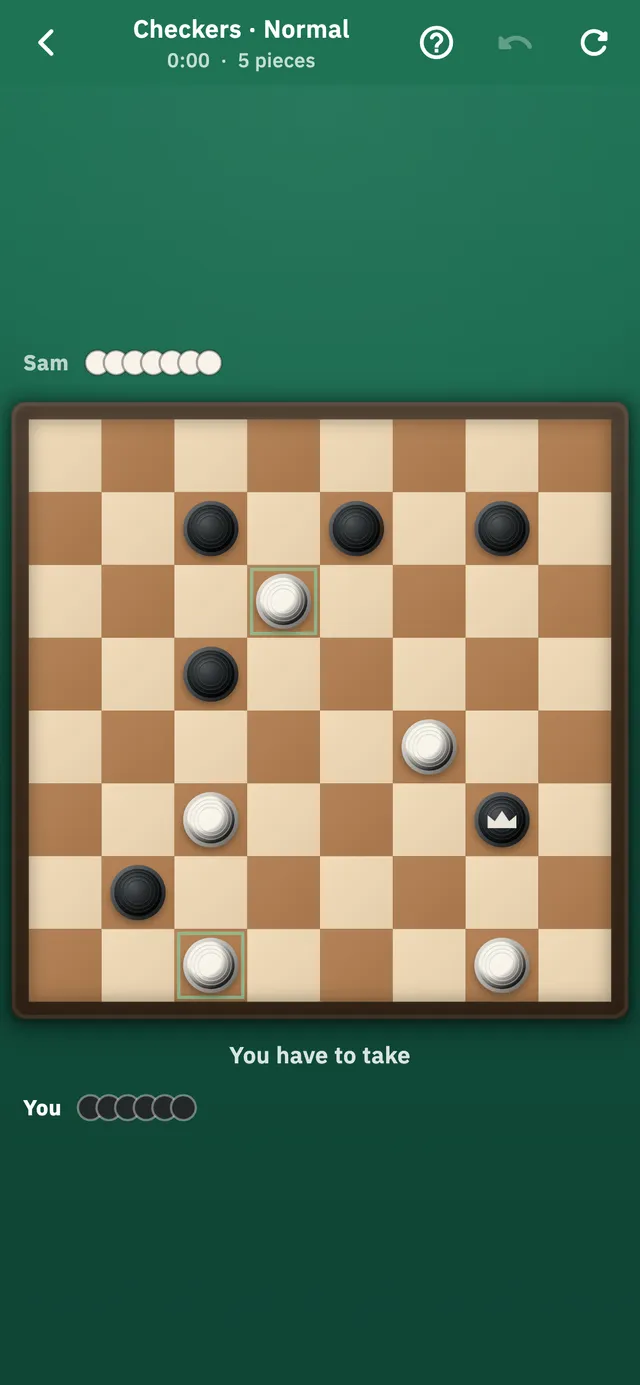
With board marks on, Fireside outlines the pieces that are allowed to take, and the line under the board says You have to take, so it is clear why the others will not move.
Kings
A man that reaches the far row is crowned and becomes a king; at a real board, stack a second piece on top of it. A king moves and jumps backward as well as forward, one square at a time.
In the American game, a man that reaches the far row in the middle of a capture stops there and is crowned. Its move is over, even if it could have jumped again.
How international draughts is different
The international game keeps everything above except these:
- The board is 10 by 10, each side sets out 20 pieces on its four nearest rows, and light moves first.
- Men still move forward only, but they jump forward or backward.
- Kings fly. A king slides any distance along a diagonal, and it may take a piece any distance away, as long as the squares between are empty, landing on any empty square beyond it.
- You must take the most. Of the captures on offer, you must play one that takes the most pieces, and a king counts as one piece, the same as a man.
- A man that reaches the far row in the middle of a capture, and can jump on, carries on as a man. It is crowned only if the capture ends there.
Flying kings make a single king worth far more here than in the American game.
| Rule | American | International |
|---|---|---|
| Board | 8 by 8 | 10 by 10 |
| Pieces | 12 each | 20 each |
| Moves first | Dark | Light |
| A man jumps | Forward only | Forward or backward |
| A king moves | One square | Any distance |
| With a choice of captures | Any will do | Take the most |
| Reaching the far row mid-capture | Stops and is crowned | Carries on as a man |
Draws
A game is drawn when the same position, with the same player to move, comes up for the third time. It is also drawn after 50 moves in a row between the two players, 25 each, in which nothing is taken and no man moves: kings shuffling about and nothing else.
Both rules are there because a king ending that neither side can force would otherwise go on forever. Fireside calls both draws itself, the moment they happen.
The house rules people argue about
Both rule books make captures compulsory, and a great many kitchen tables do not. Fireside plays the American game with compulsory captures while Default is on; turn Default off on the House Rules sheet and your table can choose the game, the capture rule, your color and the board marks.
-
Which game are you playing?
The two games share their basic moves and little else. International draughts is longer and much sharper, and Fireside keeps a separate record for each.
- American Fireside’s standard Eight squares, twelve a side. Men take forward, kings step one square, and any capture will do.
- International Ten squares, twenty a side. Men take backward too, kings fly the length of a diagonal, and you must take the most you can.
In Fireside: House Rules, under Which game, with Default turned off.
-
Do you have to take?
Both rule books say yes, and compulsory captures are what let a player set a trap. Optional captures make a gentler game, and it is how a great many kitchen tables play.
- You must take Fireside’s standard If any capture is possible, you must play one. The rule in both codified games.
- Taking is optional You may take or play something else, but a capture you start must be run to its end. In the international game, if you do take, you must still take the most you can.
In Fireside: House Rules, with Default turned off.
-
Which color do you play?
The two games disagree about who goes first: dark in the American game, light in the international.
- Dark Fireside’s standard You move first in the American game, and second in the international.
- Light You move first in the international game, and second in the American.
- Tossed A fresh color every game, so a run of games is not a run of the same side.
In Fireside: House Rules, with Default turned off.
-
Should the board show where a piece may go?
Marks help while you learn the moves, and they show which pieces must take. A bare board is how it looks at a real table.
- Show where a piece may go Fireside’s standard The squares a picked-up piece can reach are marked, one jump at a time along a capture, and so are the pieces that are allowed to take.
- No marks A bare board. The rules still hold: an illegal move is simply refused.
In Fireside: House Rules, with Default turned off.
Fireside deals every game at its standard rules, the ones this page teaches, until you change them. To play your own way, open Checkers in the app, tap House Rules, turn off Default and choose. Your table stays as you set it, on your device, and the rules, the lesson and the practice game all follow it.
Learn it in Fireside
How to Play holds three things, and all three follow the game and house rules your table has set.
Rules is the rules sheet. How It Works shows the rules people trip over, and the house rules that change the game, on real positions out of a real game.
Practice Game is a real game with a coach on the help button that will name the move it would make and say why. Nothing is counted.
Quick answers
Do you have to jump in checkers?
Yes, in Fireside’s standard game and in both the American and the international rule books: if you can take, you must. The house rule Taking is optional turns that off.
Can a checker move backward?
A man, an uncrowned piece, never moves backward. In the American game it jumps only forward too, while in the international game it may jump backward. A king moves and jumps in both directions.
How does a king move in checkers?
In American checkers, a king moves one square diagonally in any direction, and jumps the same way. In international draughts a king flies: it slides any distance along a diagonal.
What happens if you cannot move in checkers?
You lose. A player who has no legal move on their turn has lost, even with pieces left on the board.
How many pieces does each player get in checkers?
Twelve each in American checkers, on a board of 8 by 8 squares, and 20 each in international draughts, on 10 by 10.