
Board and tile games
How to play Chess
Chess is played by two armies of 16 pieces on a board of 64 squares, and it has one goal: trap the other side’s king. Below is every rule you need for a real game, including the three special moves: castling, en passant and promotion.
- Players
- 2: you and one opponent
- Equipment
- A chessboard and 16 pieces each
- Goal
- Checkmate the other side’s king
- Length
- One game, untimed or on a rapid or blitz clock
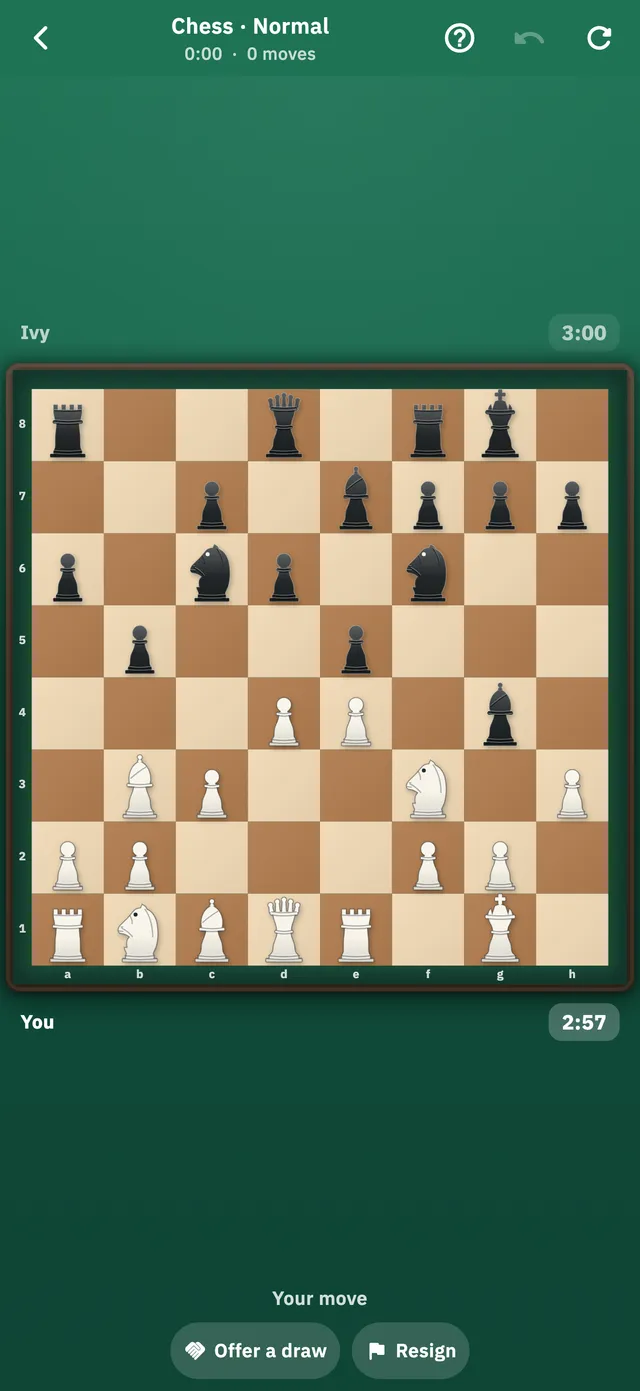
Play Chess on your phone or tablet
We’re two brothers, and we made Fireside Classic Games to play Chess by the rules on this page, along with 26 more classic games.


Play three games of Chess free, at Easy, Normal or Hard, before you decide. After that, a monthly or yearly subscription unlocks every game at every level, Expert included, with the first month free for new subscribers, or a one-time purchase unlocks them for good. Klondike, Hearts, Checkers and Number Place are free for good.
- No ads, ever
- Works offline, with no connection needed
- No account to make
- A large, clear board that is easy to read
- Four levels of computer opponent, from Easy, which plays like a beginner, to Expert, which is stronger than most club players
- Play untimed, rapid or blitz, pick your color, and choose how draws are called, how pawns promote and whether moves are marked
On this page
The goal
Chess is a game for two players, White and Black. You win by checkmate: trapping the other side’s king so that it is attacked and has no way out. Checkmate ends the game on the spot; the king is never actually taken.
A game can also end when a player resigns or runs out of time, or in a draw.
The board and the pieces
The board has 64 squares, eight by eight, colored light and dark in turn. Its rows are called ranks and its columns files. Set it so that each player has a light square in the corner at their right hand.
Each player has 16 pieces: a king, a queen, two rooks, two bishops, two knights and eight pawns. Set yours out on the two ranks nearest you:
- The rooks go in the two corners, the knights next to them, and the bishops next to the knights.
- Of the two middle squares, the queen takes the one of her own color: a light square for the white queen, a dark one for the black.
- The king takes the last square, beside his queen.
- The eight pawns fill the rank in front of them.
Squares are named by file and rank: files a to h from White’s left, ranks 1 to 8 from White’s side, so White’s king starts on e1 and Black’s on e8. White always moves first. Then the players take turns, one move each, and nobody may pass.
How the pieces move
You move one piece a turn. To take one of the other side’s pieces (to capture it), move onto its square, and it comes off the board. You may never move onto a square held by one of your own pieces.
| Piece | How it moves |
|---|---|
| King | One square in any direction |
| Queen | Any distance along a rank, a file or a diagonal |
| Rook | Any distance along a rank or a file |
| Bishop | Any distance along a diagonal |
| Knight | Two squares one way and one square the other, like an L, jumping over anything between |
| Pawn | One square straight ahead, or two from its starting square; it takes one square diagonally ahead |
Every piece but the knight is blocked by the first piece in its path, and may take that piece if it belongs to the other side. Pieces take the same way they move, except the pawn.
Pawns
A pawn moves one square straight forward, or two on its first move, and only onto empty squares. It is the only piece that moves and takes differently: it takes one square diagonally forward. It can never move backward.
Because a pawn cannot take straight ahead, a pawn with a piece directly in front of it is stuck until that piece moves or something comes within its diagonal reach.
Check and checkmate
A king that is attacked is in check. You must get out of check on your very next move, in one of three ways:
- Move the king to a square that is not attacked.
- Put one of your pieces in the way. There is no blocking a knight, which jumps.
- Take the piece that is giving check.
You may never make a move that leaves your own king in check, and a king may never step onto an attacked square. A king in check with no way out is checkmated, and the game is over: whoever gave checkmate wins.
Good to know
Fireside accepts only legal moves, so it will never let you leave your king in check by mistake. The move is simply refused.
Castling
Castling is the one move in which two pieces move at once. The king moves two squares toward one of its rooks, and that rook hops over the king to the square right beside it. Each side may castle once a game, toward either rook, as long as all of these are true:
- Neither the king nor that rook has moved yet.
- Every square between them is empty.
- Your king is not in check.
- The king does not pass through, or land on, a square the other side attacks.
Good to know
In Fireside, castle by moving your king two squares toward the rook. The rook follows on its own.
En passant
If a pawn moves two squares from its starting square and lands right beside one of the other side’s pawns, that pawn may take it as though it had moved only one. It steps diagonally onto the square the first pawn passed over, and the first pawn comes off the board. This is en passant, French for “in passing,” and it must be done on the very next move or not at all.
For example, Black has a pawn on d4, and White moves a pawn from e2 to e4, passing over e3. On the very next move, Black may move the pawn from d4 to e3 and take White’s pawn on e4.
It is the rule most people have never been told, and it is the reason a pawn cannot simply sprint past a square an enemy pawn guards.
Promotion
A pawn that reaches the far side of the board is promoted at once: it becomes a queen, rook, bishop or knight of its own color, whichever you choose, whatever is already on the board. So a player can have two queens, or more.
It is nearly always a queen. Choosing anything else is called under-promotion, and the usual case is a knight: when a queen would leave the other side in stalemate (no legal move, which is a draw) and a knight gives check instead.
Good to know
Fireside asks which piece you want each time one of your pawns gets there. The house rule Always a queen promotes without asking.
Draws
Not every game has a winner. A game is drawn by any of these:
- Stalemate: the player to move has no legal move, and is not in check.
- Neither side can mate: neither side has enough left to checkmate, such as a king against a king, or a king and a single bishop or knight against a king. Fireside ends the game the moment it happens.
- Threefold repetition: the same position comes up for the third time.
- The fifty-move rule: each side has played 50 moves with no piece taken and no pawn moved.
- Agreement: one player offers a draw and the other accepts.
In Fireside’s standard game, a threefold repetition or the fifty-move count ends the game by itself, the moment it happens. At a table that sets the house rule Claimed, play goes on until somebody claims the draw, and a button appears when you may.
Good to know
Stalemate is a draw, not a win. When you are far ahead, leave the other king a legal move until you can checkmate it.
Playing on a clock
Fireside’s standard game has no clock: take as long as you like over every move. A table can choose a clock instead:
- Rapid: 10 minutes each for the whole game, with nothing added back.
- Blitz: 3 minutes each, and every move puts 2 seconds back on the clock of the player who made it, so a won position cannot be lost to the last few seconds.
Only the clock of the player to move runs. Run out of time and you lose, unless the other side has nothing left to mate you with: only a king, or a king and a single bishop or knight. Then it is a draw.
How a game ends
A game of chess ends in one of four ways:
- Checkmate: the player who gives it wins.
- Resignation: a player may give up at any point, and the other side wins.
- Time: on a clock, a player whose time runs out loses, or draws when the other side cannot mate.
- A draw, in any of the ways above.
In Fireside, Offer a draw and Resign sit under the board. Ivy, your computer opponent, answers a draw offer by accepting it or playing on.
The house rules people argue about
The rules of chess are the same everywhere, but players still differ on the clock, on which color to take, on whether a repeated position ends the game by itself, and on how much help the board should give. Fireside plays the standard game while Default is on; turn Default off on the House Rules sheet and your table can choose each one.
-
Is there a clock?
Untimed, you can think as long as you like. On a clock, playing well before your time runs out becomes part of the game.
- Untimed Fireside’s standard No clock. Think about it for as long as you like.
- Rapid Ten minutes each for the whole game.
- Blitz Three minutes each, with 2 seconds added back after every move, so a won game is not lost to the last of them.
In Fireside: House Rules, under The clock, with Default turned off.
-
Which color do you play?
White moves first: the usual way to learn, and the easier side. Black is harder, and it is the side you will have half the time against anybody else.
- White Fireside’s standard You move first.
- Black Ivy opens and you answer.
- Toss for it A new color every game, as at a real board.
In Fireside: House Rules, with Default turned off.
-
Does a repeated position end the game by itself?
The written rules say a threefold repetition or the fifty-move count is a draw only when somebody claims it. Most players expect the game to stop on its own.
- Called automatically Fireside’s standard The game stops the moment a position comes up for the third time, or each side has played 50 moves with no piece taken and no pawn moved.
- Claimed What the written rules say: the game goes on until somebody claims the draw, and a button appears when you may. A fifth repetition, or 75 moves each with no piece taken and no pawn moved, still ends the game by itself.
In Fireside: House Rules, with Default turned off.
-
Do you choose the piece when a pawn promotes?
A queen is right almost every time, and the rare exceptions are the ones that win games.
- Ask me Fireside’s standard You choose the piece each time a pawn gets through.
- Always a queen One tap fewer. Under-promotion is given up with it.
In Fireside: House Rules, with Default turned off.
-
Should the board show where a piece may go?
Marks help while you learn the moves, though they never say which move is any good. A bare board is how it looks at a real table.
- Show the legal moves Fireside’s standard Pick a piece up and the squares it may go to are marked, with the last move played shaded.
- Board only No marks of any kind. How it looks at a real board, and what a strong player usually wants.
In Fireside: House Rules, with Default turned off.
Fireside deals every game at its standard rules, the ones this page teaches, until you change them. To play your own way, open Chess in the app, tap House Rules, turn off Default and choose. Your table stays as you set it, on your device, and the rules, the lesson and the practice game all follow it.
Learn it in Fireside
How to Play holds three things, and all three follow the clock and house rules your table has set.
Rules is the rules sheet. How It Works shows the rules people trip over, and the house rules that change the game, on real positions out of a real game.
Practice Game is a real game with a coach on the help button that will name the move it would make and say why. Nothing is counted.
Quick answers
Who moves first in chess?
White, always. In Fireside’s standard game you play White, and a house rule lets you take Black or toss for your color.
Can you castle out of check?
No. You may not castle while your king is in check, and the king may not pass through or land on a square the other side attacks. Neither the king nor that rook may have moved before.
What is en passant in chess?
A special way for a pawn to take. When a pawn moves two squares and lands right beside an enemy pawn, that pawn may take it as if it had moved only one, but only on the very next move.
Is stalemate a win or a draw?
A draw. Stalemate means the player to move has no legal move and is not in check, so the game ends with no winner.
What happens when a pawn reaches the other side of the board?
It is promoted to a queen, rook, bishop or knight of its own color, nearly always a queen. Fireside asks which piece you want each time, unless your table has set Always a queen.