
Card games
How to play Canasta
Canasta is the classic partnership card game for four players, played with two packs and four jokers. You and your partner build melds toward canastas of seven cards, and a discard pile worth fighting over can turn a hand around in one turn.
- Players
- 4, in two partnerships; in Fireside, three computer players sit with you
- Equipment
- 2 packs and 4 jokers, 108 cards
- Deal
- 11 cards each
- Goal
- Make canastas and outscore the other side
- Length
- First to 5,000 and in the lead; to 2,500 as a house rule
Play Canasta on your phone or tablet
We’re two brothers, and we made Fireside Classic Games to play Canasta by the rules on this page, along with 26 more classic games.


Play three games of Canasta free, at Easy, Normal or Hard, before you decide. After that, a monthly or yearly subscription unlocks every game at every level, Expert included, with the first month free for new subscribers, or a one-time purchase unlocks them for good. Klondike, Hearts, Checkers and Number Place are free for good.
- No ads, ever
- Works offline, with no connection needed
- No account to make
- Large, clear cards that are easy to read
- A computer partner and two computer opponents, at four levels from Easy to Expert, each described before you start
- Play to 5,000 or 2,500, and go out on one canasta or two
On this page
- The goal
- The cards and the deal
- What the cards are worth
- Melds, canastas and wild cards
- A turn
- Taking the discard pile
- Freezing the pile
- Red threes and black threes
- Opening: your side’s first melds
- Going out
- Scoring
- Printable score sheet
- How the game ends
- House rules
- Learn it in Fireside
- Quick answers
The goal
Canasta is played by four people in two partnerships, partners sitting across from each other. You and your partner are a side, and everything either of you lays on the table belongs to the side.
Your side lays down melds: groups of three or more cards of the same rank, face up on the table. A meld of seven or more cards is a canasta, and it pays a bonus far bigger than the cards in it: 500 for a clean canasta, with no wild cards in it, and 300 for a dirty canasta, with at least one.
Each deal is called a hand, and each hand is scored when it ends. In Fireside’s standard game, the first side to finish a hand at 5,000 or more and in the lead wins.
The cards and the deal
You need two standard 52-card packs and four jokers, shuffled together: 108 cards in all. Jokers and twos are wild cards, which can stand in for other cards in a meld. Every other card is a natural card.
- Deal 11 cards to each player, and put the rest face down in the middle as the stock, which you draw from.
- Any red three you are dealt goes face up on the table in front of your side at once, and you draw a card from the stock to replace it.
- Turn the top card of the stock face up to start the discard pile.
- The player to the dealer’s left goes first, and play passes to the left. Each new hand, the deal moves one seat to the left.
What the cards are worth
Every card has a point value. It counts for your side when the card is in one of your melds at the end of a hand, and against your side when it is still in a player’s hand.
| Card | Points |
|---|---|
| Joker (wild) | 50 |
| Two (wild) | 20 |
| Ace | 20 |
| King, queen, jack, 10, 9, 8 | 10 |
| 7, 6, 5, 4 | 5 |
| Black three | 5 |
| Red three, always on the table | 100 each, or 800 for all four, counted against a side that never opens |
Melds, canastas and wild cards
A meld is built on one rank, from fours up to aces, and suits never matter. It needs at least two natural cards and may never hold more than three wild cards: eight, eight, joker is a meld, and so is eight, eight, two, two, joker.
Seven or more cards in one meld make a canasta. A canasta can keep growing past seven, and a clean canasta that later takes a wild card becomes dirty and scores 300 instead of 500. Red threes are never melded, and black threes only in the one case described below.
A turn
- Draw. Take one card from the stock, or take the whole discard pile (see below).
- Meld. Lay down any melds you like, and add cards to any of your side’s melds.
- Discard. Put one card face up on the discard pile to finish your turn.
A red three you draw goes straight to the table, and you draw another card to replace it.
If the stock is empty and you cannot take the discard pile, the hand is over. It also ends when the last card of the stock is a red three: the hand ends as soon as it is laid.
Taking the discard pile
Instead of drawing, you may take the discard pile, and you take all of it, however deep. That is why a big pile decides hands.
The top card has to be one you can use: you hold two natural cards of its rank, or your side already has a meld of that rank on the table. Until your side has opened, only the two natural cards will do. They go down with the top card, and that meld, with any others from your hand, has to make your opening.
Once the pile is yours, lay down a meld before you discard.
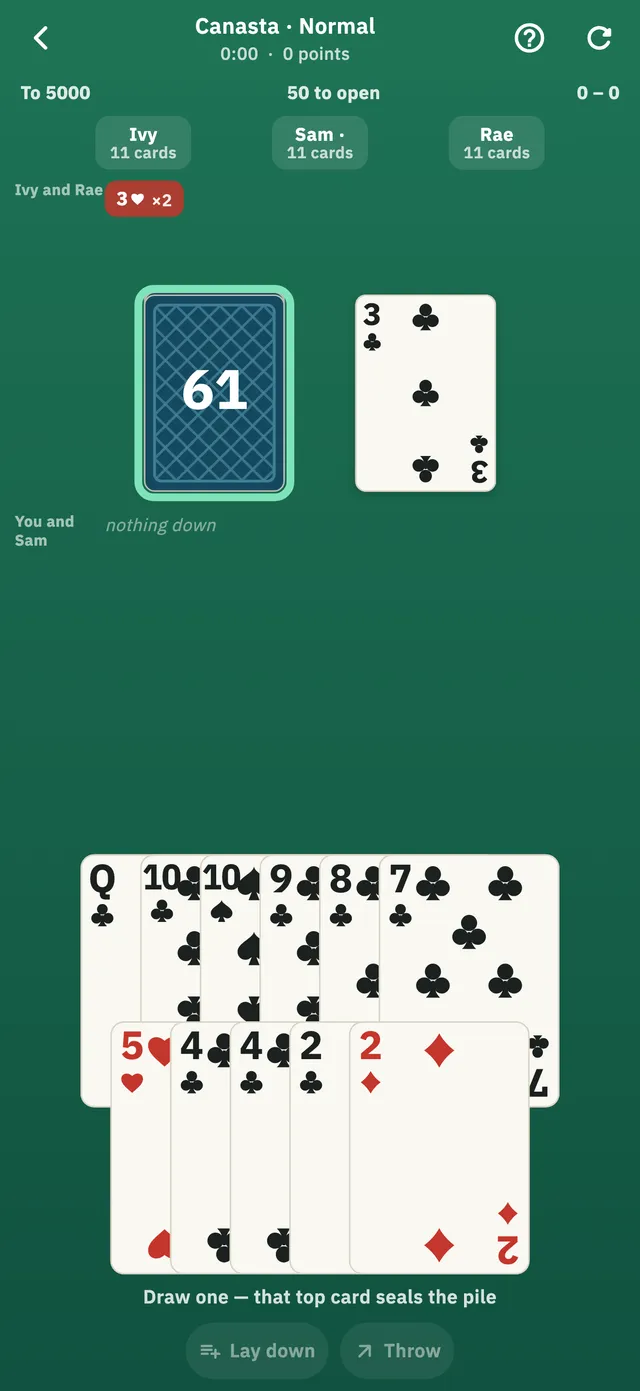
A wild card or a black three on top seals the pile: nobody may take it until another card is discarded on top. A red three turned up to start the pile seals it the same way.
Good to know
When the pile is out of reach, the line under your cards in Fireside says why, such as “Draw one — that top card seals the pile.”
Freezing the pile
A wild card on the discard pile freezes it, whether it was discarded there or turned up to start the pile, and so does a red three turned up to start it. The pile stays frozen until somebody takes it and keeps it.
A frozen pile can only be taken with two natural cards of the top card’s rank from your hand: a meld already on the table is not enough. So discarding a wild card late in a hand is a real decision.
Red threes and black threes
Red threes are a bonus. Whenever one comes to you, dealt, drawn or in a pile you take, it goes straight to the table and you draw a replacement while the stock lasts. Each is worth 100, and all four on one side are worth 800, but they count against a side that has not opened by the end of the hand.
Black threes block the pile: one on top means the next player cannot take it. You may meld black threes only on the turn you go out, as three or four black threes with no wild cards, made of the last cards in your hand. A black three left in your hand at the end costs 5.
Good to know
Fireside lays your red threes for you and draws the replacement, so you never hold one.
Opening: your side’s first melds
Before your side may put any melds down to stay, one of you has to lay down a minimum count in a single turn: the points of the cards laid that turn, added together. That first lay-down is your side’s opening, and the minimum depends on your side’s score.
| Your side’s score | Opening worth at least |
|---|---|
| Below 0 | 15 |
| 0 to 1,499 | 50 |
| 1,500 to 2,999 | 90 |
| 3,000 or more | 120 |
Everything laid that turn counts together, but canasta bonuses and red threes do not count toward it. If it comes up short, take it all back and try again on a later turn. If you took the pile for it, the pile goes back too, and you draw from the stock instead.
So the side that is ahead has to work harder to get started, which keeps a match from running away.
Going out
Your side needs at least one canasta before either of you may go out. Then you empty your hand, either by discarding your last card or by melding it, and the hand ends.
Going out is worth 100, or 200 with a concealed hand: going out in one turn without having melded anything before. Until your side has its canasta, you may not meld your hand down to fewer than two cards: one to discard and one to keep.
Scoring
When the hand ends, each side adds up:
- 500 for each clean canasta and 300 for each dirty one
- the points of every card in its melds, canastas or not
- its red threes: 100 each, or 800 for all four, taken off instead if it never opened
- the going-out bonus: 100, or 200 for a concealed hand
Then it takes off the points of every card still in its players’ hands. What is left, which can be below zero, is added to the side’s score.
| For | Points |
|---|---|
| A clean canasta: seven or more cards, no wild cards | 500 |
| A dirty canasta: seven or more cards, with a wild card | 300 |
| Each red three | 100 |
| All four red threes, on one side | 800 |
| Going out | 100 |
| Going out with a concealed hand | 200 |
For example, say your side ends a hand with a clean canasta of queens (500, plus 70 for the cards), a meld of three aces (60) and one red three (100), and you go out (100). Your partner is caught holding a king and a four (15 off), so your side scores 815 for the hand.
How the game ends
Hands are dealt one after another until a hand ends with one side at 5,000 or more and in the lead, and that side wins. If the two sides finish a hand level, play goes on.
A shorter match, to 2,500, is a house rule, described below.
The house rules people argue about
Canasta’s rules are more settled than those of most family card games, but tables still differ on how long a match runs and on what it takes to go out. Fireside lets your table choose both.
-
How long is the match?
The full game runs to 5,000, long enough for the opening minimum to climb with your score. A shorter match can be settled by one good pile.
- To 5000 Fireside’s standard The full game. The opening count climbs as your score does.
- To 2500 Two or three hands. One good pile can settle it.
In Fireside: House Rules, under The match, with Default turned off.
-
How many canastas does your side need to go out?
One canasta lets a good hand finish quickly. Two makes every hand longer and changes what everybody is playing for.
- One canasta Fireside’s standard The standard rule: once your side has a canasta, either of you may go out.
- Two canastas A much longer hand, and the second canasta becomes the thing everybody is playing for rather than a bonus collected on the way out.
In Fireside: House Rules, with Default turned off.
Fireside deals every game at its standard rules, the ones this page teaches, until you change them. To play your own way, open Canasta in the app, tap House Rules, turn off Default and choose. Your table stays as you set it, on your device, and the rules, the lesson and the practice game all follow it.
Learn it in Fireside
Tap How to Play on Canasta’s opening screen for three ways to learn, all of them following the house rules your table has set. Rules is the full rules sheet: what counts, what it is worth, and the order it all happens in.
Watch a Hand is one real deal, a step at a time, with the reason for every card and nothing to play. Practice Hand is a real hand with everybody’s cards readable, where the coach on the help button says what it takes to pick up the discard pile, and nothing is counted.
Quick answers
How many cards do you deal in Canasta?
Each of the four players gets 11 cards, from two packs and four jokers shuffled together, 108 cards in all. Any red three you are dealt goes straight to the table and is replaced from the stock.
What does a frozen pile mean in Canasta?
A wild card on the discard pile freezes it, and so does a red three turned up to start it. A frozen pile can only be taken with two natural cards of the top card’s rank from your hand, and it stays frozen until somebody takes it.
How many points do you need to go down in Canasta?
It depends on your side’s score: 50 at the start of a match, 90 from 1,500 and 120 from 3,000. A side whose score is below zero needs only 15, and only the cards laid that turn count.
What are red threes worth in Canasta?
Each red three is worth 100, and all four on one side are worth 800. They count against a side that has not opened by the end of the hand.
How do you go out in Canasta?
In Fireside’s standard game your side needs at least one canasta; then you empty your hand by melding your last card or discarding it. Going out is worth 100, or 200 with a concealed hand.