
Card games
How to play Hand and Foot
Hand and Foot is a partnership game from the Canasta family, for four players with five packs of cards. Everybody is dealt two sets of 11 cards, a hand to play first and a foot to finish with, and the big points come from books of seven cards of one rank.
- Players
- 4, in two partnerships; in Fireside, three computer players sit with you
- Equipment
- 5 packs with their jokers, 270 cards
- Deal
- 11 cards to your hand and 11 to your foot
- Goal
- Build books of seven and outscore the other side
- Length
- 4 rounds as standard; 2 or 5 rounds, or first to 10,000 or 20,000, as house rules
Play Hand and Foot on your phone or tablet
We’re two brothers, and we made Fireside Classic Games to play Hand and Foot by the rules on this page, along with 26 more classic games.


Play three games of Hand and Foot free, at Easy, Normal or Hard, before you decide. After that, a monthly or yearly subscription unlocks every game at every level, Expert included, with the first month free for new subscribers, or a one-time purchase unlocks them for good. Klondike, Hearts, Checkers and Number Place are free for good.
- No ads, ever
- Works offline, with no connection needed
- No account to make
- Large, clear cards that are easy to read
- A computer partner and two computer opponents, at four levels from Easy to Expert, each described before you start
- Pick the match, the packs, how much of the pile you take, when your foot arrives and what threes cost, or play Sevens From Hell
On this page
- The goal
- The cards and the deal
- What the cards are worth
- Books and wild cards
- A turn
- Your hand, then your foot
- Taking the discard pile
- Opening: your side’s first books
- Red threes and black threes
- Going out
- Scoring
- Printable score sheet
- How the game ends
- House rules
- Learn it in Fireside
- Quick answers
The goal
Hand and Foot is played by four people in two partnerships, partners sitting across from each other. You and your partner are a side, and everything either of you lays on the table belongs to the side.
Your side builds books: groups of three to seven cards of the same rank, laid face up on the table. Laying cards down like this is called melding. A book of exactly seven cards is closed, and it pays a bonus far bigger than the cards in it: 500 for a clean book, with no wild cards in it, and 300 for a dirty book, with one or two.
Fireside’s standard match is four rounds. Each round is scored when it ends, and the side with the higher total after the fourth round wins.
The cards and the deal
You need five standard 52-card packs, each with its two jokers, shuffled together: 270 cards in all. Jokers and twos are wild cards, which can stand in for other cards in a book. Every other card is a natural card.
- Deal each player 11 cards face down for their hand, and 11 more face down beside them for their foot.
- Pick up your hand. Your foot stays face down until your hand is gone.
- Turn the next card face up to start the discard pile. The rest go face down in the middle as the stock, which you draw from.
- The player to the dealer’s left goes first, and play passes to the left. Each new round, the deal moves one seat to the left.
What the cards are worth
Every card has a point value. It counts for your side when the card is in one of your books at the end of a round, and against your side when it is still in a player’s hand or foot.
| Card | Points |
|---|---|
| Joker (wild) | 50 |
| Two (wild) | 20 |
| Ace | 20 |
| King, queen, jack, 10, 9, 8 | 10 |
| 7, 6, 5, 4 | 5 |
| Red three played to the table | 100, or 100 against your side if it never opens |
| Red or black three left in a hand or foot | 5 against your side |
Books and wild cards
A book is built on one rank, from fours up to aces. It needs at least two natural cards, may hold no more than two wild cards, and must always have more natural cards than wild ones. So eight, eight, joker is a book, and so is five eights with two twos, but eight, eight, joker, two is not.
A book closes at exactly seven cards and takes nothing more. Your side may have only one unfinished book of a rank at a time, but once it closes you may start another, so a long round can see two or three books of eights. Suits never matter, and a three can never go into a book.
Good to know
When a wild card you play could go to more than one of your books, Fireside asks you where it goes. It can be worth several hundred points, so the choice is always yours.
A turn
- Draw. Take two cards from the stock, or take the discard pile (see below).
- Meld. Lay down whatever you can and want to: new books, cards added to your side’s unfinished books, and any red threes you choose to play.
- Discard. Put one card face up on the discard pile. That ends your turn.
When only one card is left in the stock, you take just that one. When the stock is empty and you cannot take the pile, the round is over.
Your hand, then your foot
You play your hand first, and while you are in it you may meld every card you have. The moment its last card is gone, you pick up your foot. If you melded that last card, your turn carries on with the foot; if you discarded it, you pick the foot up, but your turn is over.
Nobody can go out without reaching their foot, so a round has two halves for every player. A foot that is never picked up counts all 11 of its cards against your side at the end.
Taking the discard pile
Instead of drawing from the stock, you may take the discard pile, but only when you hold two natural cards of the top card’s rank. Wild cards do not count as either of the two, and a book of that rank already on the table does not excuse them. Nobody may take the pile while a wild card or a three is on top.
The top card and your two naturals go straight to the table as you take the pile: as a new book, or onto your side’s unfinished book of that rank. If that book has room for fewer than three, it is filled to exactly seven and the rest start the next book, which takes more cards from your hand.
You take the top card and the six beneath it, or every card if the pile holds fewer than seven. Whatever does not go to the table goes into your hand.
If your side has not opened yet, you may take the pile only if those cards and other books from your hand can make your opening that turn (see below). And nobody may take it if it would leave them unable to end their turn.
Good to know
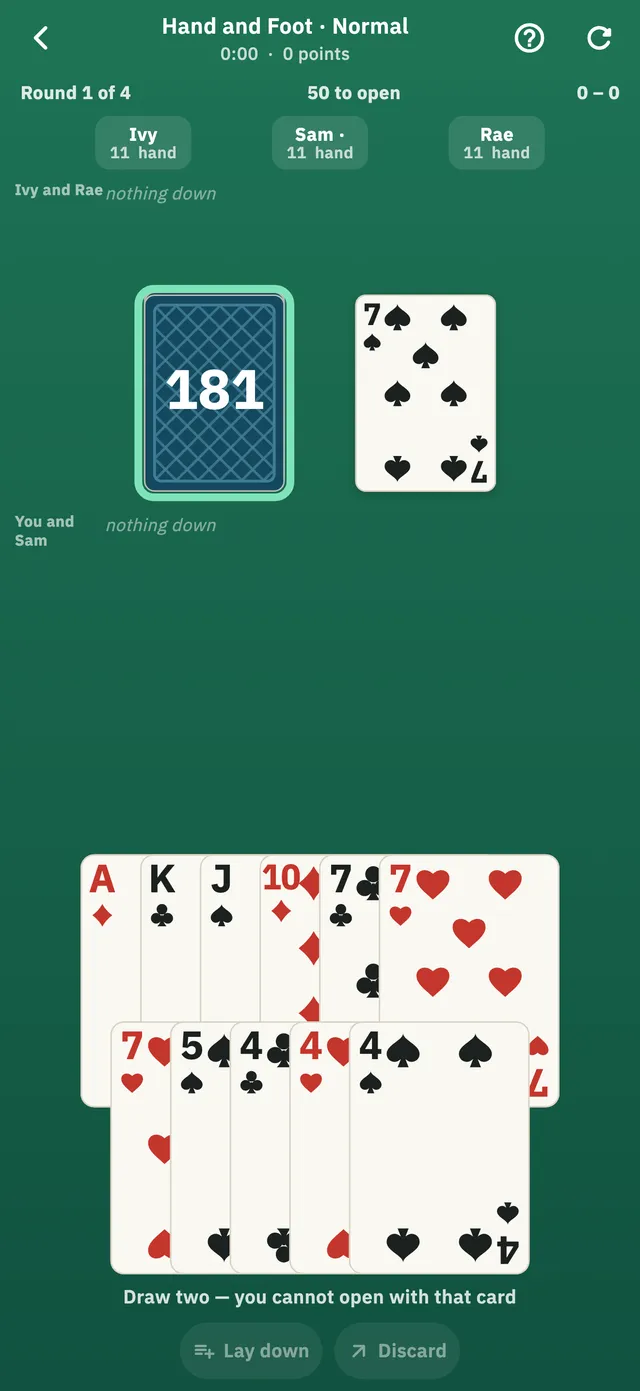
When the pile is out of reach, the line under your cards in Fireside says why, such as “Draw two — you cannot open with that card.”
Opening: your side’s first books
Before your side may put any books on the table to stay, one of you has to lay down a minimum count in a single turn. That first lay-down is your side’s opening. The count is the points of the cards laid that turn, added together; book bonuses and red threes do not count toward it.
| Round | Opening worth at least |
|---|---|
| 1 | 50 |
| 2 | 90 |
| 3 | 120 |
| 4 | 150 |
Books go down one at a time, and everything laid that turn counts together. If it comes up short, take it all back and try again on a later turn. If you took the pile for it, the pile goes back too, and you draw from the stock instead.
Once your side has opened, either of you may lay down any legal book for the rest of the round.
Red threes and black threes
A red three is a gamble. On your turn you may play it to the table as a move of its own, and you draw a card from the stock to replace it while the stock lasts. Each red three on the table is worth 100 to your side if your side opens that round, and 100 against it if it never does.
Black threes are only good for discarding. A three of either color can never go into a book, and one on top of the discard pile means nobody can take it. Any three still in a hand or foot when the round ends costs its side 5.
Good to know
Fireside never plays a red three for you: choose it and tap Play red 3 when you decide to.
Going out
Going out ends the round, and it is worth 100 to your side. To go out, you must be playing from your foot, and your side must have closed at least one clean book and at least one dirty book. Then you discard your last card: you cannot go out by melding it.
Until your side has both of those books, a player in their foot must keep two cards back from the table: one to discard and one to hold. In your hand, before the foot, there is no such limit.
Good to know
Two clean books are not enough on their own: your side needs a dirty book too before anybody may go out.
Scoring
When the round ends, each side adds up:
- 500 for each clean book and 300 for each dirty book
- the points of every card in its books, closed or unfinished
- 100 for each red three it has on the table, or 100 off for each one if it never opened
- 100 if one of its players went out
Then it takes off the points of every card still in its players’ hands and feet; a foot never picked up counts all 11 of its cards. What is left, which can be below zero, is added to the side’s score.
| For | Points |
|---|---|
| A clean book: seven cards, no wild cards | 500 |
| A dirty book: seven cards, one or two wild cards | 300 |
| Each red three on the table | 100, or 100 against a side that never opens |
| Going out | 100 |
For example, say your side ends a round with a clean book of kings (500, plus 70 for the cards), a dirty book of five fives and two twos (300, plus 65) and a red three on the table (100), and your partner went out (100). You are caught holding a jack and a black three (15 off), so your side scores 1,120 for the round.
How the game ends
Fireside’s standard match is four rounds, and the opening minimum climbs each round: 50, 90, 120, then 150. After the fourth round, the side with the higher total wins.
Shorter and longer matches, and matches played to a score, are house rules. They are below, with everything else tables play differently.
The house rules people argue about
Hand and Foot has no official rule book. It spread from one kitchen table to the next, so almost every part of it is played two or three ways, and Fireside lets your table choose each one.
-
How long is the match?
Each match length also sets what it costs to open: round by round, or by your side’s score.
- Four rounds Fireside’s standard The full game: 50 to open in the first round, then 90, 120 and 150.
- Two rounds The first round costs 50 to open and the second 90. Half the evening.
- Five rounds The four rounds, and then a fifth where nothing but a finished clean book of seven, laid in one turn, will open your side.
- First to 10,000 As many rounds as it takes, until a round ends with one side at 10,000 or more and in the lead. The count to open climbs to 150 and stays there.
- First to 20,000 A long match, until a round ends with one side at 20,000 or more and in the lead. What it costs to open depends on your side’s score: 15 below zero, 50 below 5,000, 90 below 10,000, 120 below 15,000, and 150 from 15,000 on.
In Fireside: House Rules, under The match, with Default turned off.
-
How many packs do you shuffle together?
More packs make seven of a rank easier to reach and the rounds longer.
- Five packs Fireside’s standard One a player and one over, 270 cards with the jokers, which makes seven of a rank a reasonable thing to go looking for.
- Six packs Four more of every rank, 324 cards in all. Books close more often and the stock lasts longer.
In Fireside: House Rules, with Default turned off.
-
What does your side need before anybody may go out?
It sets how long a round runs, because nobody can end it until their side has the books.
- One clean and one dirty Fireside’s standard The usual rule: at least one closed book of each kind, and a round ends when somebody is ready.
- Two of each At least two clean books and two dirty ones. Played in a great many houses, and a considerably longer round, because each side needs twice as many books.
In Fireside: House Rules, with Default turned off.
-
How much of the discard pile do you take?
Taking the pile always needs the same thing: two natural cards of the top card’s rank, melded with it at once. What changes is how much of the pile comes with it.
- The top seven Fireside’s standard The card you take and six beneath it.
- The top five The card you take and four beneath it. A smaller bite, and a pile that stays worth fighting over for longer.
- The whole pile Every card in it, however deep it has grown, so a pile nobody has managed to take becomes a prize.
- Eight, once it is eight deep Nobody may take the pile until it holds eight cards, and then they take eight. It keeps the pile alive early in the round.
In Fireside: House Rules, with Default turned off.
-
What happens when your hand runs out?
Reaching your foot is the turning point of a round, and houses disagree on whether you may play from it at once.
- Straight into it Fireside’s standard Melding your last card picks the foot up and your turn carries on. Discarding your last card picks it up and ends the turn.
- Foot up, turn over You pick the foot up as soon as the hand is gone, but you play none of it until your next turn.
- Draw first, then look The foot stays face down until your next turn, and you draw from the stock before you may see it.
In Fireside: House Rules, with Default turned off.
-
What is a red three for?
At some tables a red three is 100 points and an extra card; at others it is a card to be rid of.
- Played to the board for one hundred Fireside’s standard You may play a red three to the table as a move of its own and draw a card to replace it while the stock lasts. It is worth 100 to a side that opens and 100 against one that never does.
- Only ever discarded Red threes are worth nothing on the table and cannot be played there. They are cards to be rid of.
In Fireside: House Rules, with Default turned off.
-
What does a red three left in your hand or foot cost?
This is a separate question from what a red three on the table is worth, so a table may play red threes to the table and still punish the ones that never got there.
- −5 Fireside’s standard The ordinary 5 points it is worth.
- −100 The same as a red three on the table is worth, the other way around.
- −300 A dirty book against you for one card left behind.
- −500 A clean book against you, which makes every red three a real danger.
In Fireside: House Rules, with Default turned off.
-
What does a black three left in your hand or foot cost?
A black three can never be melded, so its price decides how hard you work to discard it.
- −5 Fireside’s standard The ordinary 5 points it is worth.
- −100 Enough that a black three is worth a turn to be rid of.
- −300 A dirty book against you for one card nobody could ever meld.
In Fireside: House Rules, with Default turned off.
-
Do you play Sevens From Hell?
A famous house rule, and a genuinely nasty one: a hand that fills up with sevens has nowhere to put them.
- Off Fireside’s standard Sevens are ordinary cards and may be discarded like any other.
- On Nobody may discard a seven until somebody has closed a clean book of sevens. If every card you have left is a locked seven and you have nothing to meld, your turn ends with nothing discarded.
In Fireside: House Rules, with Default turned off.
Fireside deals every game at its standard rules, the ones this page teaches, until you change them. To play your own way, open Hand and Foot in the app, tap House Rules, turn off Default and choose. Your table stays as you set it, on your device, and the rules, the lesson and the practice game all follow it.
Learn it in Fireside
Tap How to Play on Hand and Foot’s opening screen for three ways to learn, all of them following the house rules your table has set. Rules is the full rules sheet: what counts, what it is worth, and the order it all happens in.
Watch a Hand is one real deal, a step at a time, with the reason for every card and nothing to play. Practice Hand is a real hand with everybody’s cards readable, where the coach on the help button says what it takes to pick up the discard pile, and nothing is counted.
Quick answers
How many cards do you deal in Hand and Foot?
Each player gets two sets of 11 cards: a hand, which you pick up and play first, and a foot, which stays face down until your hand is gone. In Fireside’s standard game they come from five packs shuffled together with their jokers, 270 cards in all.
How many points do you need to go down in Hand and Foot?
In Fireside’s standard four-round match, your side’s opening must be worth at least 50 points in the first round, then 90, 120 and 150. Only the cards laid that turn count, not book bonuses or red threes, and other match lengths set other figures.
What is the difference between a clean book and a dirty book?
Both are closed books of seven cards of one rank. A clean book has no wild cards and earns a 500-point bonus; a dirty book has one or two and earns 300. Your side needs at least one of each before anybody may go out.
How do you pick up the pile in Hand and Foot?
You need two natural cards of the top card’s rank in your hand, and wild cards do not count. The top card and your pair go straight to the table, and in Fireside’s standard game you take the top seven cards of the pile.
What are red threes worth in Hand and Foot?
In Fireside’s standard game, a red three played to the table is worth 100 to your side if your side opens that round, and 100 against it if it never does. One left in a hand or foot at the end costs 5, and house rules can raise that to 100, 300 or 500.