
Board and tile games
How to play Dominoes
Dominoes is one game with many tables: the same line of tiles and the same duty to play if you can, scored a different way almost everywhere it is played. This page teaches the partnership block game played across Latin America and the Caribbean, Fireside’s standard, then the draw game, All Fives and four more.
- Players
- 4, in two partnerships (or one on one, or four each alone)
- Equipment
- A double-six set (28 tiles); a double-nine set for the Cuban game
- Goal
- First side to 100 points
- Length
- 100 points, usually four or five hands
- Ways to play
- Seven, from the block game to All Fives
Play Dominoes on your phone or tablet
We’re two brothers, and we made Fireside Classic Games to play Dominoes by the rules on this page, along with 26 more classic games.


Play three games of Dominoes free, at Easy, Normal or Hard, before you decide. After that, a monthly or yearly subscription unlocks every game at every level, Expert included, with the first month free for new subscribers, or a one-time purchase unlocks them for good. Klondike, Hearts, Checkers and Number Place are free for good.
- No ads, ever
- Works offline, with no connection needed
- No account to make
- Large, clear tiles that are easy to read
- Four levels of computer opponent, from Easy to Expert, each described before you start
- Choose from seven ways to play, then set the target, the lead, the bonuses and how a blocked hand is settled
On this page
Seven ways to play
Fireside plays dominoes seven ways, picked under Set Difficulty, The game. The standard game, Partners, is taught in full first; each of the others has a short section further down saying what changes.
- Partners, the block game: four players in two partnerships, 7 tiles each, and nobody draws.
- Draw, one on one: the draw game for two, with a boneyard.
- Fives, one on one: All Fives, scoring multiples of five as you play.
- Cuban double nine: partners with a 55-tile set and 10 tiles each.
- Brazilian, to six: partners, scored by how you go out.
- Jamaican, six-love: partners, and six hands in a row to win.
- Solo, four players: four players and no partners.
The goal
In the standard game, you and your partner sit across from each other and play against the other two. Get rid of your tiles before anybody else does, and leave the other side holding as many pips (the spots on the tiles) as possible when you do. The first side to 100 points wins the game.
The tiles
Partners uses a double-six set: 28 tiles, every pair of numbers from blank to six once each, so each number turns up on seven tiles. Shuffle them face down, and each player takes 7.
That is every tile in the set, so whatever is not on the table is in somebody’s hand. Nobody draws in this game: it is a block game.
Who leads
The first hand is opened by whoever holds the double six, and they must open with it. After that, whoever won the last hand leads the next, with any tile they like.
After a blocked hand, the lead goes to whichever partner on the winning side held fewer pips. If a blocked hand comes out level, the lead passes one seat to the right.
Playing
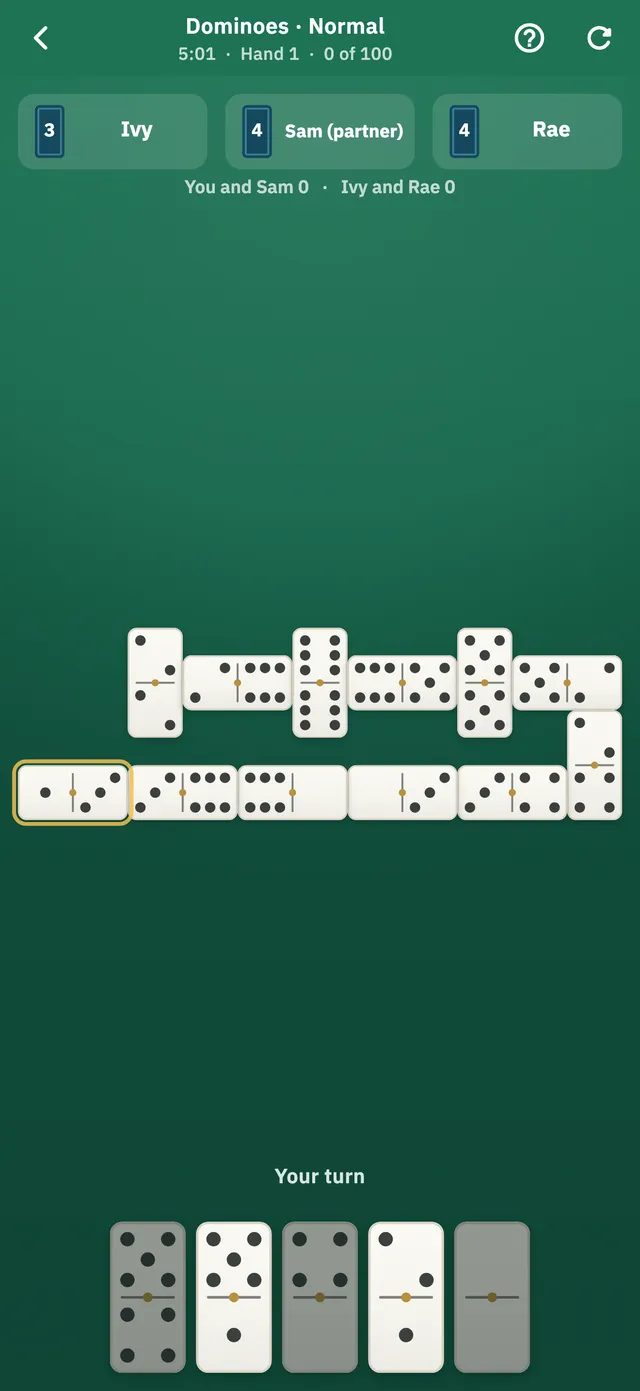
Play goes around to the right. On your turn, put down one tile that matches a number at either open end of the line: a four goes against a four. Doubles go crosswise, and the line only ever has two ends.
If nothing fits, you pass. If you can play, you must.
Good to know
Play goes to the right, as it does across Latin America and the Caribbean, not to the left as in most card games. Of Fireside’s ways to play, only the Brazilian game goes to the left.
Going out
Put down your last tile and the hand is over: domino. Your side wins it, whichever of the two of you went out.
A blocked hand
Sometimes nobody can play, because every tile that would fit is already down. That is a tranque, a blocked hand, and the pips decide it. Each side adds up the pips both partners are holding, and the lower total wins. If it comes out level, nobody scores.
Scoring
The side that wins a hand scores the pips the losers are still holding. Whatever the winners have left counts for nothing.
Go out while the other side holds the six-four and the three-blank, and your side scores 13.
Winning the game
The first side to 100 points wins the game. Win it before the other side has scored at all and that is a shutout: a chiva in Puerto Rico, a zapato in Venezuela.
Draw, one on one
The draw game, for two. You and one opponent each take 7 tiles from the double-six set, and the other 14 go face down to one side as the boneyard.
The first hand is opened by whoever holds the highest double, and it must be that double. If nothing in your hand fits, draw from the boneyard until something does, and play it. Once the boneyard is empty, a player who cannot play passes.
Going out wins the hand; in a blocked hand, whoever holds fewer pips wins it. The winner scores the pips the loser is still holding, and the first to 100 points wins.
Fives, one on one (All Fives)
All Fives is the draw game for two with a second way to score. Every time you play, add up the open ends of the line, and if they come to a multiple of five, you score that many at once.
A double at an end counts both its halves, so a five-five showing at one end is worth 10 by itself. The first tile of a hand counts all its pips: lead the six-four and you score 10.
The spinner. The first double played is a spinner. Tiles go against both its sides first; after that the line can grow off its two ends as well, so there can be four ends to play on and to count. Until both its sides are covered the spinner counts both its halves, and after that it counts only through the lines grown off it.
The leader of the first hand is drawn by lot and may lead any tile, and you draw from the boneyard as in the draw game. Whoever goes out, or holds fewer pips in a blocked hand, scores the pips the other player is still holding, rounded to the nearest five: 12 counts 10, and 13 counts 15.
The first to 250 points wins, and reaching it ends the game there and then, even in the middle of a hand.
Cuban double nine
Partners with a double-nine set: 55 tiles, blank to nine. Each player takes 10, and the other 15 stay face down all hand, never seen, so nothing can be counted for certain.
The leader of the first hand is drawn by lot and may lead anything. A blocked hand goes to the side of the one player holding the fewest pips, whatever their partner holds, and that player leads the next hand. A hand dealt five or more doubles is thrown in and the tiles are shuffled again.
The game is to 100. Win it before the other side has scored and that is a pollona; score 100 or more in a single hand and that is a viajera.
Brazilian, to six
Partners with a double-six set and 7 tiles each, but play goes to the left, and a hand is scored by how you go out rather than by the pips. The double six opens the first hand, and after that the winners of each hand lead the next.
| Your last tile | Called | Points |
|---|---|---|
| An ordinary tile | batida | 1 |
| A double | carroça | 2 |
| A tile that fits both ends, showing different numbers | lá-e-lô | 3 |
| A double, with both ends showing its number | cruzada | 4 |
A blocked hand earns the side holding fewer pips between them 1 point. If the two sides are level, nobody scores, and the next hand counts double. The first side to 6 points wins.
Jamaican, six-love
Partners with a double-six set and 7 tiles each, and every hand won is worth 1 point: no pips, no bonuses. Win six hands in a row and you win the game six-love.
Win a hand while the other side has points on the board, and instead of scoring, you wipe the board back to love-all, nothing to nothing. A blocked hand goes to the side of the one player holding the fewest pips.
The double six opens the first hand, and opens again at love-all and after a tied hand; otherwise the winners of the last hand lead.
Solo, four players
Four players and no partners, with a double-six set and 7 tiles each. Whoever goes out scores every pip the other three are still holding, and in a blocked hand the single player holding the fewest pips wins it. The first player to 100 points wins.
Gallinazo, a house rule below, turns the scoring around: seven deals in which everybody pays for what they are left holding, and the lowest total wins.
The house rules people argue about
Nearly every country that plays dominoes, and often every town, keeps score its own way, and tables argue about all of it. Fireside lets your table play it your way. Each rule below says which ways to play it belongs to, and the House Rules sheet shows only the ones for the game you have chosen.
-
Which way do you want to play?
The seven ways share the line of tiles and the duty to play, and differ in the set, the deal and above all the scoring.
- Partners Where Fireside starts You and Sam against Ivy and Rae, seven tiles each from a double-six set, and nobody draws. The game across Latin America and the Caribbean.
- Cuban double nine Partners with a 55-tile set: ten tiles each, and 15 that never come out of the box, so nothing can be counted for certain. Havana and Miami.
- Brazilian, to six Partners, scored by how you go out: one point, two for a double, three for a tile that fits both ends. Play goes to the left.
- Jamaican, six-love Partners, a point a hand, and six in a row to win: every hand the other side takes sends the score back to love-all.
- Solo, four players Four players and no partners: whoever goes out takes every pip the other three are holding.
- Draw, one on one You and Sam, seven tiles each, and a boneyard to draw from when nothing fits.
- Fives, one on one All Fives: score whenever the open ends add up to a multiple of five, with the first double spinning off in four directions.
In Fireside: Set Difficulty, under The game
-
What score wins the game?
For Partners, Solo and Draw. A longer game gives a bad hand or two the time to even out.
- One hundred Fireside’s standard Most kitchen tables from Santo Domingo to Mexico City. Four or five hands.
- Two hundred Puerto Rico’s favorite, and the length every tournament plays.
- Five hundred Puerto Rico’s quinientos. A long game; pair it with the Puerto Rican bonuses.
In Fireside: House Rules, with Default turned off.
-
Whose tiles count when a hand is won?
For Partners and the Cuban game. Counting every tile left adds the winners’ own leftovers to the score, so hands are worth more.
- The losers’ tiles Fireside’s standard The winners score what the other side is still holding, and their own leftovers count for nothing. Cuba, Venezuela, Mexico, Colombia.
- Every tile left The winners score every pip still held at the table, their partner’s included. Puerto Rico, and every tournament.
In Fireside: House Rules, with Default turned off.
-
Are there bonuses on top of the count?
For Partners. Bonuses reward going out in style and add points the count alone would not.
- None Fireside’s standard A hand is worth its count and nothing more.
- Dominican Twenty-five each for a capicúa (going out with a tile that fits both ends, when they show different numbers), a pase de salida (the player after the leader cannot answer the first tile, and the side that led scores) and a pase corrido (you play a tile every other player has to pass on, so the turn comes straight back to you).
- Puerto Rican One hundred each for a capicúa and a chuchazo (going out with the double blank), and 100, 75, 50 and 25 more for the first four hands of the game won by going out. Hands won in a tranque do not count toward those four.
In Fireside: House Rules, with Default turned off.
-
Who opens the first hand?
For Partners. Opening with the double six gets the heaviest tile out at once; a leader drawn by lot may start with anything.
- The double six leads Fireside’s standard Whoever holds it opens with it: el burro, la cochina, la mula de seis.
- Drawn by lot The leader is drawn at random and may lead anything, as tournaments do it.
In Fireside: House Rules, with Default turned off.
-
Who leads after the first hand?
For every way to play except the Jamaican, which settles the lead itself. Letting the winner lead hands a winning side the next start too.
- The winner leads Fireside’s standard Whoever won the last hand opens the next one.
- The lead goes round One seat a hand, and the leader may put down anything. Venezuela, and every tournament.
In Fireside: House Rules, with Default turned off.
-
Who wins a blocked hand?
For Partners. With nobody drawing, a hand can block at any time, and this decides who takes it.
- Lower pair wins Fireside’s standard Each side adds up both partners’ pips, and the lower total takes the hand.
- Lowest hand wins The one player holding the fewest pips wins it for their side. Cuba and Colombia.
- Con el de abajo The player who shut the line is held up against the next player only, and the lower of those two hands wins. The Dominican rule.
In Fireside: House Rules, with Default turned off.
-
Who takes a blocked hand that ties?
For Partners, the Cuban game, Draw, and Solo unless it is played as Gallinazo.
- Nobody scores Fireside’s standard Shuffle up and play on. Cuba, Venezuela and the tournaments.
- The side that led La mano gana: whoever opened the hand takes it.
- The side that shut it Whoever played the tile that blocked the line takes it.
In Fireside: House Rules, with Default turned off.
-
What happens to a hand with five doubles?
For Partners. A double fits one number only, so a hand of five doubles has little hope.
- Play it out Fireside’s standard Cinco dobles se juega: whatever you are dealt, you play.
- Shuffle again A hand that hopeless is thrown in and the tiles are shuffled again.
In Fireside: House Rules, with Default turned off.
-
How far do you draw from the boneyard?
For Draw and Fives. Leaving two tiles behind keeps a little doubt about what is left.
- Drawn to the last tile Fireside’s standard Keep drawing until something fits or the boneyard is empty.
- The last two stay The last two tiles are never drawn, so nobody can be sure what is left.
In Fireside: House Rules, with Default turned off.
-
What score wins a game of Fives?
For Fives. The target sets how long a game runs.
- Two hundred and fifty Fireside’s standard The standard game for two players.
- Two hundred What three or four players go to, and a little quicker for two.
- One hundred and fifty A brisk game of a few hands.
In Fireside: House Rules, with Default turned off.
-
How many tiles does each player take in Fives?
For Fives. More tiles in hand means more to plan with and less left to draw.
- Seven Fireside’s standard The usual deal, leaving 14 in the boneyard.
- Nine The more demanding game: more to plan with, and only 10 in the boneyard.
In Fireside: House Rules, with Default turned off.
-
Does the first double spin?
For Fives. A spinner gives four ends to play on and to score; without one there are only ever two.
- Spins Fireside’s standard All Fives as American tournaments play it: once both its sides are covered, the line grows off its ends too, and four ends score.
- Stays in the line Muggins in a straight line: every double goes crosswise and there are only ever two ends.
In Fireside: House Rules, with Default turned off.
-
What score wins a Cuban game?
For the Cuban game. Havana and Miami disagree on how long a game should run.
- One hundred Fireside’s standard The Cuban game as Havana plays it.
- One hundred and fifty Miami’s favorite, in the parks of Little Havana.
- Two hundred A long game, as some towns play it.
In Fireside: House Rules, with Default turned off.
-
Who wins a blocked hand in the Cuban game?
For the Cuban game. Counting the single lowest hand rewards the player who has shed the most, whatever their partner holds.
- Lowest hand wins Fireside’s standard The one player holding the fewest pips wins it for their side, as Cuba plays it.
- Lower pair wins Each side adds up both partners’ pips, and the lower total takes the hand.
In Fireside: House Rules, with Default turned off.
-
What happens to a Cuban hand with five doubles?
For the Cuban game, where ten doubles in the set make such a hand more likely.
- Shuffle again Fireside’s standard Show them and the tiles are shuffled again, as Cuba plays it.
- Play it out Whatever you are dealt, you play.
In Fireside: House Rules, with Default turned off.
-
What is a cruzada worth?
For the Brazilian game. A cruzada, going out with a double that fits both ends, is the rarest way to go out.
- Four points Fireside’s standard Four in most of Brazil’s published rules.
- Six — the game As some Brazilian tables have it: a cruzada wins the game outright from nothing.
In Fireside: House Rules, with Default turned off.
-
Is every tile dealt in the Brazilian game?
For the Brazilian game. Tiles left face down mean a number can run out without anybody knowing.
- Seven each Fireside’s standard Every tile in the set is dealt.
- Six each, four asleep As Pernambuco and Paraíba play it: four tiles stay face down, so a number can run out unseen. The first hand is opened by whoever holds the highest double.
In Fireside: House Rules, with Default turned off.
-
Must the six hands come in a row?
For the Jamaican game. Wiping the slate makes every hand the other side wins hurt.
- Love-all when they win Fireside’s standard Six hands in a row: every hand the other side wins wipes the slate. The Jamaican game.
- Straight six The first side to win six hands, however many the other side has won.
In Fireside: House Rules, with Default turned off.
-
Is going out on the key bone worth more?
For the Jamaican game. The key bone is the one tile left that fits both ends, when every other tile of both numbers is down.
- An ordinary hand Fireside’s standard Every hand won is worth 1 point, however it is won.
- Worth two Going out on the only tile left that fits both ends counts double.
In Fireside: House Rules, with Default turned off.
-
How is the solo game scored?
For Solo. Gallinazo makes everybody pay for what they hold, so every hand counts against everybody.
- The winner takes the count Fireside’s standard Whoever goes out scores every pip the other three are holding, to the target.
- Gallinazo Seven deals, and everybody pays for what they are left holding; whoever goes out pays nothing. In a blocked hand, the player who shut the line pays four times over unless their hand is strictly the lowest. The lowest total after the seventh deal wins, a tie for lowest plays another deal, and the highest buys the beer. San Lorenzo and Guadalajara.
In Fireside: House Rules, with Default turned off.
Fireside deals every game at its standard rules, the ones this page teaches, until you change them. To play your own way, open Dominoes in the app, tap House Rules, turn off Default and choose. Your table stays as you set it, on your device, and the rules, the lesson and the practice game all follow it.
Learn it in Fireside
How to Play holds the rules sheet for whichever way your table plays, written with its house rules in force; the lesson and the practice game follow them too.
Watch a Hand shows one real hand a tile at a time, with the reason for every play; there is nothing to play.
Practice Hand is a real game with everybody’s tiles readable and a coach on the help button that says what it would play and why. Nothing is counted.
Quick answers
How many dominoes does each player get?
In a four-player game with a double-six set, 7 each, which deals out all 28 tiles, so nobody draws. In the draw game for two, each player also takes 7 and the other 14 are the boneyard; in the Cuban game, with a double-nine set, each player takes 10.
What is the difference between block and draw dominoes?
In the block game nobody draws: a player who cannot play passes. In the draw game, a player who cannot play draws from the boneyard until something fits. Fireside’s standard game, Partners, is a block game, and Draw, one on one, is the draw game.
Who goes first in dominoes?
In Fireside’s standard game, whoever holds the double six opens the first hand with it. After that, the winner of each hand leads the next with any tile.
What happens when nobody can play?
The hand is blocked, a tranque, and the pips decide it. In Fireside’s standard game each side adds up both partners’ pips and the lower total wins the hand; if the totals are level, nobody scores.
How do you score in dominoes?
In the standard partners game, the side that goes out scores the pips the losers are still holding, and the first side to 100 wins. In All Fives you also score whenever the open ends add up to a multiple of five.