
Board and tile games
How to play Texas 42
Texas 42 is bridge played with dominoes: four players in two partnerships bid for the right to name trumps, then take tricks and count dominoes to make the bid. It is the state domino game of Texas, and a real partnership game.
- Players
- 4, in two partnerships
- Equipment
- A double-six set of dominoes (28 tiles)
- Deal
- 7 tiles each, and no boneyard
- Goal
- Make your bid, or set the other side’s
- Length
- First side to 7 marks
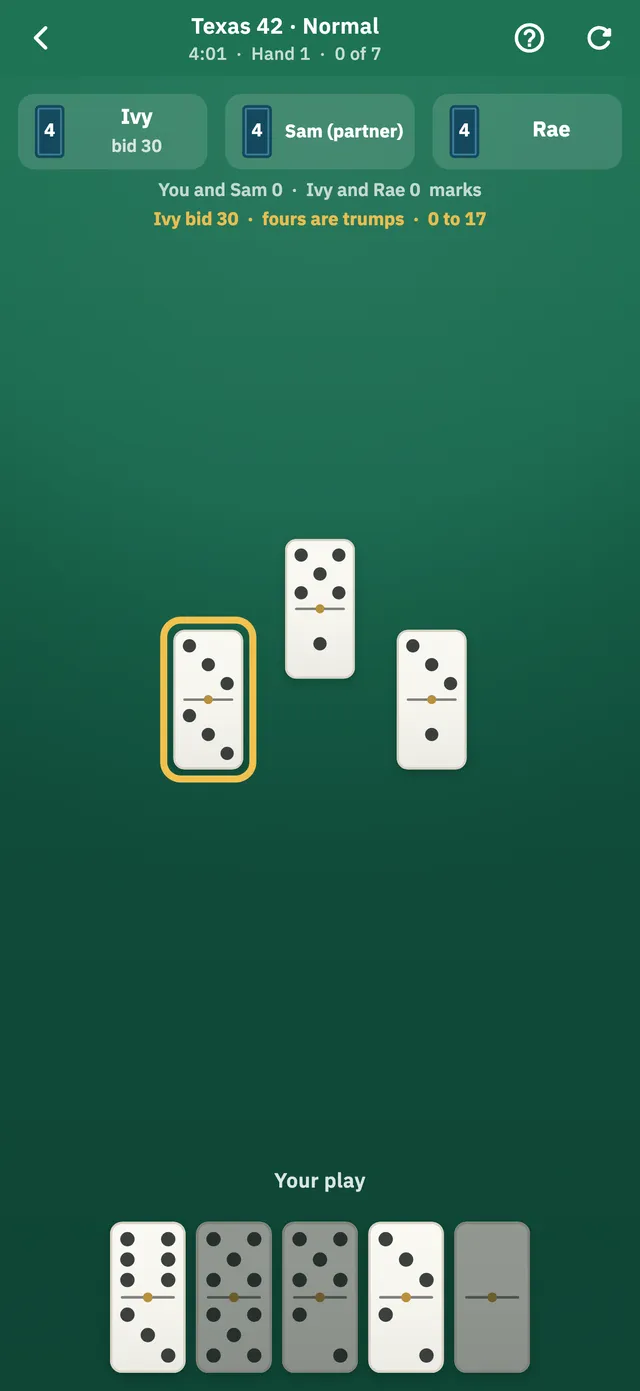
Play Texas 42 on your phone or tablet
We’re two brothers, and we made Fireside Classic Games to play Texas 42 by the rules on this page, along with 26 more classic games.


Play three games of Texas 42 free, at Easy, Normal or Hard, before you decide. After that, a monthly or yearly subscription unlocks every game at every level, Expert included, with the first month free for new subscribers, or a one-time purchase unlocks them for good. Klondike, Hearts, Checkers and Number Place are free for good.
- No ads, ever
- Works offline, with no connection needed
- No account to make
- Large, clear tiles that are easy to read
- Four levels of computer opponent, from Easy to Expert, each described before you start
- Pick marks or points, a stuck dealer or a fresh shake, and who may go Nello
On this page
The goal
Four players sit in two partnerships, partners facing each other across the table. Each hand begins with bidding for the right to name trumps. The side that wins the bid, the bidders, must then take at least as many points as it bid, and the other side tries to stop it.
Making the bid, or setting it (stopping the bidders short), earns marks. The first side to 7 marks wins the game.
The tiles and the deal
Texas 42 uses a double-six set: 28 tiles, every pair of numbers from blank to six once each. The tiles are shuffled face down, which 42 players call the shake, and each player takes 7. Every tile is dealt, so there is no boneyard.
The deal passes one seat to the left after every hand.
The count: 42 points a hand
Every hand holds exactly 42 points. Each of the seven tricks is worth 1 point, and five tiles, the count dominoes, carry 35 more between them. Whoever takes a trick takes any count dominoes in it.
| Tile | Points |
|---|---|
| Five-five | 10 |
| Six-four | 10 |
| Five-blank | 5 |
| Four-one | 5 |
| Three-two | 5 |
| Each of the 7 tricks | 1 |
Good to know
An easy way to remember the count: each count domino is worth its own pips. The two whose pips add up to 10 are worth 10, and the three that add up to 5 are worth 5.
Bidding
There is one round of bidding. It starts with the player on the dealer’s left and ends with the dealer. Each player in turn either passes or bids higher than the last bid.
Bids in points run from 30 to 41: bid 34, and your side must take at least 34 of the 42 points. Above 41, players bid marks. A bid of 1 mark means taking all 42 points, which means winning every trick, and so does any bid in marks.
The first bid in marks may be 1 or 2 marks. Each bid after it may go up by only one mark.
If everybody passes
If the first three players pass, the dealer is stuck with the bid and must bid at least 30. That is why a dealer’s partner holding a middling hand will often bid 30, to spare the dealer the trouble.
Some tables shake the tiles again instead. That is one of the house rules below.
Naming trumps
Whoever made the high bid names trumps, choosing one of these:
- A suit, blanks through sixes. Every tile carrying that number is a trump. The double ranks highest, then the rest by their other end: with sixes as trumps, the six-six, then the six-five, and so on down to the six-blank.
- Doubles. The seven doubles are the trumps, from the double six down to the double blank.
- Follow me. No trumps at all: the highest tile of the suit led takes each trick.
- Nello, where the house allows it: a bid to lose every trick, explained below.
The bidder then leads the first trick, with any tile.
Good to know
A tile carrying the trump number is a trump and nothing else. With sixes as trumps, the six-two is a trump, not a two.
The suits
A tile that is not a trump belongs to both of its numbers: the five-three is in the fives and in the threes. Led, though, it counts as its higher number, so leading the six-two leads sixes.
In each suit the double ranks highest, and the other tiles rank by their other end: in fives, the five-five beats the five-four, which beats the five-three. In follow me, the doubles stay highest.
Playing the tricks
- The leader plays any tile. A trump leads trumps; any other tile leads the suit of its higher number.
- Going to the left, each player must follow suit if they can. When a trump is led, following suit means playing a trump.
- A player who cannot follow may play any tile. Trumping is allowed, but never required.
- The highest trump takes the trick. If no trump was played, the highest tile of the suit led takes it.
- Whoever takes the trick leads the next one.
Scoring
If the bidders take at least what they bid, they score 1 mark, or as many marks as they bid. If they fall short, the other side scores those marks instead. Only one side scores in a hand.
Bid 30 and take 31, and your side scores 1 mark. Bid 2 marks and lose a single trick, and the other side scores 2.
The hand ends the moment it is decided: as soon as the bidders have their points, or the other side has taken enough to set them.
Nello
In Fireside’s standard game, a dealer stuck with the bid may declare Nello instead of naming trumps. Nello is worth 1 mark, whatever the dealer was stuck at.
The bidder’s partner lays their tiles down and sits out the hand, and there are no trumps. The bidder leads and must lose every trick; taking even one sets the bid.
The doubles form a suit of their own, the double six highest. When a double is led, you must answer with a double if you have one.
Winning the game
The first side to reach 7 marks wins the game. Some family tables keep score in points instead, playing to 250; Fireside offers that as a house rule, below.
The house rules people argue about
Every Texas table settles a few questions its own way: what happens when all four pass, who may go Nello, how the doubles rank with no trumps, and whether to count marks or points. Fireside starts from the way most Texas tables play, and lets your table choose each one.
-
Do you play for marks or for points?
Marks make each hand a plain win or loss. Points count every tile taken, so the other side scores its share even when the bid is made.
- Seven marks Fireside’s standard A bid made or set is worth 1 mark, or as many marks as were bid, and the first side to 7 marks wins. The tournament standard.
- Two hundred and fifty Every point taken is scored: if the bidders make their bid, both sides score what they took, and if not, the other side scores the bid plus its own points. A bid in marks is worth 42 points a mark, and the first side to 250 wins.
In Fireside: House Rules, with Default turned off.
-
What happens when all four players pass?
A stuck dealer has to play a hand nobody wanted; shaking again throws the deal in and starts over.
- The dealer is stuck Fireside’s standard The dealer has to bid at least 30, the way most Texas tables play it.
- Shake again The tiles are shaken again and the deal moves on to the next player, as the national tournaments play it. Nobody is ever stuck, so Nello “Only when stuck” never comes up.
In Fireside: House Rules, with Default turned off.
-
Who may bid Nello?
Nello gives a hand full of low tiles a way to win. Some tables let any high bidder call it, and some never allow it.
- Only when stuck Fireside’s standard A stuck dealer may bid to lose every trick, for 1 mark. Most local tournaments play it this way.
- Anybody, at a mark Any high bidder who bid 1 mark or more may call Nello instead of naming trumps, as many college tables have it.
- Never No Nello at all: straight 42, as the national association plays it.
In Fireside: House Rules, with Default turned off.
-
How do the doubles rank in Nello?
In Nello you are trying to lose tricks, so whether a double is high or low decides which tiles are safe to keep. The choice appears whenever your table allows Nello.
- Their own suit Fireside’s standard The doubles are a suit of their own, the double six highest, and a double led must be answered with a double.
- High in their suits Each double stays the highest tile of its number, just as in any other hand.
- Low in their suits Each double is the lowest tile of its number.
- Their own suit, upside down A suit of their own, with the double blank highest and the double six lowest. A double led must still be answered with a double.
In Fireside: House Rules, with Default turned off.
-
In follow me, are the doubles high or low?
With no trumps, a high double is a sure trick, and a low one is a tile to get rid of.
- Doubles high Fireside’s standard The double heads its suit, as it does everywhere else. The tournament rule.
- Doubles low The double is the lowest tile of its suit, a house rule some tables swear by.
In Fireside: House Rules, with Default turned off.
Fireside deals every game at its standard rules, the ones this page teaches, until you change them. To play your own way, open Texas 42 in the app, tap House Rules, turn off Default and choose. Your table stays as you set it, on your device, and the rules, the lesson and the practice game all follow it.
Learn it in Fireside
How to Play holds three things, and all of them follow your table’s house rules: the rules sheet, a lesson and a practice game.
Watch a Hand shows one real hand, from the bidding and the trump call through every trick, with the reason for every bid and play; there is nothing to play.
Practice Hand is a real game with everybody’s tiles readable and a coach on the help button that says what it would bid and play, and why. Nothing is counted.
Quick answers
How many points are in a hand of Texas 42?
Exactly 42: 1 for each of the seven tricks, and 35 on the five count dominoes. The five-five and the six-four are worth 10 each, and the five-blank, four-one and three-two are worth 5 each.
What is the lowest bid in 42?
30. Bids in points run from 30 to 41 and then go up in marks, where a bid of 1 mark means taking all 42 points. In Fireside’s standard game, a dealer stuck with the bid after three passes must bid at least 30.
How many marks win a game of 42?
Seven. Making a bid earns the bidders 1 mark, or as many as they bid, and setting it earns those marks for the other side. Fireside also offers the family way of scoring, points to 250, as a house rule.
What is Nello in Texas 42?
A bid to lose every trick. The bidder’s partner sits out, there are no trumps, and taking a single trick sets the bid. In Fireside’s standard game, only a dealer stuck with the bid may call it, for 1 mark.
Do you have to trump in 42 if you can’t follow suit?
No. If you cannot follow the suit led, you may play any tile you like, a trump or not.