
Board and tile games
How to play Mexican Train
Mexican Train is the domino game that brings out the double-twelve set: everybody builds a train out of the double in the middle of the table, and one more train, the Mexican train, is open to anybody. Play 13 rounds, and the lowest score wins.
- Players
- 4, every player for themselves
- Equipment
- A double-twelve set (91 tiles) and a marker for each player
- Goal
- The lowest total after the last round
- Length
- 13 rounds, the double twelve down to the double blank
- Also
- Chicken Foot, on a double-nine set
Play Mexican Train on your phone or tablet
We’re two brothers, and we made Fireside Classic Games to play Mexican Train by the rules on this page, along with 26 more classic games.


Play three games of Mexican Train free, at Easy, Normal or Hard, before you decide. After that, a monthly or yearly subscription unlocks every game at every level, Expert included, with the first month free for new subscribers, or a one-time purchase unlocks them for good. Klondike, Hearts, Checkers and Number Place are free for good.
- No ads, ever
- Works offline, with no connection needed
- No account to make
- Large, clear tiles that are easy to read
- Four levels of computer opponent, from Easy to Expert, each described before you start
- Set the length, what the double blank costs, the first turn and what a double asks for
On this page
The goal
Every player plays for themselves. Get rid of your tiles: when somebody plays their last one, everybody else pays for the pips (the spots) left in their hand. The payments add up from round to round, and after the last round the lowest total wins.
The tiles and the engine
Mexican Train uses a double-twelve set: 91 tiles, every pair of numbers from blank to twelve once each. Each round is played off one double, the engine, set in the middle of the table as the station every train runs out of.
Set the round’s engine out before the deal. Each of the four players takes 15 tiles, and the other 30 go face down to one side as the boneyard, to draw from.
Thirteen rounds
The first round’s engine is the double twelve, the next round’s the double eleven, and so on down to the double blank: 13 rounds in all. The first turn of each round moves one seat to the left.
The trains
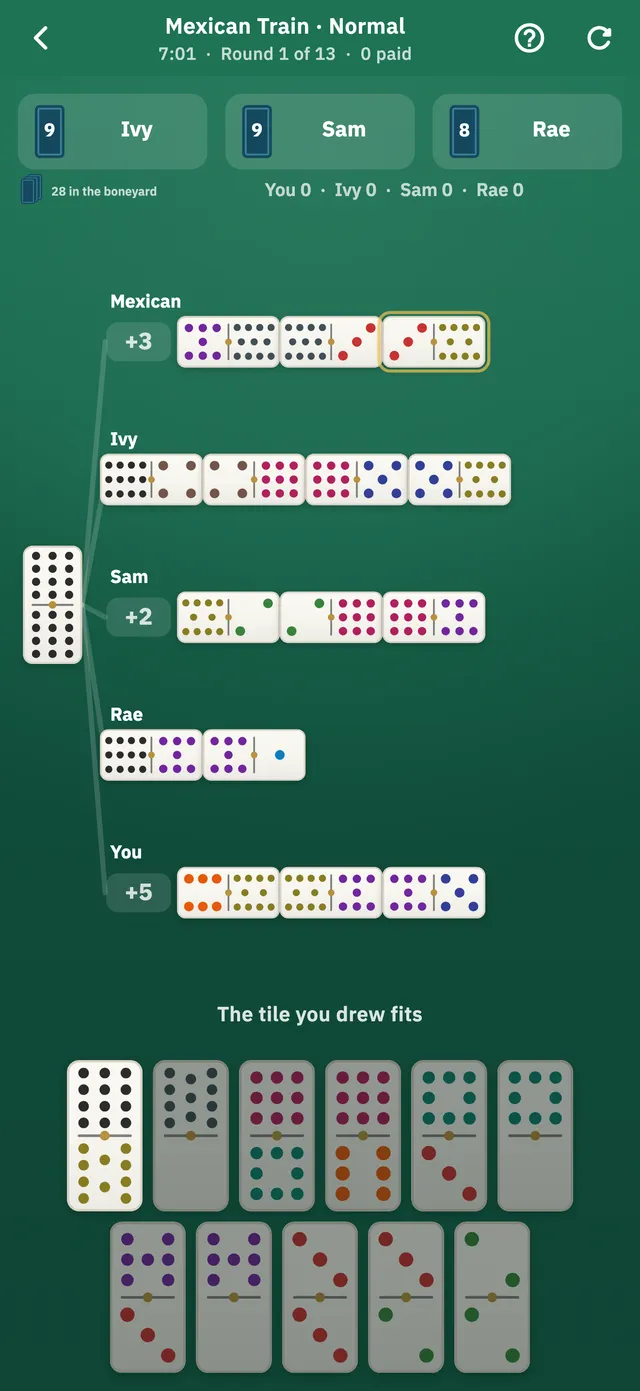
Every player has a train of their own: a line of tiles running out of the engine toward them. The first tile of a train must match the engine, so in the double-twelve round it carries a twelve. Each tile after that must match the open end of the train: a twelve-five laid on a twelve leaves a five open.
There is one more train, the Mexican train, which belongs to nobody. In Fireside’s standard game, anybody may play on it at any time, even on their very first turn.
A turn
Play goes to the left. On your turn you play one tile: on your own train, on the Mexican train, or on another player’s train that has a marker on it. If you can play, you must.
When nothing fits: the marker
If you cannot play, draw one tile from the boneyard. If it fits, play it. If it does not, your turn is over and your marker goes out on your own train.
A marker on your train lets anybody play on it. It stays there until you play on your own train yourself, which takes the marker off. Once the boneyard is empty, a player who cannot play passes and puts their marker out.
Doubles
A double is laid crosswise, and whoever lays one plays another tile at once: on the double, or anywhere else they could play.
If they have nothing that fits, they draw one tile. If that does not fit either, their marker goes out, and the double is left open.
An open double
A double left uncovered at the end of a turn must be answered before anything else is played anywhere. The next player has to play on it, on whoever’s train it sits, or draw for it. If they still cannot, their marker goes out and the duty passes on to the next player.
Two doubles waiting are answered in the order they were laid. A double whose number is already all on the table can never be answered, so it stops holding up play.
Good to know
Answering an open double is the one time you may play on another player’s train when it has no marker.
Going out
Play your last tile and the round is over, even when that tile is a double. Everybody else pays for what they are holding.
A blocked round
If the boneyard is empty and nobody can play, the round ends there, and everybody pays for what they are holding.
Scoring
At the end of a round, each player adds up the pips on the tiles left in their hand, and that is what they pay. Whoever went out pays nothing. In Fireside’s standard game the double blank costs nothing, like the blanks it shows.
| Left in your hand | You pay |
|---|---|
| Twelve-ten and three-one | 26 |
| Double six | 12 |
| Double blank | 0, or 25 or 50 by house rule |
The payments add up from round to round, and lowest is best.
Winning
After the last round, the lowest total wins. Level totals go to whoever went out in more rounds, and after that to whoever had the best single round.
Chicken Foot
Chicken Foot is the other game in Fireside’s Mexican Train, chosen under Set Difficulty, The game. It keeps the boneyard, the duty to answer doubles and the scoring, but grows a tree of lines instead of trains.
- The tiles. A double-nine set: 55 tiles, blank to nine. Each of the four players takes 11, and the other 11 are the boneyard.
- The rounds. Ten, each played off a new double, from the double nine down to the double blank.
- The center. Whoever holds the round’s double sets it in the middle of the table, and play starts on their left. If nobody holds it, everybody draws in turn until it turns up. Before anything else, four lines must grow out of the center double, one tile a turn.
- A turn. One tile on the end of any line, going around to the left, and if you can play, you must. There are no private trains and no markers: every line is open to everybody.
- The chicken foot. A double laid on the end of a line is a chicken, and it grows a foot: three tiles off its far end before play goes on anywhere else. The next three players lay them, one each, and whoever laid the double gets no extra tile. Each of the three starts a new line, and nothing more goes on the double itself.
- When nothing fits. Draw one tile, play it if it fits, and pass if it does not. With the boneyard empty, a player who cannot play passes. A double whose number is all on the table cannot grow its foot, and stops holding up play.
- Going out and scoring. Play your last tile, a double included, and the round is over; a blocked round ends with everybody paying, as in Mexican Train. By Chicken Foot’s own rule the double blank costs 50, which makes it the most dangerous tile in the set to be caught holding.
The house rules people argue about
Mexican Train is played a different way at nearly every kitchen table, and the printed rule sheets disagree with each other too. Fireside starts from the rules most of them give, and lets your table choose: six house rules for Mexican Train and three for Chicken Foot, each shown on the House Rules sheet for its own game.
-
Mexican Train or Chicken Foot?
They share a box of habits but not a table: Mexican Train gives everybody a train, and Chicken Foot grows a foot of new lines from every double.
- Mexican Train Where Fireside starts A double-twelve set, 15 tiles each, a train for everybody and the Mexican train for anybody. Thirteen rounds, the double twelve down to the double blank.
- Chicken Foot A double-nine set and 11 tiles each. Lines grow out of the center double, and every double laid grows a foot of three more.
In Fireside: Set Difficulty, under The game
-
How many rounds is a game of Mexican Train?
Thirteen rounds plays every double in the set; seven stops at the double six.
- Thirteen rounds Fireside’s standard The double twelve down to the double blank: the whole game, an evening at the kitchen table.
- Seven rounds The double twelve down to the double six, the way tables play it when the evening is short.
In Fireside: House Rules, with Default turned off.
-
What does the double blank cost in Mexican Train?
At nothing it is a safe tile to be caught holding; at 50 it is the one to get rid of first.
- Nothing Fireside’s standard The published rule: a blank counts as the nothing it shows.
- Twenty-five A common house rule, for a little sting.
- Fifty The house rule half of America plays: the tile nobody wants to be caught holding.
In Fireside: House Rules, with Default turned off.
-
Is your first turn of a round one tile, or a whole train?
One tile keeps every turn alike; building a train lets a good hand get rid of several tiles at once.
- One tile Fireside’s standard Like every other turn, and it may go anywhere a tile can go. Puremco’s rules, and most boxed sets.
- Build your train Lay as much of your own train as you can, one tile after another, and stop when you like. Nothing else is played on a first turn, and a player who cannot start a train puts their marker out instead of drawing.
In Fireside: House Rules, with Default turned off.
-
When may players start the Mexican train?
Holding it back makes everybody start on their own train first. The choice appears with one-tile first turns, since a first turn that builds your train never touches the Mexican train.
- Any time Fireside’s standard Anybody may start it, even on their very first turn.
- From your second turn Nobody touches it on their first turn of a round.
In Fireside: House Rules, with Default turned off.
-
Where does the tile after a double go?
Played anywhere, it lets you leave a double open for the next player to deal with; on the double, you must cover it yourself.
- Goes anywhere Fireside’s standard Anywhere you could play, the double included.
- Goes on the double It has to answer the double itself. With nothing for it, you draw one tile, and if that does not fit either, your marker goes out.
In Fireside: House Rules, with Default turned off.
-
Can you go out on a double?
Allowed, a double makes a fine last tile. If it must be answered, a double kept to the end can keep you in the round.
- Allowed Fireside’s standard A double can be your last tile, and the round ends on it.
- Must be answered A double still wants its answer, so a player who lays a double as their last tile draws for it like anybody else.
In Fireside: House Rules, with Default turned off.
-
How many rounds is a game of Chicken Foot?
Ten rounds plays every double in the set; five stops at the double five.
- Ten rounds Fireside’s standard The double nine down to the double blank, as the game was invented.
- Five rounds The double nine down to the double five.
In Fireside: House Rules, with Default turned off.
-
What does the double blank cost in Chicken Foot?
Chicken Foot’s own rule makes the double blank the most dangerous tile in the set to be caught holding.
- Fifty Fireside’s standard Chicken Foot’s own rule, as the game’s inventors give it.
- Twenty-five A gentler house rule.
- Nothing A blank counts as the nothing it shows.
In Fireside: House Rules, with Default turned off.
-
How many lines must grow from the center double?
Every line from the center is laid before anything else is played, so more lines make a longer start.
- Four lines Fireside’s standard A tile on every side of the center double before anything else.
- Six lines A double chicken foot: three off each side.
- Eight lines The longest start, and a crowded center.
In Fireside: House Rules, with Default turned off.
Fireside deals every game at its standard rules, the ones this page teaches, until you change them. To play your own way, open Mexican Train in the app, tap House Rules, turn off Default and choose. Your table stays as you set it, on your device, and the rules, the lesson and the practice game all follow it.
Learn it in Fireside
How to Play holds the rules sheet for the game your table has chosen, Mexican Train or Chicken Foot, written with your house rules in force; the lesson and the practice game follow them too.
Watch a Round shows one real round a tile at a time, with the reason for every play; there is nothing to play.
Practice Round is a real game with everybody’s tiles readable and a coach on the help button that says what it would play and why. Nothing is counted.
Quick answers
How many dominoes does each player get in Mexican Train?
In Fireside’s game for four, with a double-twelve set, each player takes 15 tiles, and the 30 left over go to the boneyard once the engine is set out. In Chicken Foot, with a double-nine set, each player takes 11.
What happens when you play a double in Mexican Train?
You lay it crosswise and play another tile at once, on the double or anywhere else you could play. A double still open at the end of your turn must be answered by the next player before anything else is played.
When do you put your marker on your train?
When you cannot play, even after drawing a tile. The marker lets everybody play on your train until you play on it yourself and take it off.
How many rounds are in Mexican Train?
Thirteen, one for each double from the double twelve down to the double blank. Fireside also offers a seven-round game, from the double twelve down to the double six.
Is the double blank worth 50 in Mexican Train?
Not in the published rules, where it counts nothing, like the blanks it shows, and that is Fireside’s standard game. Many tables charge 25 or 50 for it, and Fireside offers both as house rules. In Chicken Foot it costs 50 as standard.